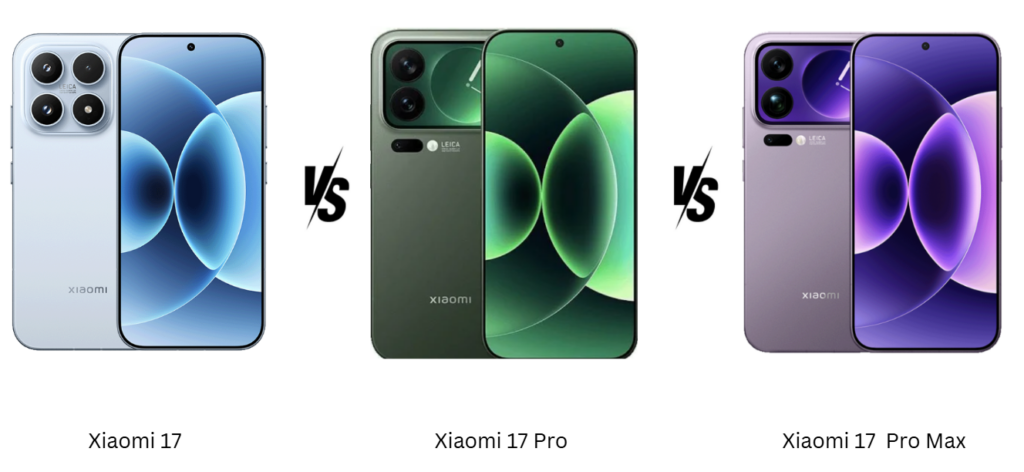
The flagship lineup of Xiaomi 17, Xiaomi 17 Pro, and Xiaomi 17 Pro Max showcases how one series can target different types of premium users. While all three models share the same design language and ecosystem advantages, they differ in performance power, camera capabilities, and feature set. This comparison gives a quick view of how each model stands out and helps identify which version delivers the best value for different user needs.
All three use a glass front with an aluminum frame and have IP68 water and dust resistance.
Water resistance depth differs: 17 up to 1.5 m, 17 Pro up to 4 m, 17 Pro Max up to 6 m.
Only the Pro and Pro Max have a rear AMOLED secondary display.
The Pro Max features stronger Dragon Crystal Glass 3 for extra durability.
The standard 17 has a simpler, cleaner back without extra display elements.
Display Quality
All models use LTPO AMOLED panels with 120 Hz refresh rate, HDR Vivid, HDR10+, Dolby Vision, and 3500 nits peak brightness.
Display size differs: 17 and 17 Pro have a 6.3-inch screen, while Pro Max has a larger 6.9-inch panel with a higher screen-to-body ratio.
The secondary rear display on the Pro and Pro Max allows quick notifications, vlogging preview, and power saving.
Brightness and quality are consistent across all three models.
Verdict: The Pro Max stands out with the most durable build, largest display, and practical rear screen, making it the most premium option. The 17 Pro adds useful features while keeping the size compact. The 17 is best for those who prefer a simple, lighter design without secondary display extras.
2. Specifications
Performance
All three use the same Snapdragon 8 Elite Gen 5 processor with identical CPU and GPU configurations.
Storage options vary: 17 goes up to 512 GB, while Pro and Pro Max offer up to 1 TB.
Pro and Pro Max have Ultra Wideband support for improved connectivity.
RAM configurations are slightly broader on the Pro and Pro Max.
Battery and Charging
Battery capacity differs: 17 has 7000 mAh, 17 Pro has 6300 mAh, and Pro Max has 7500 mAh.
All support 100 W wired charging, 50 W wireless charging, and 22.5 W reverse wireless charging.
The Pro has a smaller battery to maintain a compact form factor.
The Pro Max’s larger battery targets power users who need endurance.
Verdict: While all three deliver top-tier performance, the Pro and Pro Max offer stronger connectivity and more storage flexibility. The Pro Max leads in battery life, making it ideal for heavy users. The 17 provides flagship power at a lower cost, while the Pro balances performance and portability.
3. Camera
Main and Secondary Lenses
All three feature a triple 50 MP camera setup with Leica lenses.
Telephoto lens differs: 17 has 2.6x optical zoom, Pro has 5x periscope zoom, Pro Max has 5x periscope with a larger sensor for improved low-light performance.
Pro and Pro Max include better stabilization and long-range zoom.
Pro Max delivers the most advanced imaging setup.
Selfie Camera
All have a 50 MP front camera capable of 4K HDR recording.
Pro and Pro Max allow users to take selfies using the rear main camera through the secondary display, improving quality and flexibility.
The 17 relies only on the front camera for selfies.
Verdict: The Pro Max is the most capable camera system overall, offering superior zoom and sensor quality. The Pro provides a strong upgrade over the base model with its periscope zoom. The 17 still delivers excellent image quality but lacks advanced zoom and the flexibility of using the rear screen for selfies.
4. Pricing
Xiaomi 17 is priced around 700 USD.
Xiaomi 17 Pro is priced at around 800 USD.
Xiaomi 17 Pro Max is priced at around 900 USD.
The 17 offers the best value for essential flagship performance.
The Pro delivers upgrades in camera, connectivity, and build for a moderate increase.
The Pro Max justifies its premium price with a larger display, better camera, stronger glass, and bigger battery.
Verdict: The Pro Max is the most feature-packed model, matching its higher price with top-end upgrades. The Pro sits in the sweet spot for buyers who want more than the basics without spending too much. The 17 remains the best option for users seeking flagship performance at the lowest cost.
5. Conclusion
Pro and Pro Max introduce secondary AMOLED displays, offering extra functionality like previewing photos and notifications.
Water resistance improves with each tier, with the Pro Max offering the best protection.
UWB support, enhanced telephoto zoom, and larger battery capacities appear on the Pro and Pro Max.
Pro Max also uses upgraded Dragon Crystal Glass 3 for better durability.
The Pro and Pro Max offer more storage, making them more versatile for creators or professionals.
Verdict:
Xiaomi 17 is the best value for users who want flagship power without premium extras. Xiaomi 17 Pro provides a balanced mix of upgraded features and a compact design. Xiaomi 17 Pro Max is the top choice for power users who prioritize display size, battery endurance, and advanced camera capabilities.
We use cookies on our website to give you the most relevant experience by remembering your preferences and repeat visits. By clicking “Accept”, you consent to the use of ALL the cookies.
This website uses cookies to improve your experience while you navigate through the website. Out of these, the cookies that are categorized as necessary are stored on your browser as they are essential for the working of basic functionalities of the website. We also use third-party cookies that help us analyze and understand how you use this website. These cookies will be stored in your browser only with your consent. You also have the option to opt-out of these cookies. But opting out of some of these cookies may affect your browsing experience.
Necessary cookies are absolutely essential for the website to function properly. This category only includes cookies that ensures basic functionalities and security features of the website. These cookies do not store any personal information.
Any cookies that may not be particularly necessary for the website to function and is used specifically to collect user personal data via analytics, ads, other embedded contents are termed as non-necessary cookies. It is mandatory to procure user consent prior to running these cookies on your website.



Comments