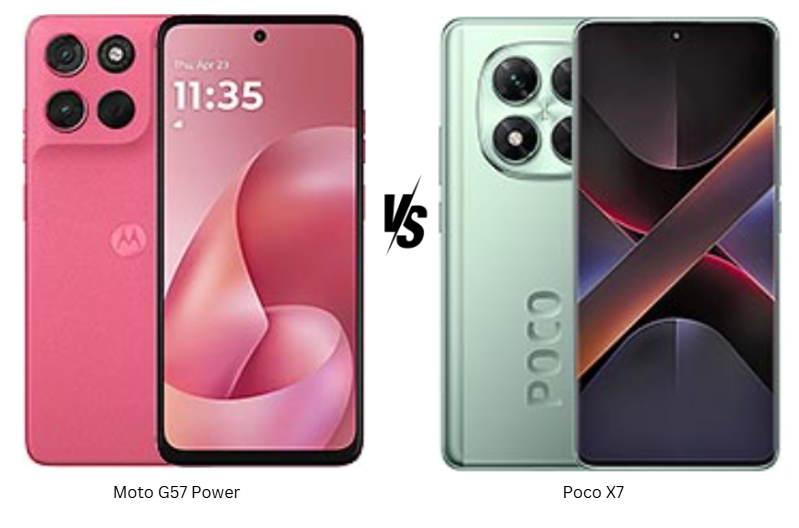
Moto G57 Power and POCO X7 5G appeal to buyers who want strong value at the mid-range price point, but with very different priorities in mind. One phone attracts users who prioritize long battery life and everyday durability, while the other draws those who want a more premium experience for entertainment and performance. Comparing them is important because both target the same budget-conscious audience, yet serve distinctly different usage styles and expectations.
Moto G57 Power leans toward durability and practicality with its IP64 rating, drop resistance, eco-leather back, and slightly heavier 7000 mAh build. It feels purpose-built for long-term everyday use, especially for users who value rugged assurance over sleek finesse. POCO X7 5G, meanwhile, delivers a more premium vibe with Gorilla Glass Victus 2, a slimmer profile, a lighter frame, and higher IP68/69 protection. Its design appears more refined and lifestyle-oriented, appealing to users seeking a modern, polished look.
Display Quality
Moto G57 Power offers a large 6.72-inch IPS LCD 120Hz panel with strong brightness for casual gaming and outdoor use. It feels functional and balanced for media and reading. POCO X7 5G elevates the experience with a 1.5K AMOLED, HDR10+, Dolby Vision, and significantly higher peak brightness, making movies, social content, and gaming look richer and more immersive.
Verdict
Moto G57 Power favors strength and utility, while POCO X7 5G stands out as the more premium and visually engaging option.
2. Specifications
Performance
Moto G57 Power runs on Snapdragon 6s Gen 4, delivering dependable mid-range performance suited for day-to-day multitasking and efficient battery-friendly usage. It feels tuned for stability rather than speed. POCO X7 5G, powered by the Dimensity 7300 Ultra, comes across as the more performance-focused device, offering stronger processing headroom and smoother handling of gaming, camera processing, and heavy apps.
Battery and Charging
Moto G57 Power takes a commanding lead in endurance with its massive 7000 mAh battery and 30–33W charging, making it ideal for long outdoor or travel-heavy usage. It feels like a phone built for users who hate frequent charging. POCO X7 5G counters with a 5110–5500 mAh battery (market-dependent) and faster 45W charging, offering a balance of speed and practicality.
Verdict
Moto G57 Power wins on sheer battery longevity, while POCO X7 5G feels more performance-oriented and efficiency-balanced for active multimedia users.
3. Camera
Main and Secondary Lenses
Moto G57 Power features a 50 MP main camera with ultrawide support, tuned for natural daylight shots and consistent color tones. It feels reliable for social photography and everyday usage, though video tops out at 1440p. POCO X7 5G steps ahead with its 50 MP OIS-enabled main camera, 4K recording, ultrawide lens, and macro support. The stabilization and sharper recording give it a more polished imaging character, especially for content creation and travel photography.
Selfie Camera
Moto G57 Power offers an 8 MP selfie camera focused on balanced skin tones and simple video calling. POCO X7 5G delivers a sharper 20 MP selfie camera with higher-quality recording and better detail, making it more appealing for users who share photos and reels frequently.
Verdict
Moto G57 Power keeps things practical and consistent, while POCO X7 5G emerges as the stronger option for creators and camera-centric users.
4. Pricing
Both smartphones sit around the $300 price point, making this a value-centric matchup where priorities decide the better buy. Moto G57 Power offers massive battery life, rugged build assurance, stereo audio with a headphone jack, and a clean Android with a planned Android 17 upgrade. The value feels centered around endurance, utility, and long-term usability.
POCO X7 5G, at the same approximate price, delivers a noticeably more premium experience, brighter AMOLED display, stronger chipset, higher-grade water resistance, in-display fingerprint sensor, and a more capable camera system with OIS and 4K video. The package feels performance-driven and multimedia-focused.
At equal pricing, Moto G57 Power appeals more to users prioritizing extreme battery backup and durability, while POCO X7 5G feels like the better all-rounder for performance, display quality, and camera capabilities.
Disclaimer: Prices are approximate and may vary based on country, region, and applicable taxes.
5. Conclusion
Moto G57 Power stands out with its 7000 mAh battery, drop-resistant design, stereo audio with Hi-Res support, and practical everyday durability. It feels ideal for travelers, outdoor users, heavy media consumers, and those who prefer charging as little as possible. POCO X7 5G distinguishes itself with premium AMOLED display quality, higher protection rating, stronger chipset, in-display fingerprint sensor, and OIS-enabled camera performance.
Verdict
For most users, POCO X7 5G makes more sense; it delivers a better display, stronger performance, more capable cameras, and a more premium overall experience at the same price point. Moto G57 Power excels in battery life and ruggedness, but POCO X7 5G offers a more balanced and future-ready phone overall.
We use cookies on our website to give you the most relevant experience by remembering your preferences and repeat visits. By clicking “Accept”, you consent to the use of ALL the cookies.
This website uses cookies to improve your experience while you navigate through the website. Out of these, the cookies that are categorized as necessary are stored on your browser as they are essential for the working of basic functionalities of the website. We also use third-party cookies that help us analyze and understand how you use this website. These cookies will be stored in your browser only with your consent. You also have the option to opt-out of these cookies. But opting out of some of these cookies may affect your browsing experience.
Necessary cookies are absolutely essential for the website to function properly. This category only includes cookies that ensures basic functionalities and security features of the website. These cookies do not store any personal information.
Any cookies that may not be particularly necessary for the website to function and is used specifically to collect user personal data via analytics, ads, other embedded contents are termed as non-necessary cookies. It is mandatory to procure user consent prior to running these cookies on your website.





Comments