
Add GIZMOCHINA as Preferred Source on Google
LG Electronics has announced LG CLOiD, an AI-powered home robot that will be shown publicly for the first time at CES 2026. The robot is designed to handle and coordinate everyday household tasks by working directly with connected home appliances. LG says the goal is to reduce the time and physical effort required for routine chores.
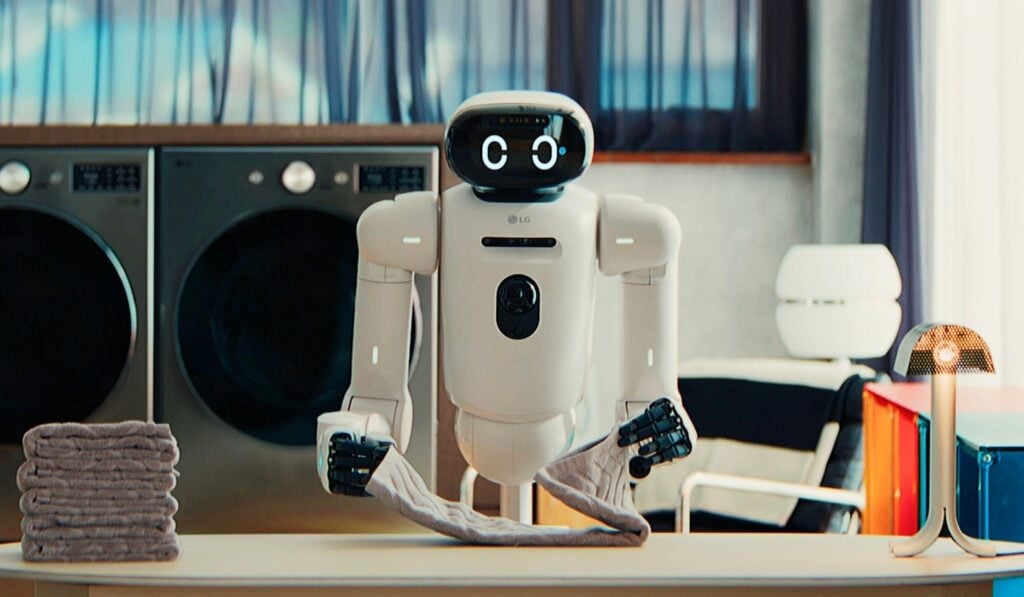
At CES 2026, LG will demonstrate CLOiD in realistic home settings. In one example, the robot takes milk from a refrigerator and places a croissant into an oven to prepare breakfast. After the occupants leave the house, CLOiD starts the laundry, then folds and stacks clothes once drying is complete. These demonstrations focus on showing how the robot understands daily routines and controls appliances based on user habits rather than fixed commands.
LG CLOiD’s hardware is designed for use inside living spaces. The robot consists of a head unit, a torso with two articulated arms, and a wheeled base with autonomous navigation. The torso can tilt to change height, allowing the robot to pick up items from knee level and from higher surfaces. Each arm has seven degrees of freedom, similar to a human arm, with movement at the shoulder, elbow, and wrist. Each hand has five independently actuated fingers, enabling precise handling of household objects in kitchens, laundry rooms, and living areas.
The wheeled base uses autonomous driving technology derived from LG’s robot vacuum products and the LG Q9. The low center of gravity improves stability and helps prevent tipping if the robot is bumped by a child or pet. LG selected this design for safety, stability, and cost efficiency.
The head of LG CLOiD functions as a mobile AI home hub. It includes the main chipset, a display, a speaker, cameras, multiple sensors, and voice-based generative AI. These components allow the robot to communicate using speech and facial expressions, learn home layouts and user lifestyles, and control connected appliances based on what it learns.
At the core of CLOiD is LG’s Physical AI technology. This combines Vision Language Models, which convert images and video into language-based understanding, and Vision Language Action models, which turn visual and verbal input into physical actions. These systems have been trained on tens of thousands of hours of household task data.
LG also announced LG Actuator AXIUM, a new actuator brand for service robots. Actuators combine motors, drives, and reducers and are among the most critical and expensive robot components. LG plans to use its appliance manufacturing expertise to deliver compact, efficient, high-torque designs.
For more daily updates, please visit our News Section.
Stay ahead in tech! Join our Telegram community and sign up for our daily newsletter of top stories.
(Source)




Comments