
Add GIZMOCHINA on Google:
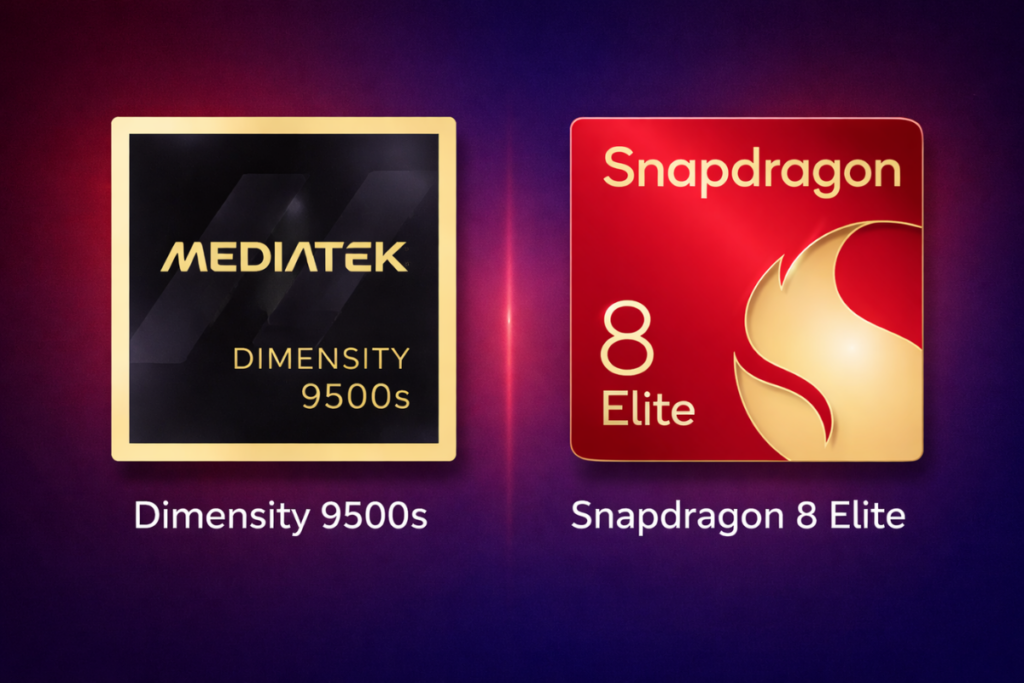
The Dimensity 9500s is a powerful high-end smartphone chipset, promising strong performance and solid power efficiency. That, paired with an upgraded NPU supporting agentic AI and a fully modern connectivity stack, positions it as a flagship-tier contender, directly competing with powerful Qualcomm chips.
The Dimensity 9500s go head-to-head with some powerful Snapdragon 8-series chips, including the Snapdragon 8 Gen 5 and Snapdragon 8 Elite. We’ve already compared it with the Snapdragon 8 Gen 5 (more about it here), and now it’s time for another high-end chip battle. In this comparison, we’ll see how the Dimensity 9500s stack up against the Snapdragon 8 Elite, with its Oryon CPU, Adreno 840 GPU, and advanced imaging capabilities.
Here’s the spec sheet to begin with:
| Dimensity 9500s | Snapdragon 8 Elite | |
|---|---|---|
| Announced | January 2025 | October 2024 |
| Process node | TSMC’s 3nm (N3E) | TSMC’s 3nm (N3E) |
| CPU | 1 x 3.73GHz — Cortex-X925 3 x 3.30GHz — Cortex-X4 4 x 2.0GHz — Cortex-A720 | 2 x 4.32GHz — Oryon (2nd-gen) 6 x 3.53GHz — Oryon (2nd-gen) |
| GPU | Immortalis-G925 MP12 ray tracing support MediaTek Adaptive Gaming Technology 3.0 | Adreno 830 ray tacing support Snapdragon Elite Gaming features |
| NPU | MediaTek NPU Agentic AI support | Qualcomm Hexagon NPU |
| Memory | LPDDR5x, up to 5.3GHz | LPDDR5x, up to 5.3GHz |
| Storage | UFS 4 + MCQ | UFS 4.0 |
| Camera | MediaTek Imagiq ISP (18-bit) up to 320MP single camera up to 108MP single camera (30fps) up to 36MP triple cameras (30fps) semantic segmentation support up to 8K/60fps video recording | Qualcomm Spectra Triple ISP (18-bit) up to 320MP single camera up to 108MP single camera (30fps, zero shutter lag) up to 48MP triple cameras (30fps, zero shutter lag) limitless real-time semantic segmentation (up to 250 layers) up to 8K/30fps video recording |
| Connectivity | 3GPP Release 17 standard download speed: 7Gbps (peak) Wi-Fi 7 (peak speed: 6.5Gbps) Bluetooth 5.4 | Snapdragon X80 5G modem download speed: up to 10Gbps upload speed: up to 3.5Gbps Wi-Fi 7 (peak speed: 5.8Gbps) Bluetooth 6.0 |
Dimensity 9500s vs Snapdragon 8 Elite: Benchmark scores
There’s no Dimensity 9500s-powered smartphone on the market right now. However, the upcoming Redmi Turbo 5 Max, which would carry the same chipset, was recently spotted in AnTuTu and Geekbench listings.
According to leaked benchmark listings, the upcoming Redmi phone powered by the Dimensity 9500s achieves 2,862 points in the single-core test and 9,130 points in the multi-core test. In contrast, the OnePlus 13 (powered by the Snapdragon 8 Elite) bags higher scores: 3,026 (single-core) and 9,306 (multi-core).
| Dimensity 9500s | Snapdragon 8 Elite | |
| Single core | 2,862 | 3,026 |
| Multi core | 9,130 | 9,306 |
The leaked AnTuTu listing for the Redmi Turbo 5 Max shows rather surprising results. The Dimensity 9500s-powered device achieves a total score close to 3.3 million, while the Snapdragon 8 Elite-powered OnePlus 13 scores a little under 3 million. The breakdown of the AnTuTu score shows that the Dimensity 9500s achieves higher scores across all tests, including CPU, GPU, memory, and user experience.
| Dimensity 9500s | Snapdragon 8 Elite | |
| AnTuTu score | 3,298,445 | 2,994,563 |
| CPU | 952,789 | 862,692 |
| GPU | 1,130,421 | 1,095,049 |
| Memory | 502,375 | 393,623 |
| UX | 712,860 | 643,199 |
Please note that benchmark scores for the Dimensity 9500s are based on leaks, not on real testing. We’ll update the score once we’ve reviewed a device powered by the same MediaTek chipset.
Dimensity 9500s vs Snapdragon 8 Elite: Key differences you should know
CPU
Starting with the CPU, the Dimensity 9500s opts for a 1+3+4 configuration, featuring one Cortex-X925 prime core, three Cortex-X4 performance cores, and four Cortex-A720 efficiency cores. In contrast, the Snapdragon 8 Elite uses a 2+6 configuration, with two Oryon prime cores and four Oryon performance cores.
The second-gen Oryon core generally outperforms Cortex-X925 in peak performance. The Snapdragon 8 Elite also benefits from a higher CPU clock speed. In terms of peak CPU performance, the Snapdragon 8 Elite has the edge. However, in day-to-day tasks like browsing the internet, scrolling through social media apps, and video streaming, there shouldn’t be a performance gap.
GPU
For graphics rendering, the Dimensity 9500s integrates Immortalis‑G925 GPU with up to 12 cores. MediaTek claims ray tracing support with console-grade lighting and reflections. MediaTek Adaptive Gaming Technology 3.0 (MAGT 3.0) and MediaTek Frame Rate Converter 3.0 (MRFC 3.0) further enhance the gameplay and power efficiency.
The Snapdragon 8 Elite features Adreno 830 GPU with Qualcomm’s sliced GPU architecture for better power efficiency and higher sustained performance. The chip also supports real-time hardware ray tracing and includes a full suite of Snapdragon Elite Gaming features to achieve higher frame rates, improved power efficiency, and lower latency.
AI and on-device capabilities
Both chipsets have capable NPUs with multimodal GenAI capabilities and support for modern LLMs. Additionally, MediaTek claims Agentic AI support for the Dimensity 9500s, whereas Qualcomm has made no such claims.
Camera
The Dimensity 9500s and Snapdragon 8 Elite feature 18-bit ISPs with support for up to 320MP resolution. One key advantage of the Qualcomm chip here is that it allows three 48MP cameras at 30fps, while the Dimensity chip limits them to 36MP. The Dimensity 9500s, however, supports 8K video recording at 60fps, while the Snapdragon 8 Elite can do 8K/30fps recording.
The Snapdragon 8 Elite supports limitless real-time semantic segmentation up to 250 layers. MediaTek hasn’t mentioned semantic segmentation on its official page, but it’s safe to say the Dimensity 9500s support it based on the chip’s capabilities. Furthermore, both chips bring numerous features to improve photos and videos.
Connectivity
The Snapdragon 8 Elite and Dimensity 9500s feature flagship-class connectivity platforms, but the Snapdragon 8 Elite is specced more aggressively for cellular peak speeds, Bluetooth standard, and integrated UWB, while Dimensity 9500s emphasizes higher Wi-Fi speed and long-range Bluetooth.
Dimensity 9500s vs Snapdragon 8 Elite: Conclusion
The Dimensity 9500s prove that MediaTek is no longer playing in the shadows of Qualcomm’s flagship lineup. It offers strong benchmark scores, modern CPU and GPU architectures, advanced AI capabilities, and robust connectivity, positioning itself as a true competitor to Snapdragon 8-series chips.
That said, the Snapdragon 8 Elite may still hold advantages in peak CPU performance, a mature ISP, and modem features, backed by Qualcomm’s mature software ecosystem and long-standing OEM trust.
Please note that there’s no Dimensity 9500s-powered smartphone on the market as of writing this post. So, this comparison may not give you the complete picture. We’ll update it after thoroughly testing a device powered by this new Dimensity chip.


Comments