As an Amazon Associate, Gizmochina earns from qualifying purchases. Links on this page may earn us a commission at no extra cost to you.
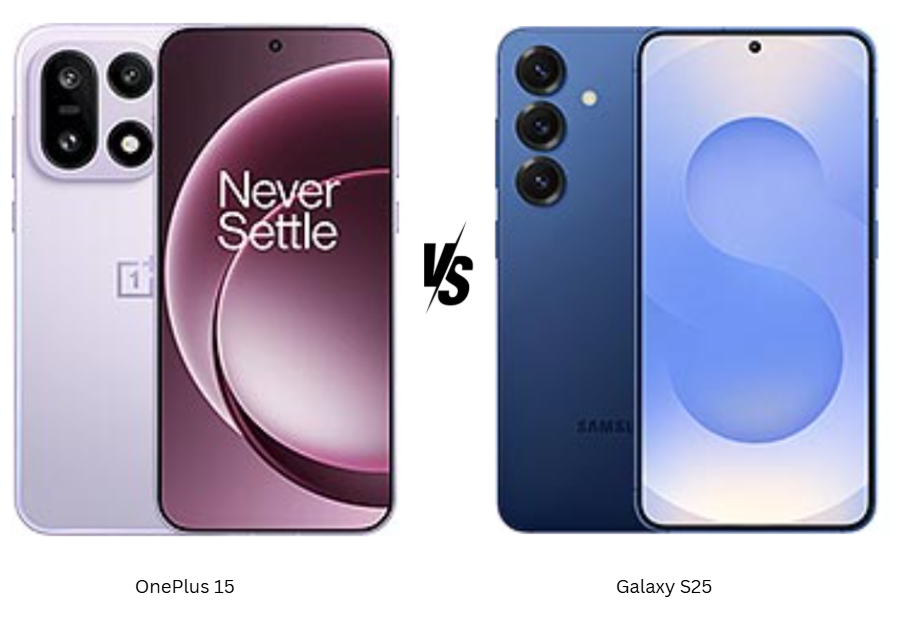
Not all flagship battles are about who has the most features; some are about how those features are used. The OnePlus 15 and Samsung Galaxy S25 sit at the same premium table, yet they chase excellence in completely different ways. One pushes raw power, faster charging, and hardware dominance, while the other focuses on balance, polish, and long-term reliability. On paper, both look impressive, but in real-world use, they appeal to very different users. This comparison cuts past the spec sheet to see which flagship approach actually delivers the better experience.
OnePlus 15 adopts a bold, performance-driven design with premium materials and extreme durability ratings. Its IP69K protection and reinforced frame give it a rugged, almost industrial confidence that clearly targets power users. The Galaxy S25 takes a very different route, focusing on clean lines, Armor Aluminum, and a refined flagship aesthetic. Samsung’s design feels understated and comfortable, making it easier to live with daily. OnePlus feels like a device built to impress hardware enthusiasts, while Samsung prioritizes elegance and long-term usability.
Display Quality
OnePlus pushes boundaries with a 165Hz LTPO AMOLED panel and broad HDR format support, delivering ultra-smooth visuals and strong cinematic appeal. The Galaxy S25 counters with superior peak brightness and excellent color tuning, resulting in a display that feels consistent and easy on the eyes. Samsung’s panel may be less aggressive on paper, but it feels more balanced for everyday use.
Verdict
OnePlus 15 suits users who want bold design and cutting-edge visuals, while Galaxy S25 feels better optimized for comfort and visual consistency
2. Specifications
Performance
OnePlus 15 runs on the newer Snapdragon 8 Elite Gen 5 chipset, paired with faster UFS 4.1 storage and higher RAM options. This gives it a clear advantage in heavy multitasking, gaming, and long-term performance headroom. Everything feels fast and uncompromising. The Galaxy S25 uses a slightly older Snapdragon 8 Elite chip, but Samsung’s tuning prioritizes stability and efficiency. Performance remains excellent, even if it feels more controlled than aggressive.
Battery and Charging
OnePlus dominates battery technology with a much larger capacity and extremely fast wired and wireless charging, minimizing downtime. Samsung takes a conservative approach, offering slower charging that favors battery longevity and ecosystem compatibility.
Verdict
OnePlus 15 leads in raw performance and charging speed, while Galaxy S25 focuses on reliability and efficiency over extremes.
3. Camera
Main and Secondary Lenses
The OnePlus 15 features a versatile triple 50MP camera setup, including a periscope telephoto that offers stronger optical zoom and flexibility. Its video tools, Dolby Vision support, and LUT controls clearly target creators. The Galaxy S25 emphasizes consistency, relying on refined processing to deliver reliable colors, strong HDR, and predictable results. While its hardware is less ambitious, the output feels polished and dependable.
Selfie Camera
OnePlus offers a higher-resolution selfie camera with autofocus, producing sharper photos and better video clarity. Samsung relies on intelligent processing and dual-pixel autofocus to maintain natural skin tones and consistent results.
Verdict
OnePlus 15 is better for creative users who want control and flexibility, while Galaxy S25 excels at effortless, reliable photography.
4. Pricing
OnePlus 15 is priced at around $900 or ₹80,000, placing it firmly in the premium flagship category. The Galaxy S25 comes slightly lower at approximately $800 or ₹75,000, making it the more accessible option. This price gap reflects their different priorities rather than outright value differences.
Is the Price Justified?
OnePlus justifies its pricing through aggressive hardware choices, faster charging, and higher-end display tech. Samsung’s pricing feels justified through long-term software support, ecosystem features, and brand reliability, even if the hardware appears more conservative.
Verdict
OnePlus 15 offers stronger hardware value, while Galaxy S25 delivers better long-term ownership value for most users.
Disclaimer: Prices are approximate and may vary based on country, region, and applicable taxes.
5. Conclusion
OnePlus 15 stands out with IP69K durability, ultra-fast charging, bypass charging, and creator-focused camera tools. It feels engineered for enthusiasts who care about performance and specifications. The Galaxy S25 differentiates itself through Samsung DeX, Wireless DeX, extended software support, and deep ecosystem integration. These features quietly enhance productivity and everyday convenience.
Verdict
If there’s only one choice, the OnePlus 15 is the better overall pick for most users. Its stronger performance, much larger battery, ultra-fast charging, and more versatile camera system make it feel more future-ready and exciting to use day to day. The Galaxy S25 remains an excellent option for those who prioritize long-term software support, ecosystem features, and a more refined, compact experience, but from a pure hardware and value perspective, the OnePlus 15 delivers more for the price.
We use cookies on our website to give you the most relevant experience by remembering your preferences and repeat visits. By clicking “Accept”, you consent to the use of ALL the cookies.
This website uses cookies to improve your experience while you navigate through the website. Out of these, the cookies that are categorized as necessary are stored on your browser as they are essential for the working of basic functionalities of the website. We also use third-party cookies that help us analyze and understand how you use this website. These cookies will be stored in your browser only with your consent. You also have the option to opt-out of these cookies. But opting out of some of these cookies may affect your browsing experience.
Necessary cookies are absolutely essential for the website to function properly. This category only includes cookies that ensures basic functionalities and security features of the website. These cookies do not store any personal information.
Any cookies that may not be particularly necessary for the website to function and is used specifically to collect user personal data via analytics, ads, other embedded contents are termed as non-necessary cookies. It is mandatory to procure user consent prior to running these cookies on your website.




Comments