
Add GIZMOCHINA as Preferred Source on Google
As an Amazon Associate, Gizmochina earns from qualifying purchases. Links on this page may earn us a commission at no extra cost to you.
Ultra smartwatches are no longer just fitness trackers; they’re built as rugged companions for extreme workouts, outdoor adventures, and everyday productivity. The Apple Watch Ultra 3 and Samsung Galaxy Watch Ultra represent the very best from Apple and Samsung, blending premium materials with serious health and performance features. But with similar durability claims and flagship specs, and now a much wider price gap, choosing the right one isn’t simple. This comparison breaks down where each watch truly excels and which one offers the best overall value.
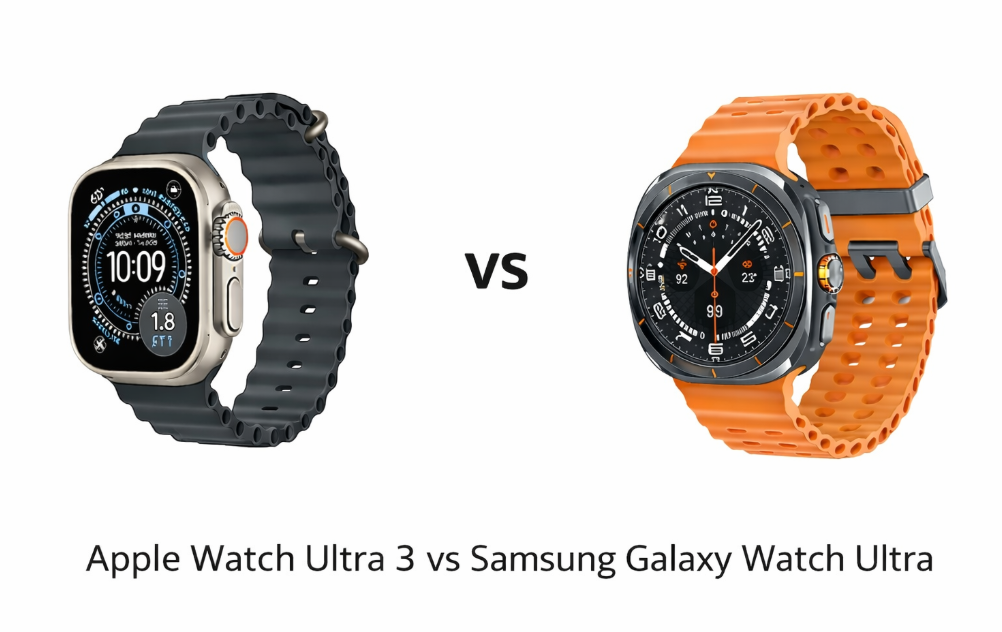
Major Features:
| Feature | Apple Watch Ultra 3 | Samsung Galaxy Watch Ultra | Winner |
|---|---|---|---|
| Display Brightness | 1.98″ LTPO3 OLED, 3000 nits | 1.5″ Super AMOLED | Apple — far brighter outdoors |
| Build & Durability | Grade 5 titanium, IP6X, 40m dive | Grade 4 titanium, IP68, 10ATM | Apple — stronger dust & dive rating |
| Health Sensors | Depth gauge, precise temp, VO2 max | BioActive, temp, ECG | Apple — more advanced adventure tools |
| Battery Capacity | 599mAh | 590mAh | Tie — nearly identical capacity |
| Software Ecosystem | watchOS 26 (Apple ecosystem) | Wear OS 5/6 (Android ecosystem) | Depends on phone used |
| Price | $800 / ₹89,900 | $500 / ₹45,000 | Samsung — significantly better value |
| Preview | Product | |
|---|---|---|

|
Samsung Galaxy Watch Ultra (47mm, LTE, Gray) with Upto 100h Battery | 3nm Processor | Dual GPS |… | Check Price on Amazon India |
Please Note: When you buy something using the links in our articles, we may earn a small commission at no cost to you.
| Preview | Product | |
|---|---|---|

|
Apple Watch Ultra 3 GPS + Cellular 49mm Black Titanium Case with Black/Charcoal Trail Loop – M/L | Check Price on Amazon India |
Please Note: When you buy something using the links in our articles, we may earn a small commission at no cost to you.
1. Design and Display
Build & Comfort
Apple Watch Ultra 3 features a 49mm titanium (grade 5) frame with sapphire crystal protection and a ceramic/sapphire back. It carries IP6X dust resistance, 100m water resistance, 40m dive certification, and MIL-STD-810H compliance. At 61.6g, it feels solid and purpose-built for rugged adventures.
Samsung Galaxy Watch Ultra uses grade 4 titanium with sapphire protection and a ceramic/sapphire back. It offers IP68, 10ATM (100m) water resistance, and MIL-STD-810H durability. At 60.5g, it is slightly lighter and more compact on the wrist.
Display Brightness & Visibility
Apple’s 1.98-inch Retina LTPO3 OLED reaches an impressive 3000 nits peak brightness, making it extremely readable under harsh sunlight.
Samsung’s 1.5-inch Super AMOLED delivers sharp 480×480 resolution and excellent contrast, but brightness levels are lower than Apple’s peak output.
Verdict
Apple dominates outdoor visibility with its ultra-bright 3000-nit panel. Samsung feels slightly more compact and balanced for daily wear. For extreme environments, Apple has the edge.
2. Health and Fitness Tracking
Sensors & Tracking Accuracy
Apple Watch Ultra 3 includes heart rate, ECG (region dependent), SpO2, VO2 max, body and water temperature sensing (0.01˚ accuracy), depth gauge (±1m), always-on altimeter, and satellite Emergency SOS. Its depth and diving tools make it particularly appealing to serious explorers.
Samsung Galaxy Watch Ultra offers heart rate, ECG, SpO2, body and water temperature, BioActive sensor suite, barometer, and altimeter. It covers all essential health metrics with reliable performance for everyday athletes.
Workout Modes
Both watches support extensive fitness tracking with multi-GNSS positioning (L1+L5 GPS support). Apple leans toward adventure and diving precision, while Samsung integrates tightly with broader Android fitness ecosystems.
Verdict
Apple stands out for advanced depth tracking and satellite safety tools. Samsung remains comprehensive for mainstream fitness users.
3. Performance and Software
UI Smoothness
Apple Watch Ultra 3 runs watchOS 26 (upgradable to 26.3) powered by the Apple S10 dual-core chip. Animations are fluid, and system optimization is typically seamless within Apple’s ecosystem.
Samsung Galaxy Watch Ultra runs Wear OS 5 (upgradable to 6.0) with One UI Watch 8 on the 3nm Exynos W1000 penta-core chipset. Multitasking benefits from up to 2GB RAM and 64GB storage options.
App Support & Features
Apple offers 64GB storage and strong ecosystem integration with iPhone, plus UWB (Gen 2) support.
Samsung provides 32GB or 64GB storage options and deep integration with Android devices. Wear OS brings broader Google app compatibility.
Verdict
Apple delivers refined ecosystem cohesion, while Samsung offers stronger hardware versatility and Wear OS flexibility. Choice largely depends on smartphone pairing.
4. Battery and Connectivity
Battery Life
Apple packs a 599mAh battery with wireless charging reaching 0–80% in 45 minutes. Fast top-ups are convenient for active users.
Samsung houses a 590mAh battery with 10W wireless charging. Capacity is similar, and efficiency depends on OS optimization.
GPS, Bluetooth, LTE
Both support eSIM for LTE connectivity. Apple includes GPS (L1+L5), GLONASS, GALILEO, BDS, QZSS, Bluetooth 5.3, dual-band Wi-Fi, NFC, and satellite Emergency SOS.
Samsung supports GPS (L1+L5), GLONASS, GALILEO, BDS, Bluetooth 5.3, dual-band Wi-Fi, and NFC.
Verdict
Battery capacities are nearly identical. Apple adds satellite connectivity and QZSS support, giving it a slight advantage for remote travel.
5. Pricing
Apple Watch Ultra 3 is priced around $800 / ₹89,900.
Samsung Galaxy Watch Ultra now comes in at approximately $500 / ₹45,000.
Verdict
The price gap is substantial. Samsung undercuts Apple by roughly $300 globally and over ₹40,000 in India. While Apple offers brighter display tech and satellite features, Samsung delivers flagship durability and performance at a dramatically more accessible price. In terms of pure value, Samsung clearly wins.
Disclaimer:
Prices are approximate and may vary based on country, region, and applicable taxes.
6. Conclusion
Apple Watch Ultra 3 suits adventurers, divers, and dedicated iPhone users who want maximum outdoor capability and advanced safety tools.
Samsung Galaxy Watch Ultra is ideal for Android users seeking premium durability and flagship performance without paying ultra-premium pricing.
Final Verdict
Overall, the Apple Watch Ultra 3 remains the more feature-rich and adventure-focused smartwatch. However, with Samsung’s aggressive pricing, the Galaxy Watch Ultra becomes the smarter buy for most people. It delivers flagship durability, strong performance, and comprehensive health tracking at a significantly lower cost. Unless satellite SOS and extreme brightness are must-haves, Samsung offers the better overall value.
| Preview | Product | |
|---|---|---|
|
|
Apple Watch Ultra 3 [GPS + Cellular 49mm] Running & Multisport Smartwatch w/Rugged Titanium Case… | Check Price on Amazon Global |
Please Note: When you buy something using the links in our articles, we may earn a small commission at no cost to you.
| Preview | Product | |
|---|---|---|
|
|
Samsung Galaxy Watch Ultra (2025) 47mm LTE Smartwatch, Titanium Casing, Advanced Sleep Coaching,… | Check Price on Amazon Global |
Please Note: When you buy something using the links in our articles, we may earn a small commission at no cost to you.
Read More:

Comments