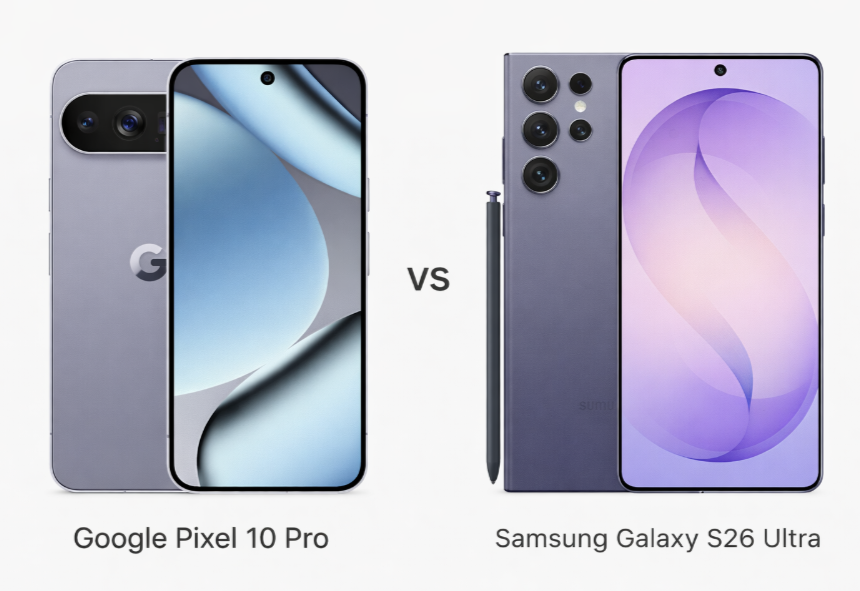
Choosing between the Google Pixel 10 Pro and Samsung Galaxy S26 Ultra isn’t just about specs; it’s about how smart a smartphone can really feel in daily life. One leans heavily into AI-driven simplicity and photography magic, while the other pushes raw power, versatility, and productivity to the limit. For buyers spending flagship-level money, this comparison matters more than ever, because both phones represent two very different visions of the “future smartphone.”
The Pixel 10 Pro keeps things minimal with a clean glass-and-aluminum design that feels compact and refined. Its understated finish gives it a premium yet subtle identity. On the other hand, the Galaxy S26 Ultra goes bold with a more industrial look, reinforced by Armor aluminum and the integrated S Pen. It feels more like a productivity tool than just a phone, which naturally appeals to power users.
Display Quality
Pixel offers a sharp LTPO OLED panel with excellent brightness and color accuracy, making it ideal for everyday usage and HDR content. However, Samsung’s larger Dynamic AMOLED display takes immersion further with higher resolution, anti-reflective coating, and a more expansive canvas. It simply feels more cinematic and easier on the eyes outdoors.
Verdict
The Pixel 10 Pro feels cleaner and more ergonomic, while the S26 Ultra delivers a more feature-rich and immersive display experience. Samsung edges ahead for media lovers.
2. Specifications Including Battery
Performance
The Pixel 10 Pro’s Tensor G5 focuses heavily on AI-driven tasks, delivering smooth real-world performance with smart optimizations. It feels fluid in daily use, especially with Google’s software integration. Meanwhile, the Snapdragon 8 Elite Gen 5 inside the S26 Ultra is built for raw power, offering superior gaming, multitasking, and sustained performance under load.
Battery and Charging
Pixel’s battery is reliable and optimized for efficiency, comfortably lasting a full day with moderate usage. Charging is decent but not particularly fast. Samsung pushes ahead with faster wired and wireless charging, making it more convenient for quick top-ups. The larger battery also helps in handling heavy workloads more confidently.
Verdict
Pixel focuses on smart efficiency, but Samsung clearly wins on raw power and faster charging. The S26 Ultra feels more future-proof for demanding users.
3. Camera
Main and Secondary Lenses
Pixel continues its legacy of computational photography, delivering highly consistent shots with excellent dynamic range and natural tones. Features like Best Take and AI enhancements elevate everyday photography. Samsung counters with sheer hardware power, a 200MP main sensor, dual telephoto lenses, and versatile zoom capabilities. It excels in detail, long-range zoom, and video flexibility.
Selfie Camera
Pixel’s high-resolution selfie camera captures sharper and more detailed images, especially useful for group shots and social content. Samsung’s selfie shooter is reliable but leans more toward balanced output rather than extreme detail.
Verdict
Pixel is still the king of smart, effortless photography, while Samsung dominates in versatility and zoom. Those who prefer point-and-shoot perfection may lean toward Pixel, but Samsung offers more creative control.
4. Pricing
The Pixel 10 Pro starts at around $1000 (₹1,10,000), while the Galaxy S26 Ultra sits higher at approximately $1300 (₹1,40,000). The price gap is noticeable and immediately positions Samsung as a premium-tier investment.
Value for Money
Pixel delivers strong value with its AI features, excellent cameras, and long-term software support, making it a smart choice for most users. Samsung, however, justifies its higher price with top-tier hardware, S Pen functionality, superior display, and stronger performance. It feels like a complete package for those who want everything in one device.
Verdict
Pixel 10 Pro offers better value for money, but the S26 Ultra justifies its premium with added power and versatility. The choice depends on whether those extras truly matter.
Disclaimer: Prices are approximate and may vary based on country, region, and applicable taxes.
5. Conclusion
Pixel stands out with its AI-first approach; features like Best Take, Zoom Enhance, and deep Google integration make it feel smarter and more intuitive. Samsung differentiates itself with the S Pen, DeX desktop experience, and a more powerful hardware ecosystem. It feels less like a phone and more like a productivity device.
Verdict
The Pixel 10 Pro is ideal for users who prioritize simplicity, AI features, and camera consistency. It delivers a polished experience without overwhelming complexity. The Galaxy S26 Ultra, however, is built for power users who want maximum performance, versatility, and premium extras.
Overall, the Pixel feels smarter, while the Samsung feels stronger. The better choice ultimately depends on whether intelligence or raw capability matters more in daily use.
We use cookies on our website to give you the most relevant experience by remembering your preferences and repeat visits. By clicking “Accept”, you consent to the use of ALL the cookies.
This website uses cookies to improve your experience while you navigate through the website. Out of these, the cookies that are categorized as necessary are stored on your browser as they are essential for the working of basic functionalities of the website. We also use third-party cookies that help us analyze and understand how you use this website. These cookies will be stored in your browser only with your consent. You also have the option to opt-out of these cookies. But opting out of some of these cookies may affect your browsing experience.
Necessary cookies are absolutely essential for the website to function properly. This category only includes cookies that ensures basic functionalities and security features of the website. These cookies do not store any personal information.
Any cookies that may not be particularly necessary for the website to function and is used specifically to collect user personal data via analytics, ads, other embedded contents are termed as non-necessary cookies. It is mandatory to procure user consent prior to running these cookies on your website.




Comments