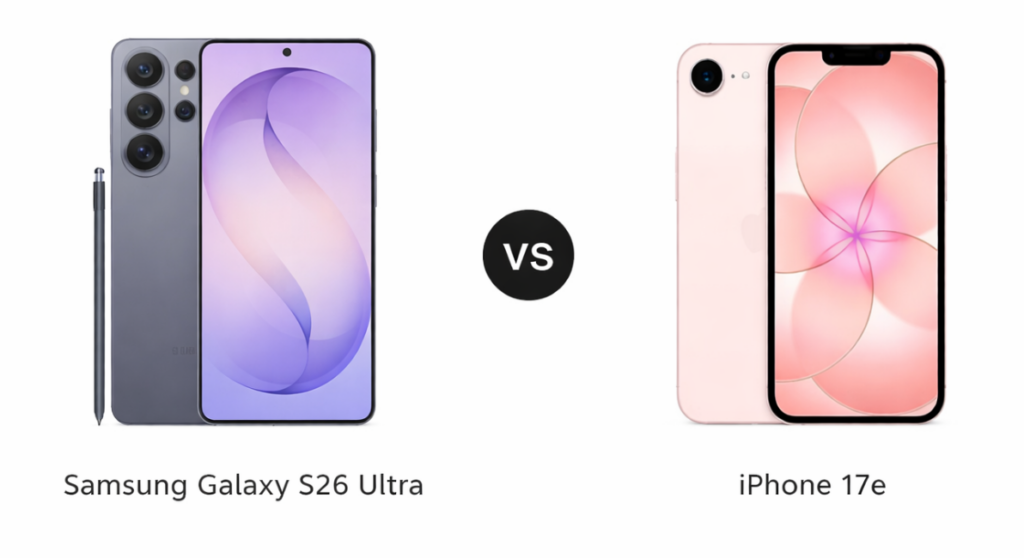
Flagship battles aren’t always about which phone is the most powerful, they’re about which one actually makes sense to buy. The Samsung Galaxy S26 Ultra pushes boundaries with top-tier specs and features, while the iPhone 17e takes a smarter, value-focused approach. This comparison isn’t just about performance; it’s about deciding whether cutting-edge hardware is worth paying nearly double, or if a balanced experience delivers the better deal.
The Samsung Galaxy S26 Ultra leans into a premium, ultra-flagship identity with Gorilla Armor 2 protection, an Armor aluminum frame, and the added utility of a built-in stylus. It feels engineered for productivity and durability, especially with enhanced scratch resistance. The iPhone 17e keeps things simpler with Ceramic Shield 2 and aluminum, offering a clean, lightweight experience that feels more approachable. The difference in philosophy is clear—Samsung aims for maximum capability, while Apple focuses on simplicity and ease of use.
Display Quality
Samsung dominates with a 6.9-inch LTPO AMOLED panel, 120Hz refresh rate, and a massive 2600 nits peak brightness. The anti-reflective coating and higher resolution make it ideal for outdoor use and media. The iPhone’s 6.1-inch OLED panel is sharp and color-accurate, but lacks high refresh rate smoothness and brightness headroom. It feels refined but less immersive.
Verdict
Samsung wins clearly with a more advanced, brighter, and smoother display, while also offering extra utility through its stylus.
2. Specifications Including Battery
Performance
The Snapdragon 8 Elite Gen 5 inside the Galaxy S26 Ultra delivers top-tier Android performance with powerful Oryon cores and a strong GPU. It is built for heavy multitasking, gaming, and long-term software support with 7 Android updates. The iPhone 17e’s A19 chip is efficient and fast in daily use, especially with iOS optimization, but it targets a more balanced experience rather than raw power. The difference becomes noticeable under sustained heavy workloads.
Battery and Charging
Samsung packs a 5000 mAh battery with 60W wired charging and faster wireless options, making it more suitable for power users. The iPhone 17e’s 4005 mAh battery is paired with slower charging, prioritizing efficiency over speed. It feels dependable, but not aggressive.
Verdict
Samsung takes this round with stronger performance and faster charging, making it better suited for demanding users and future-proofing.
3. Camera
Main and Secondary Lenses
The Galaxy S26 Ultra offers a versatile quad-camera setup with a massive 200MP sensor, dual telephoto lenses (3x and 5x), and a high-resolution ultrawide. This setup provides flexibility across all shooting scenarios, especially zoom and landscape photography. The iPhone 17e sticks to a single 48MP sensor, which delivers consistent and reliable results but lacks versatility. Samsung’s system feels more like a professional toolkit.
Selfie Camera
Both devices feature 12MP front cameras with autofocus, but Apple adds depth sensing and strong video capabilities like Dolby Vision. Samsung counters with HDR10+ and solid autofocus performance. The difference is subtle, but Apple leans slightly toward video quality.
Verdict
Samsung wins overall with its superior camera versatility and zoom capabilities, while Apple remains strong in consistency and video.
4. Pricing
Price Comparison
The Galaxy S26 Ultra is priced around ₹140,000 ($1300), firmly in ultra-premium territory. The iPhone 17e, at around ₹65,000 ($600), sits in a much more accessible range. The gap is significant, and it directly reflects the difference in hardware and features.
Is the Price Justified?
Samsung justifies its price with cutting-edge display tech, advanced cameras, flagship performance, and productivity features like DeX and stylus support. It feels like a complete powerhouse. The iPhone 17e delivers solid performance, reliable cameras, and iOS ecosystem benefits at a much lower cost, making it a strong value pick for everyday users.
Verdict
The iPhone 17e wins on value for money, while the S26 Ultra justifies its premium with unmatched features.
5. Conclusion
The Galaxy S26 Ultra stands out with its S Pen, DeX desktop experience, advanced camera system, and ultra-bright display. It is built for users who want maximum capability in a single device. The iPhone 17e focuses on essentials, a smooth iOS experience, strong optimization, satellite features, and a simplified camera system that delivers consistent results.
Verdict
The Samsung Galaxy S26 Ultra stands out as the best overall smartphone, delivering top-tier performance, a superior display, versatile cameras, and advanced features that clearly place it at the top of the flagship segment. It feels like a complete powerhouse built for users who want the absolute best without compromise.
However, the iPhone 17e emerges as the more logical and value-driven choice. It delivers a smooth, reliable flagship-like experience at nearly half the price, making it far more balanced for most users. The real-world difference simply does not match the massive price gap.
Final takeaway:
Best overall phone: S26 Ultra
Best logical + value choice: iPhone 17e
Disclaimer: This comparison is based on the provided specifications and is for informational purposes. Actual performance, camera results, and battery life may vary depending on real-world usage and software updates.
We use cookies on our website to give you the most relevant experience by remembering your preferences and repeat visits. By clicking “Accept”, you consent to the use of ALL the cookies.
This website uses cookies to improve your experience while you navigate through the website. Out of these, the cookies that are categorized as necessary are stored on your browser as they are essential for the working of basic functionalities of the website. We also use third-party cookies that help us analyze and understand how you use this website. These cookies will be stored in your browser only with your consent. You also have the option to opt-out of these cookies. But opting out of some of these cookies may affect your browsing experience.
Necessary cookies are absolutely essential for the website to function properly. This category only includes cookies that ensures basic functionalities and security features of the website. These cookies do not store any personal information.
Any cookies that may not be particularly necessary for the website to function and is used specifically to collect user personal data via analytics, ads, other embedded contents are termed as non-necessary cookies. It is mandatory to procure user consent prior to running these cookies on your website.




Comments