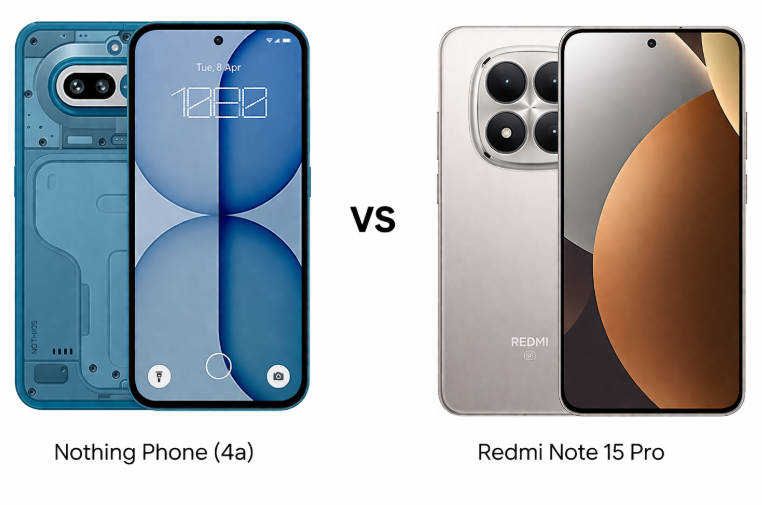
Two very different philosophies collide in the mid-range segment with the Nothing Phone (4a) and Redmi Note 15 Pro. One focuses on clean software, unique design, and a more refined everyday experience, while the other pushes aggressive specs, a bigger battery, and stronger durability at a lower price. This comparison matters for buyers who want more than just numbers, because the real difference shows up in daily use. The decision ultimately comes down to whether refinement or raw value fits better into your lifestyle.
Nothing Phone (4a) brings a more distinctive design with its transparent back and mini-LED glyph lighting, giving it a unique identity in a crowded segment. The glass back and front feel premium, though the IP64 rating limits serious water exposure. Redmi Note 15 Pro, on the other hand, focuses on durability with stronger protection, better water resistance, and even drop resistance. It feels more rugged and practical, especially for long-term use. The eco-leather option also adds a slightly more refined grip and finish.
Display Quality
Both phones feature AMOLED panels with 120Hz refresh rates, but the Redmi pushes brightness and color depth further. Its higher peak brightness and Dolby Vision support make it better suited for outdoor use and HDR content. The Nothing display is still sharp and vibrant, with excellent HDR10+ tuning and smoother PWM dimming that may feel easier on the eyes.
Verdict
Nothing Phone (4a) wins in design personality, while Redmi Note 15 Pro clearly leads in durability and display performance.
2. Specifications Including Battery
Performance
Nothing Phone (4a) uses the Snapdragon 7s Gen 4, offering balanced performance with strong efficiency and reliable GPU output. It feels smoother in UI transitions and sustained usage, especially with Nothing OS optimization. Redmi Note 15 Pro’s Dimensity 7400 Ultra is capable but leans more toward raw CPU bursts than consistent performance. In daily use, both handle multitasking well, but the Nothing phone feels slightly more refined overall.
Battery and Charging
Redmi takes a big lead with its massive battery, easily lasting longer across heavy usage. It is built for endurance, making it ideal for gamers or power users. However, Nothing Phone (4a) counters with faster charging speeds, reaching full charge quicker and offering better convenience for busy routines. Reverse charging is present on both, but Redmi offers more flexibility.
Verdict
Nothing Phone (4a) feels smoother and more optimized, while Redmi Note 15 Pro dominates battery life with sheer capacity.
3. Camera
Main and Secondary Lenses
Nothing Phone (4a) delivers a more versatile camera setup with a dedicated periscope telephoto lens, enabling true optical zoom. This adds real-world flexibility for portraits and distant shots. Its primary sensor also produces balanced, natural-looking images. Redmi Note 15 Pro focuses on a high-resolution 200MP sensor, which captures impressive detail but relies heavily on processing rather than lens variety. The lack of a telephoto lens limits its flexibility despite the megapixel advantage.
Selfie Camera
Nothing again holds an edge with a higher-resolution front camera, producing sharper selfies with better detail retention. Redmi’s selfie camera is decent for social media but doesn’t stand out in clarity or dynamic range.
Verdict
Nothing Phone (4a) clearly wins for camera versatility and overall consistency, while Redmi focuses more on raw resolution than practical usage.
4. Pricing
Nothing Phone (4a) is priced around ₹32,000, while Redmi Note 15 Pro comes in at approximately ₹27,000. The price gap is noticeable, placing Redmi in a more aggressive value segment.
Value for Money
Redmi Note 15 Pro offers strong value with its durable build, massive battery, and high-end display features at a lower price. It is clearly aimed at buyers who want maximum hardware for less money. Nothing Phone (4a), while more expensive, justifies its pricing through a cleaner software experience, better camera system, and unique design approach. It feels more polished rather than purely spec-driven.
Verdict
Redmi Note 15 Pro is the better deal for budget-focused buyers, while Nothing Phone (4a) justifies its higher price with a more premium and balanced experience.
Disclaimer: Prices are approximate and may vary based on country, region, and applicable taxes.
5. Conclusion
Nothing Phone (4a) stands out with its glyph interface, cleaner UI, and telephoto camera, features that enhance daily usability rather than just numbers on paper. Redmi Note 15 Pro focuses on practicality with its massive battery, stronger durability, and brighter display, making it more of a powerhouse device.
Verdict
If only one has to be chosen, the Nothing Phone (4a) is the better overall pick. It delivers a smoother, more refined experience with cleaner software, a more versatile camera system, and a premium design that feels distinct in daily use. While the Redmi Note 15 Pro offers better battery life and stronger value for money, it leans more on raw specs than real-world polish. For a balanced, long-term experience, Nothing Phone (4a) is the smarter choice.
Disclaimer: This comparison is based on the specifications provided and is intended for general informational purposes. Actual performance, camera results, battery life, and overall experience may vary depending on real-world usage, software updates, and individual preferences.
We use cookies on our website to give you the most relevant experience by remembering your preferences and repeat visits. By clicking “Accept”, you consent to the use of ALL the cookies.
This website uses cookies to improve your experience while you navigate through the website. Out of these, the cookies that are categorized as necessary are stored on your browser as they are essential for the working of basic functionalities of the website. We also use third-party cookies that help us analyze and understand how you use this website. These cookies will be stored in your browser only with your consent. You also have the option to opt-out of these cookies. But opting out of some of these cookies may affect your browsing experience.
Necessary cookies are absolutely essential for the website to function properly. This category only includes cookies that ensures basic functionalities and security features of the website. These cookies do not store any personal information.
Any cookies that may not be particularly necessary for the website to function and is used specifically to collect user personal data via analytics, ads, other embedded contents are termed as non-necessary cookies. It is mandatory to procure user consent prior to running these cookies on your website.




Comments