
Add GIZMOCHINA as Preferred Source on Google
The Snapdragon 7 Gen 4 is a performance-friendly mid-range chipset, which is already powering a flurry of devices from top smartphone brands. It was announced in mid-2025, and three months later, Qualcomm announced the Snapdragon 7s Gen 4 with a similar spec sheet. However, there are still several key differences that set them apart.
In this detailed comparison, we’ll review the benchmark data and key differences to determine which Snapdragon chip delivers higher performance and, more importantly, better overall value.
Here’s the spec sheet to begin with:
| Snapdragon 7 Gen 4 | Snapdragon 7s Gen 4 | |
|---|---|---|
| Announced | May 2025 | August 2025 |
| Process node | 4nm (TSMC) | 4nm (TSMC) |
| CPU | 1 x 2.8 GHz (Cortex-A720) 4 x 2.4 GHz (Cortex-A720) 3 x 1.84 GHz (Cortex-A520) | 1 x 2.7 GHz (Cortex-A720) 3 x 2.4 GHz (Cortex-A720) 4 x 1.8 GHz (Cortex-A520) |
| GPU | Adreno 722 Snapdragon Elite Gaming features | Adreno 810 Snapdragon Elite Gaming features |
| NPU | Qualcomm Hexagon NPU | Qualcomm Hexagon NPU |
| Memory | LPDDR5x, up to 4.2GHz | LPDDR5, up to 3.2GHz |
| Storage | UFS 4.0 | UFS 3.1 |
| Camera | Qualcomm Spectra ISP (Triple AI-ISPs, 12-bit) up to 200MP single camera up to 64MP single camera with zero shutter lag up to 32+21MP dual cameras with zero shutter lag up to 21MP triple cameras with zero shutter lag up to 4K/60fps video recording | Qualcomm Spectra ISP (Triple ISPs, 12-bit) up to 200MP single camera up to 64MP single camera with zero shutter lag up to 32+21MP dual cameras with zero shutter lag up to 21MP triple cameras with zero shutter lag up to 4K/30fps video recording |
| Connectivity | Snapdragon 5G modem download speed: 4.2 Gbps (peak speed) Wi-Fi 7 (peak speed: 5.8 Gbps) Bluetooth 6.0, LE | Snapdragon 5G modem download speed: up to 2.9 Gbps Wi-Fi 6E (peak speed: 2.9 Gbps) Bluetooth 5.4, LE |
Quick verdict:
Choose the Snapdragon 7 Gen 4 if you prioritize performance, gaming, advanced AI, and modern connectivity.
Choose Snapdragon 7s Gen 4 if you’re a value-conscious buyer who prioritizes battery life and daily reliability over high-end performance.
Snapdragon 7 Gen 4 vs 7s Gen 4: Benchmark score
[Note: To obtain benchmark results, the tests were performed using the Vivo T4 Pro (powered by Snapdragon 7 Gen 4) and POCO M8 Pro (powered by Snapdragon 7s Gen 4).]
Geekbench score
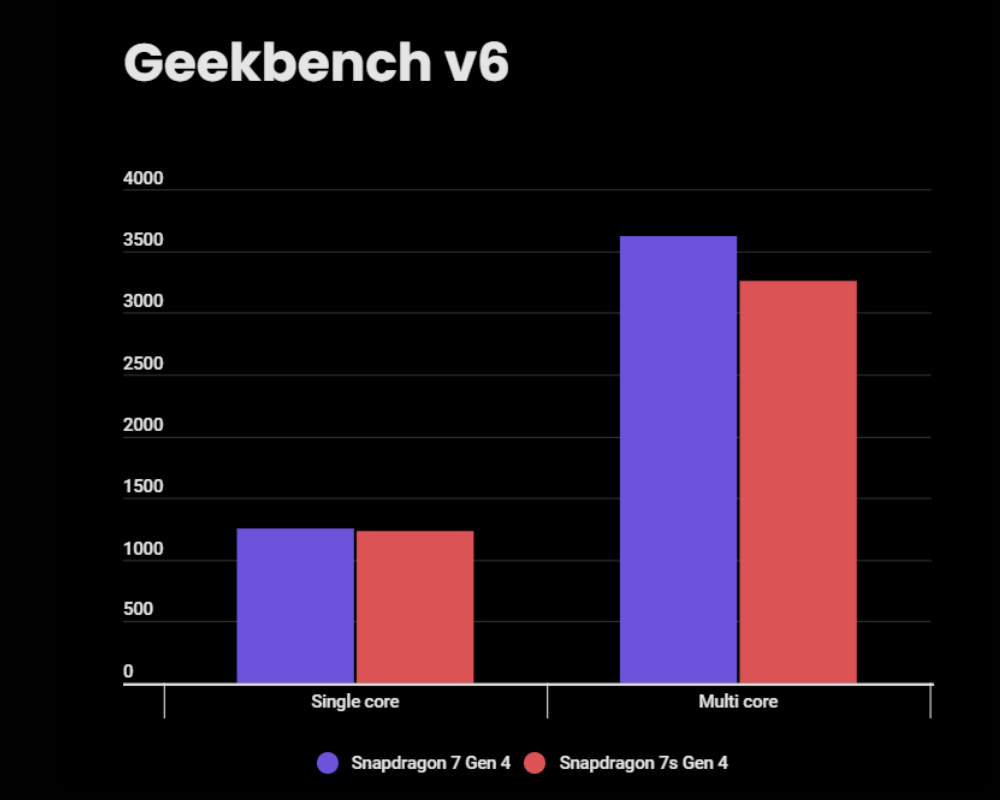
On Geekbench v10, the Snapdragon 7 Gen 4 pulls just ahead in single-core performance. However, the gap widens in multi-core performance, with the Snapdragon 7 Gen 4 posting a 10% higher score. So, demanding apps that require multiple cores to work together would perform better on a device powered by Snapdragon 7 Gen 4 than on one powered by Snapdragon 7s Gen 4.
| Snapdragon 7 Gen 4 | Snapdragon 7s Gen 4 | |
| Single core | 1,252 | 1,231 |
| Multi core | 3,620 | 3,257 |
AnTuTu score
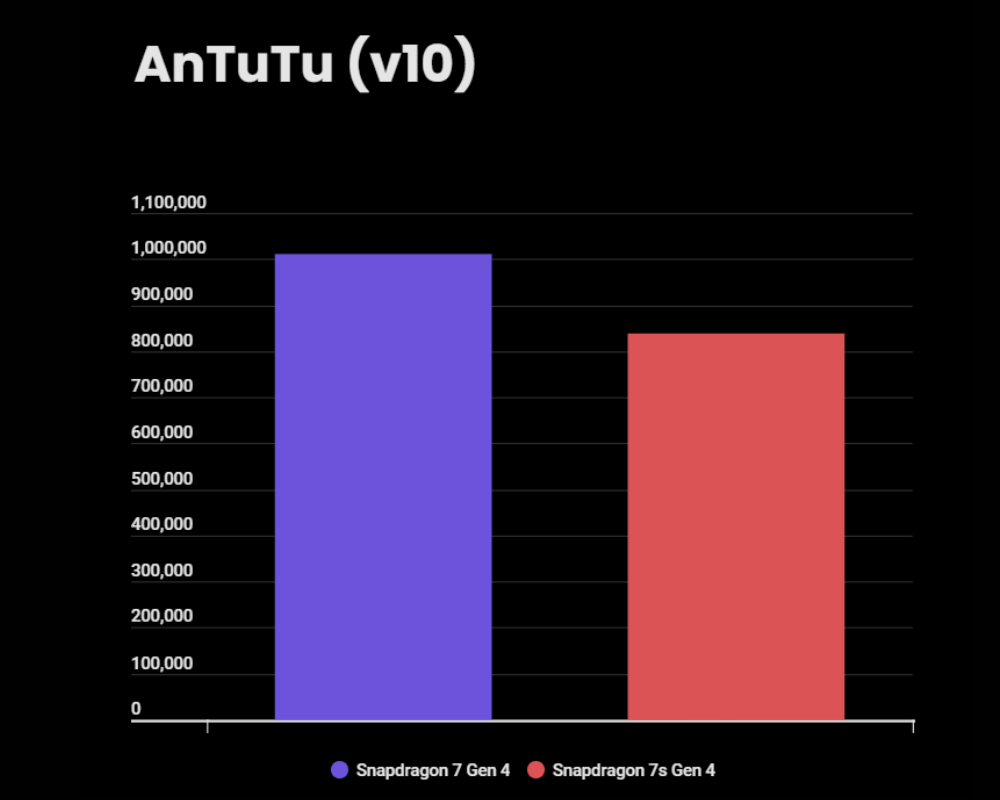
The Snapdragon 7 Gen 4 has achieved over 1 million AnTuTu points, while the Snapdragon 7s Gen 4 gets 838K points. That’s a 20% solid uplift for the 7 Gen 4, but the overall score doesn’t offer much clarity. So, we look at the breakdown of the AnTuTu score.
| Snapdragon 7 Gen 4 | Snapdragon 7s Gen 4 | |
| AnTuTu score | 1,010,864 | 838,402 |
| CPU | 309,273 | 276,892 |
| GPU | 323,797 | 211,590 |
| Memory | 182,776 | 162,373 |
| UX | 195,019 | 187,547 |
The Snapdragon 7 Gen 4 outperforms the 7s Gen 4 in all aspects. The CPU score is up by 11%; the GPU score is up by 53%, and the memory score is up by 12%. The 7 Gen 4 also pulls ahead in the UX score, even though the difference is small.
Performance-wise, the Snapdragon 7 Gen 4 looks promising, but we must also review other key aspects, such as camera capabilities and connectivity features, to pick the right one. (more on that below)
Snapdragon 7 Gen 4 vs 7s Gen 4: Key differences that matter
Performance
CPU
The Snapdragon 7 Gen 4 prioritizes raw power by using five performance cores (1 prime + 4 performance), whereas the Snapdragon 7s Gen 4 uses a traditional four-performance core setup (1 prime + 3 performance), leaning more on its efficiency cores for battery savings.
The Snapdragon 7 Gen 4 also benefits from a higher peak clock speed of 2.8 GHz compared to the 2.7 GHz on the 7s Gen 4, offering additional performance advantage to the standard 7 Gen 4 SoC.
GPU
For graphics rendering, the 7 Gen 4 relies on the Adreno 722 GPU, which may seem weaker than the Adreno 810 GPU on the 7s Gen 4 at first sight, but it’s actually more powerful. It has a higher frequency, shading units, and FLOPS, resulting in consistent frame rates and reliable gaming performance. The 7 Gen 4 also features advanced Snapdragon Elite Gaming features to deliver smoother gaming with reduced stutter.
AI & NPU
Coming to the AI part, both Snapdragon chips have Hexagon NPUs, but the one on the Snapdragon 7 Gen 4 is significantly more powerful than the NPU on the Snapdragon 7s Gen 4. Qualcomm claims a 65% higher AI performance than the 7 Gen 3, but the 7s Gen 3 is only described generically as an updated Hexagon NPU with “better AI performance” than the 7s Gen 3.
The 7 Gen 4 supports on-device generative AI assistants and large language models (LLMs) for the first time in the Snapdragon 7-series. Also, the first-in-series to run models like Stable Diffusion 1.5 locally on-device. In short, the 7 Gen 4 features a significant upgrade to generative AI, while the 7s Gen 4 hasn’t received a major NPU upgrade.
Camera
While both Snapdragon SoCs use the same 12-bit Spectra ISPs, there are still crucial differences that can significantly affect output quality. This includes the hardware-enabled Electronic Image Stabilization (EIS) support on the Snapdragon 7 Gen 4 for the first time in the Snapdragon 7-series.
The Snapdragon 7 Gen 4 leverages AI-powered autofocus, auto white balance, and auto exposure, now baked into the ISP hardware. The Real-time Video Super Resolution is also AI-assisted, enhancing detail while also reducing noise. In contrast, the 7s Gen 4 features modest AI features such as Snapdragon Low Light Vision and AI Remosaic.
The 7 Gen 4 also excels in video recording, supporting 4K HDR videos at 60fps, while the 7s Gen 4 supports 4K HDR recording at 30fps.
Connectivity
The Snapdragon 7 Gen 4 features more modern, high-end connectivity, which includes Wi-Fi 7 and Bluetooth 6.0. In contrast, the 7s Gen 4 has Wi-Fi 6E and Bluetooth 5.4.
The 7 Gen 4 also excels in connectivity speeds, supporting up to 4.2 Gbps on a 5G connection and up to 5.8 Gbps on a Wi-Fi connection, while the 7s Gen 4 can reach just 2.9 Gbps on both cellular and Wi-Fi connections.
Snapdragon 7 Gen 4 vs 7s Gen 4: Conclusion
The Snapdragon 7 Gen 4 is a premium mid-range chipset, featuring a performance-focused CPU, a superior GPU, and robust connectivity. The Snapdragon 7s Gen 4 sits below it, prioritizing balanced performance and power efficiency.
If you prioritize gaming, AI features, and modern connectivity, the Snapdragon 7 Gen 4 is the better choice. For those looking for reliable daily performance at a lower cost, the Snapdragon 7s Gen 4 is a good fit.



Comments