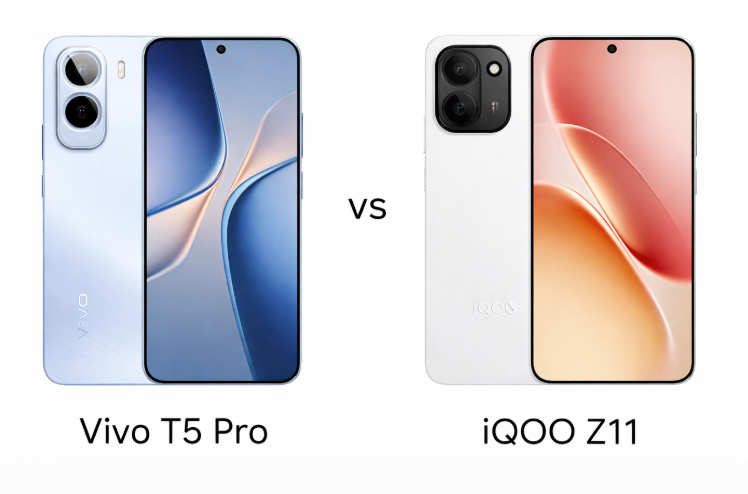
Two smartphones, almost identical on paper, yet built for completely different experiences, the Vivo T5 Pro and iQOO Z11 redefine how brands approach the ₹30K segment. With massive batteries, high-refresh-rate displays, and modern hardware, both seem equally compelling at first glance, but the real difference lies in performance tuning, camera capabilities, and feature choices that shape everyday usage. This comparison highlights which one truly delivers better value depending on whether the priority is raw power or a more balanced, refined experience.
Major Features:
Feature
Vivo T5 Pro
iQOO Z11
Winner
Design & Build
Glass front, plastic frame/back, IP68/IP69
Glass front, plastic frame/back, IP68/IP69
Tie – Same durability and build
Display
AMOLED, 144Hz, 5000 nits peak
AMOLED, 165Hz, HDR, 2160Hz PWM, 5000 nits peak
iQOO Z11 – Higher refresh + better display features
Resolution
1260 × 2800, ~450 ppi
1260 × 2800, ~450 ppi
Tie – Identical sharpness
Chipset
Snapdragon 7s Gen 4
Dimensity 8500 (4nm)
iQOO Z11 – More powerful and newer architecture
GPU
Adreno 810
Mali-G720 MC8
iQOO Z11 – Better gaming performance
RAM & Storage
Up to 12GB / 256GB, UFS 3.1
Up to 16GB / 512GB
iQOO Z11 – More RAM and storage options
Rear Camera
50MP (no OIS)
50MP with OIS
iQOO Z11 – OIS improves stability and low light
Video (Rear)
4K@30fps
4K + EIS + OIS
iQOO Z11 – Better stabilization
Selfie Camera
32MP, 4K video
16MP, 1080p
Vivo T5 Pro – Higher resolution + 4K
Battery
9020mAh
9020mAh
Tie – Same massive battery
Charging
90W wired
90W + PD/PPS + UFCS
iQOO Z11 – More charging flexibility
Connectivity
Wi-Fi 6, BT 5.2, No NFC
Wi-Fi 6, BT 5.4, NFC, IR
iQOO Z11 – More features like NFC & IR
Audio
Stereo speakers
Stereo speakers
Tie – Same setup
Price
₹30,000
₹31,000
Vivo T5 Pro – Slightly cheaper
Disclaimer: Specs are based on available data. Actual performance may vary. Verify details from official sources before buying.
Both phones follow a similar design language with glass fronts and plastic frames, but the overall finish differs slightly in perception. The Vivo T5 Pro feels a bit more refined in hand with a cleaner aesthetic, while the iQOO Z11 leans toward a slightly more performance-focused look. Both offer IP68/IP69 protection, which is a strong addition at this price point and adds confidence for long-term usage. The in-hand feel is solid on both, though the Vivo device subtly feels more polished in everyday use.
Display Quality
The displays are nearly identical in size and resolution, but the refresh rate and tuning create separation. The iQOO Z11’s 165Hz panel offers smoother scrolling and a more responsive feel, especially noticeable in gaming. It also adds better PWM dimming and HDR support, making it more versatile for media consumption. The Vivo T5 Pro still delivers a bright and sharp AMOLED experience with a 144Hz panel, but it lacks some of the finesse seen on the iQOO.
Verdict
iQOO Z11 takes the edge with a more feature-rich display, while Vivo T5 Pro feels slightly more premium in design execution.
2. Specifications Including Battery
Performance
The biggest gap appears in performance. The iQOO Z11, powered by the Dimensity 8500, delivers significantly higher raw power and better sustained performance. It is clearly tuned for gaming and heavy multitasking, making it more future-proof. The Vivo T5 Pro’s Snapdragon 7s Gen 4 is efficient and capable for daily use, but it sits a tier below in terms of peak performance. For users who prioritize stability over raw speed, the Vivo still holds its ground well.
Battery and Charging
Both phones pack a massive 9020mAh battery, which is a standout feature in this segment. Battery life is exceptional on both, easily stretching beyond a day and a half with moderate use. Charging speeds are identical at 90W, but the iQOO Z11 adds more charging protocols like PD/PPS and UFCS, making it more flexible across different chargers.
Verdict
iQOO Z11 clearly wins with stronger performance and more versatile charging, while battery life remains equally impressive on both.
3. Camera
Main and Secondary Lenses
Both devices feature a 50MP primary camera with similar sensor sizes, but the iQOO Z11 gains a clear advantage with OIS support. This results in more stable shots and better low-light performance. Video recording is also more reliable on the iQOO due to gyro-EIS combined with OIS. The Vivo T5 Pro still captures good photos with decent dynamic range, but it lacks the consistency seen on the iQOO. The difference becomes noticeable in challenging lighting conditions.
Selfie Camera
The Vivo T5 Pro stands out with a higher-resolution 32MP front camera, delivering sharper selfies and better detail retention. It also supports 4K video recording, which is rare in this segment. The iQOO Z11’s 16MP selfie camera is serviceable but feels basic in comparison, especially for users who prioritize front camera quality.
Verdict
iQOO Z11 is better for rear camera performance, while Vivo T5 Pro is the stronger choice for selfies and front video.
4. Pricing
The Vivo T5 Pro is priced at around ₹30,000, while the iQOO Z11 comes slightly higher at approximately ₹31,000. The difference is minimal, making this a direct value-based decision rather than a budget constraint. At this price, expectations around performance, camera, and features become very important.
Is the Price Justified?
The iQOO Z11 justifies its slightly higher price with a more powerful chipset, better display features, OIS in the camera, and added connectivity options like NFC and infrared. It feels like a more complete package for power users. The Vivo T5 Pro, however, focuses on balanced usage with a better selfie camera and a slightly more refined design, which may appeal to casual users and content creators.
Verdict
iQOO Z11 offers better overall value for performance-focused buyers, while Vivo T5 Pro remains a solid alternative for balanced everyday use.
Disclaimer: Prices are approximate and may vary based on country, region, and applicable taxes.
5. Conclusion
The iQOO Z11 stands out with its Dimensity 8500 chipset, 165Hz display, OIS camera system, and additional features like NFC and infrared. It is clearly designed for users who want maximum performance and versatility. On the other hand, the Vivo T5 Pro highlights a stronger selfie camera, a clean design approach, and a dependable overall experience. Both devices share excellent battery life, which is a major selling point in this segment.
Verdict
For gaming, performance, and long-term value, the iQOO Z11 is the better pick. For users who prefer a more balanced phone with better selfies and a slightly more refined feel, the Vivo T5 Pro still makes sense. The final choice depends on whether performance or overall balance matters more.
Disclaimer: This comparison is based on the specifications provided and is intended for general informational purposes. Actual performance, camera results, battery life, and overall experience may vary depending on real-world usage, software updates, and individual preferences.
We use cookies on our website to give you the most relevant experience by remembering your preferences and repeat visits. By clicking “Accept”, you consent to the use of ALL the cookies.
This website uses cookies to improve your experience while you navigate through the website. Out of these, the cookies that are categorized as necessary are stored on your browser as they are essential for the working of basic functionalities of the website. We also use third-party cookies that help us analyze and understand how you use this website. These cookies will be stored in your browser only with your consent. You also have the option to opt-out of these cookies. But opting out of some of these cookies may affect your browsing experience.
Necessary cookies are absolutely essential for the website to function properly. This category only includes cookies that ensures basic functionalities and security features of the website. These cookies do not store any personal information.
Any cookies that may not be particularly necessary for the website to function and is used specifically to collect user personal data via analytics, ads, other embedded contents are termed as non-necessary cookies. It is mandatory to procure user consent prior to running these cookies on your website.


Comments