
Add GIZMOCHINA as Preferred Source on Google
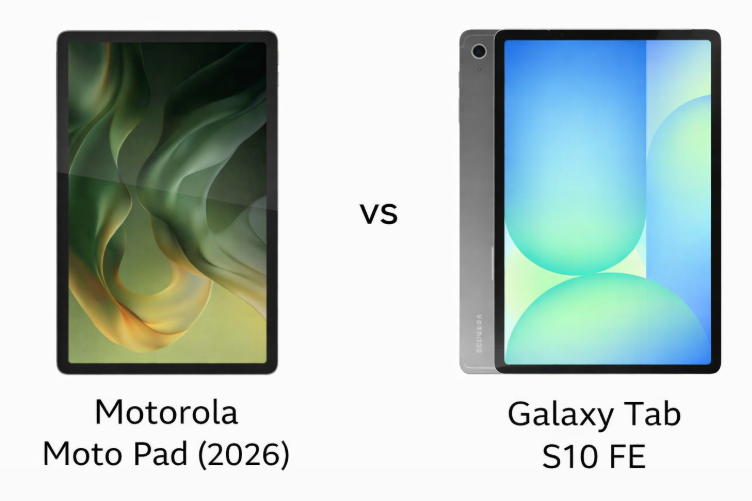
Choosing the right tablet in 2026 isn’t just about screen size anymore; it’s about how well it fits your daily workflow. The Moto Pad 2026 and Samsung Galaxy Tab S10 FE sit at two very different price points, yet they overlap in ways that make this comparison surprisingly relevant. One focuses on delivering strong value for entertainment and casual use, while the other pushes toward a more powerful, productivity-ready experience. If the goal is to balance performance, features, and long-term usability, this head-to-head matters more than it seems at first glance.
1. Design and Display
Build Quality
Moto Pad 2026 keeps things slim at 7mm with a clean aluminum finish, offering a balanced in-hand feel and lighter weight. It includes splash resistance, which adds minor durability. Samsung Galaxy Tab S10 FE goes thinner at 6mm and adds IP68 water and dust resistance, making it significantly tougher for long-term use. The inclusion of both Nano-SIM and eSIM also gives Samsung an edge in connectivity flexibility. Overall, Samsung feels more premium and durable despite being slightly heavier.
Display & Multimedia
Moto Pad 2026 offers a slightly larger 11-inch panel with higher resolution and sharper pixel density, which helps in reading and content clarity. It also features Dolby Atmos with quad speakers and retains a 3.5mm jack, rare but useful. Samsung’s 10.9-inch display is slightly less sharp but still smooth at 90Hz. However, it compensates with better brightness consistency and refined tuning for media.
Verdict
Moto Pad 2026 wins on sharpness and audio flexibility, but Samsung Galaxy Tab S10 FE takes the lead in durability and overall premium feel.
2. Performance and Software
Processor & UI Smoothness
Moto Pad 2026 runs on Dimensity 6300, which is efficient but clearly mid-range. It handles daily tasks smoothly but may struggle with heavier workloads or gaming spikes. Samsung’s Exynos 1580 is a much more powerful 4nm chip with newer Cortex-A720 cores, offering noticeably better performance headroom. UI fluidity feels more consistent, especially under load.
Productivity & Multitasking
Samsung pushes ahead with up to 12GB RAM and One UI 7 optimizations, making multitasking smoother and more desktop-like. Features like split-screen and app continuity feel more polished. Moto Pad’s 8GB RAM is sufficient, but the experience leans more toward casual usage rather than productivity-heavy workflows.
Verdict
Samsung Galaxy Tab S10 FE clearly dominates in performance and multitasking, making it the better choice for power users and long-term usage.
3. Battery and Accessories
Battery Life
Moto Pad 2026 packs a 7040mAh battery, which should deliver decent endurance for casual streaming and browsing. However, the 20W charging feels slow in 2026 standards. Samsung steps up with an 8000mAh battery and much faster 45W charging, making it more reliable for longer sessions and quicker top-ups.
Stylus, Keyboard & Ecosystem
Both tablets support stylus input, but Samsung’s ecosystem is more mature. Its integration with keyboards, accessories, and cross-device features feels refined. Moto Pad offers basic stylus support but lacks the deeper ecosystem advantages that Samsung brings.
Verdict
Samsung Galaxy Tab S10 FE wins comfortably with better battery capacity, faster charging, and a stronger accessory ecosystem.
4. Camera & Media
Rear and Front Camera
Moto Pad 2026 keeps things basic with an 8MP rear and 5MP front camera, good enough for scanning documents and occasional video calls. Samsung upgrades significantly with a 13MP rear and a 12MP ultrawide front camera, which is ideal for group calls and better framing.
Video & Audio Quality
Samsung supports 4K video recording on both front and rear cameras, giving it a clear edge for content creation and meetings. Moto Pad lacks detailed video capabilities. Audio-wise, Moto Pad’s quad speakers with Dolby Atmos deliver a more immersive experience, especially for movies.
Verdict
Samsung leads in camera and video versatility, while the Moto Pad counters with stronger speaker output. Overall, Samsung takes the edge for modern media needs.
5. Pricing
Moto Pad 2026 comes in at around $250, making it a strong budget-friendly option with solid essentials. Samsung Galaxy Tab S10 FE sits at roughly $500, doubling the price but also offering significantly better performance, durability, cameras, and ecosystem features.
Moto Pad clearly delivers higher value per dollar for casual users, while Samsung justifies its price with a more complete flagship-like experience.
Disclaimer:
Prices are approximate and may vary based on country, region, and applicable taxes.
6. Conclusion
Moto Pad 2026 stands out with its sharper display, quad speakers with Dolby Atmos, and headphone jack, features that still matter for media-focused users. Samsung Galaxy Tab S10 FE brings IP68 protection, a far more powerful chipset, better cameras, faster charging, and a polished ecosystem that feels closer to a productivity device.
Verdict
Moto Pad 2026 is the smarter pick for budget buyers who want a solid entertainment tablet without overspending. Samsung Galaxy Tab S10 FE is the better long-term investment, offering stronger performance, durability, and versatility.
Disclaimer: The Moto Pad 2026 has not been officially released yet, and its specifications are based on announced details. Actual performance, features, and pricing may vary once the device becomes available.
Read More:

Comments