
Add GIZMOCHINA on Google:
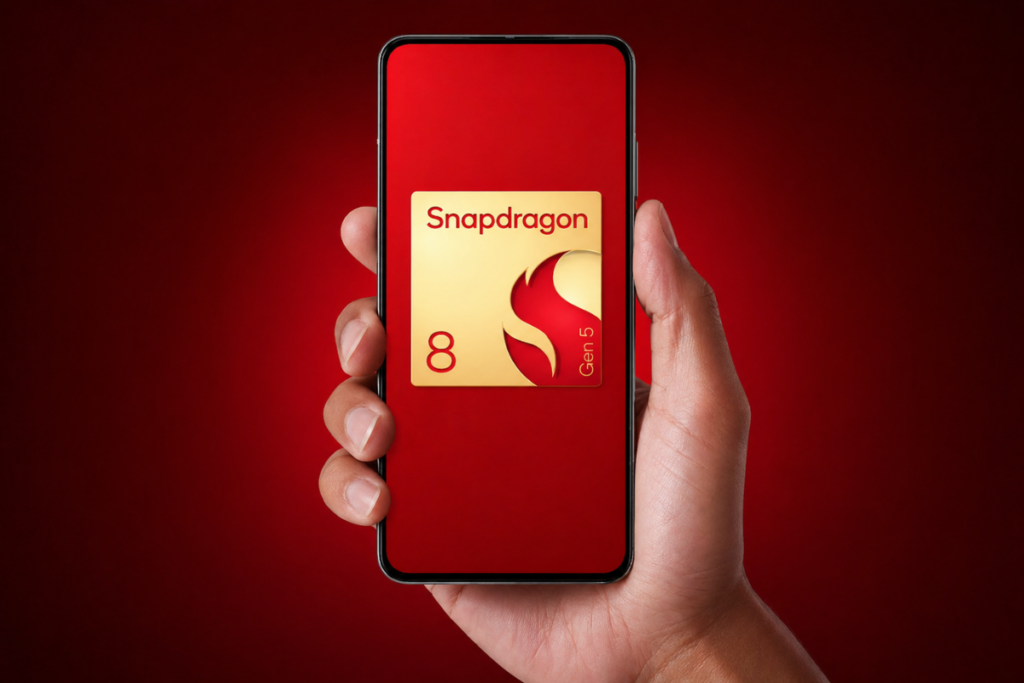
The Snapdragon 8 Gen 5 is positioned as a high-end smartphone chipset, offering flagship-level performance at a much lower price. It’s built using a newer architecture and packed with AI-driven enhancements, but let’s be honest – not every new chip translates into a worthwhile upgrade for the users.
If you’re already using a device powered by a Snapdragon 8-series chipset, the big question is whether the Snapdragon 8 Gen 5 is a meaningful upgrade or just another incremental spec bump? Because in 2026, raw performance alone isn’t enough. Users want real-world gains in AI capabilities, battery efficiency, and camera processing for an upgrade to justify.
Here, we’ll take a closer look at whether the Snapdragon 8 Gen 5 offers meaningful upgrades or if it’s better to hold onto your current device. Let’s break it down.
Snapdragon 8 Gen 5 benchmark scores look promising, but there’s a catch

The Snapdragon 8 Gen 5 puts solid gains on the table when compared to the Snapdragon 8 Gen 3, but it couldn’t outperform the Snapdragon 8 Elite. This essentially tells the correct positioning of the newer Snapdragon 8 Gen 5 – sitting between the other two.
To obtain benchmark results, we selected devices from a single brand to reduce software-related differences. We ran the tests on the OnePlus 15R (Snapdragon 8 Gen 5), the OnePlus 13 (Snapdragon 8 Elite), and the OnePlus 13R (Snapdragon 8 Gen 3).
In the Geekbench 6 CPU test, the Snapdragon 8 Gen 5 sits between the other two chips, with 3,026 points in single-core performance. In the multi-core test, however, the Snapdragon 8 Gen 5 bridges the gap with the Snapdragon 8 Elite, while the 8 Gen 3 lags much further behind.
| SD 8 Gen 5 | SD 8 Elite | SD 8 Gen 3 | |
| Single core | 2,837 | 3,026 | 2,243 |
| Multi core | 9,352 | 9,306 | 6,591 |
We also tested the devices on the AnTuTu benchmark to get a clearer picture. In terms of total score, the Snapdragon 8 Gen 5 sits in the middle, again, with a total score of 2.96 million. The Snapdragon 8 Elite leads with 2.96 million points, while the Snapdragon 8 Gen 3 sits below the other two with 2.27 million points.
| SD 8 Gen 5 | SD 8 Elite | SD 8 Gen 3 | |
| AnTuTu score | 2,961,236 | 2,994,563 | 2,274,520 |
| CPU | 914,878 | 862,692 | 607,409 |
| GPU | 974,402 | 1,095,049 | 796,782 |
| Memory | 382,729 | 393,623 | 353,279 |
| UX | 689,228 | 643,199 | 517,050 |
The breakdown of the AnTuTu score offers much better insights than a vague total score. In the CPU test, the Snapdragon 8 Gen 5 pulls off a 6% higher score than the Snapdragon 8 Elite, which widens to 50% when compared to the 8 Gen 3.
In the GPU test, the Snapdragon 8 Gen 5 gets about 12% lower score than the Snapdragon 8 Elite, but outperforms the Snapdragon 8 Gen 3 by 22%.
Performance upgrades
The Snapdragon 8 Gen 5 uses TSMC’s N3P (3nm) node, which yields slightly better performance and efficiency over the N3E (3nm) node used for the Snapdragon 8 Elite. The 8 Gen 3 chip uses an older N4P (4nm) node.
Except for the Snapdragon 8 Gen 3, the other two chips use custom-designed Oryon CPU cores, which deliver better performance over the ARM CPU cores in the 8 Gen 3. The 8 Gen 5 also benefits from newer-generation Oryon cores, but the higher clock speeds on the Snapdragon 8 Elite offer the chip an edge in CPU performance.
The Snapdragon 8 Elite also maintains an edge in gaming performance, thanks to a stronger peak graphics performance on the Snapdragon 8 Elite, while the 8 Gen 5’s Adreno 829 is a cut-down, more affordable GPU with modern gaming features.
The Elite chip is a better choice for max settings, ray tracing, and higher sustained frame rates. That said, the Snapdragon 8 Gen 5 still remains strong enough for demanding games and emulators except at the most extreme settings.
The AI gap between the Snapdragon 8 Gen 5 and Snapdragon 8 Elite is much smaller than the GPU gap, as both chips use a very similar Hexagon NPU setup, promising fast on-device AI and multimodal Gen AI support.
Camera upgrades
The camera upgrades are real and promising. It borrows the 20-bit AI ISP from the top-tier Snapdragon 8 Elite Gen 5 chipset, offering more headroom for HDR, denoising, and color processing compared to the 18-bit ISP on the Snapdragon 8 Elite and 8 Gen 3.
The rest of the camera specs match those of the Snapdragon 8 Elite, including support for up to 320MP single-camera capture, 4K/120fps video recording, and limitless real-time semantic segmentation.
Connectivity upgrades
The Snapdragon 8 Gen 5 features the same connectivity as the Snapdragon 8 Elite. Meaning, a peak speed of 10Gbps on a cellular connection and 5.8Gbps on a Wi-Fi connection. Both chips have the modern Bluetooth 6.0 connectivity.
In short, the Snapdragon 8 Gen 5 borrows the connectivity features from the Snapdragon 8 Elite, both of which are a step up over the 8 Gen 3.
Snapdragon 8 Gen 5: Should you upgrade or skip it?
Well, that depends. If you’re using a Snapdragon 8 Gen 3 or older chipset, upgrading to the Snapdragon 8 Gen 5 makes sense. You should expect at least 20% jump in the CPU and GPU performance. So, gaming would feel smoother, snappier, and more consistent. The new chip also offers better AI capabilities, a more powerful ISP, and modern connectivity features. So, there are improvements in almost every aspect, making it a true upgrade.
However, if you’re already using a Snapdragon 8 Elite or newer flagships, switching to Snapdragon 8 Gen 5 would feel like a downgrade. The Elite chip excels in raw performance, especially in CPU‑burst and sustained‑GPU workloads.
Best Snapdragon 8 Gen 5 phones:
| Snapdragon 8 Gen 5 | Snapdragon 8 Elite | Snapdragon 8 Gen 3 | |
|---|---|---|---|
| Announced | November 2025 | October 2024 | October 2023 |
| Process node | TSMC’s 3nm (N3P) | TSMC’s 3nm (N3E) | TSMC’s 4nm (N4P) |
| CPU | 2 x 3.8 GHz — Oryon (3rd gen) 6 x 3.32 GHz — Oryon (3rd gen) | 2 x 4.32 GHz — Oryon (2nd gen) 6 x 3.53 GHz — Oryon (2nd gen) | 1 x 3.3 GHz — Cortex-X4 3 x 3.15 GHz — Cortex-A720 2 x 2.96 GHz — Cortex-A720 2 x 2.27 GHz — Cortex-A520 |
| GPU | Adreno 829 ray tracing support Snapdragon Elite Gaming features | Adreno 830 ray tracing support Snapdragon Elite Gaming features | Adreno 750 ray tracing support Snapdragon Elite Gaming features |
| NPU | Qualcomm Hexagon NPU agentic AI support | Qualcomm Hexagon NPU | Qualcomm Hexagon NPU |
| Memory | LPDDR5x, up to 4.8 GHz | LPDDR5x, up to 5.3 GHz | LPDDR5x, up to 4.8 GHz |
| Storage | UFS 4.1 | UFS 4.0 | UFS 4.0 |
| Camera | Qualcomm Spectra triple AI ISP (20-bit) up to 320MP single camera up to 108MP single camera with zero shutter lag up to 48MP triple cameras with zero shutter lag real-time semantic segmentation (limitless) 4K/120fps video recording 1080p/480fps slow-mo video recording | Qualcomm Spectra triple AI ISP (18-bit) up to 320MP single camera up to 108MP single camera with zero shutter lag up to 48MP triple cameras with zero shutter lag real-time semantic segmentation (limitless) 8K/30fps video recording 1080p/480fps slow-mo video recording | Qualcomm Spectra triple AI ISP (18-bit) up to 200MP single camera up to 108MP single camera with zero shutter lag up to 36MP triple cameras with zero shutter lag real-time semantic segmentation (up to 12 layers) 8K/30fps or 4K/120fps video recording 720p/960fps slow-mo video recording |
| Connectivity | Snapdragon X80 5G modem download speed: 10 Gbps (peak) upload speed: 3.5 Gbps (peak) Wi-Fi 7 (peak speed: 5.8 Gbps) Bluetooth 6.0 | Snapdragon X80 5G modem download speed: 10 Gbps (peak) upload speed: 3.5 Gbps (peak) Wi-Fi 7 (peak speed: 5.8 Gbps) Bluetooth 6.0 | Snapdragon X75 5G modem Download speed: 10 Gbps (peak) Upload speed: 3.5 Gbps (peak) Wi-Fi 7 (peak speed: 5.8 Gbps) Bluetooth 5.4 |

Comments