
Add GIZMOCHINA as Preferred Source on Google
Samsung Display may already be experimenting with what comes after today’s smartphone screens, and if a new leak is accurate, the company is looking far beyond foldables this time.
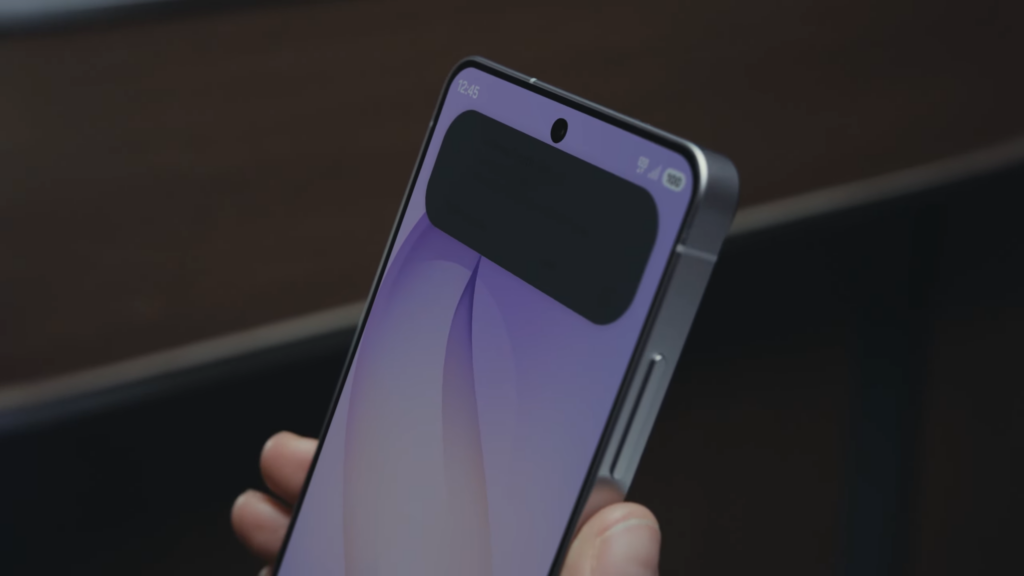
According to information shared by leaker Schrödinger, also known as phonefuturist on X, Samsung is currently researching a holographic display system internally under the codename MH1 or simply H1. The long-term idea reportedly involves a future “Spatial iPhone,” with Apple being mentioned as a possible customer for the technology down the line.
At the moment, though, this sounds very early. The leak claims the display uses a combination of a nano-structured holographic layer, eye-tracking, and beam-steering technology to create a glasses-free 3D effect directly on the screen. In theory, users would be able to slightly move or tilt the phone and view objects from different angles, almost like looking around them rather than just at a flat image.
Apparently, the system would still preserve full resolution during normal 2D use, which is important because older glasses-free 3D attempts usually came with pretty noticeable compromises in image quality. And honestly, that’s probably the biggest challenge here.
The smartphone industry has experimented with glasses-free 3D before, but most implementations ended up feeling gimmicky or difficult to use consistently. Devices like the Nintendo 3DS worked, but only within a narrow viewing angle, and the effect could break pretty easily if your eyes shifted too far off-center. Samsung’s reported beam-steering approach is supposedly meant to solve some of those limitations by directing light much more precisely toward the viewer’s eyes.
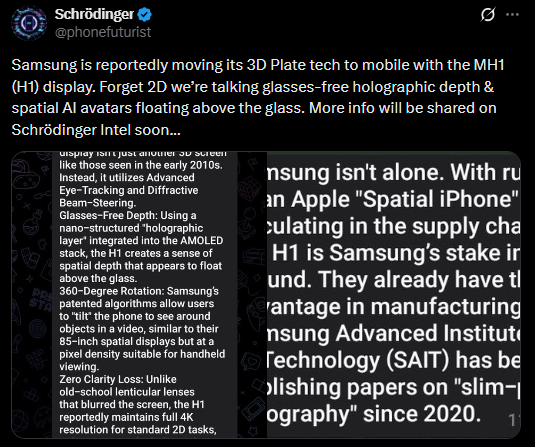
Still, the project is reportedly only in the first phase of research and development. Even the original leak suggests commercialization likely wouldn’t happen any time soon, assuming the technology actually reaches mass production at all.
That said, Samsung Display has a pretty strong history when it comes to pushing new panel technologies into the mainstream. The company played a major role in foldable OLED adoption and has already experimented with glasses-free 3D monitors and spatial displays in other categories. More recently, Samsung introduced hardware-level viewing angle control technology with the Galaxy S26 Ultra, and similar implementations are reportedly expected to appear in flagship phones from Xiaomi, Oppo, and Vivo later this year.
If something like MH1 eventually becomes real, it could open the door to much more immersive interfaces on phones, whether that’s floating UI elements, spatial gaming, or deeper integration with mixed reality ecosystems like Apple’s Vision Pro.
(Source: @phonefuturist)



Comments