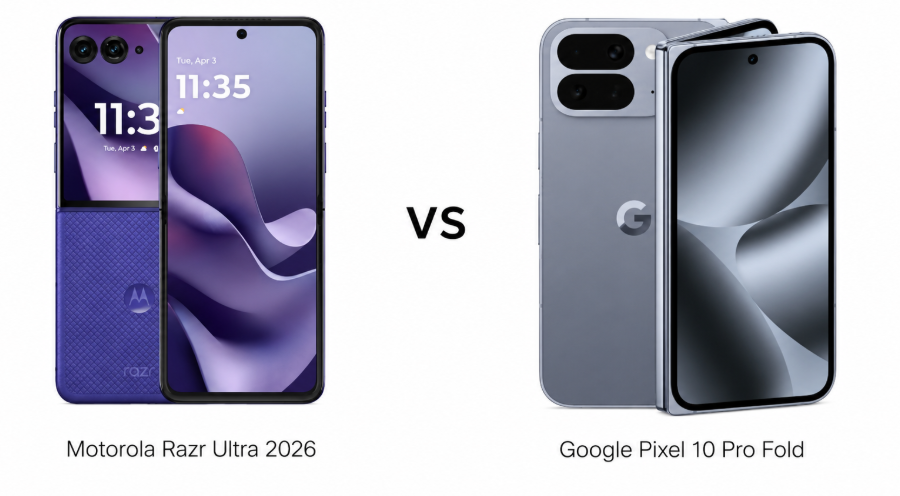
Foldable smartphones are evolving in two very different directions, and the Motorola Razr Ultra 2026 and Google Pixel 10 Pro Fold perfectly represent that split. One focuses on sleek portability, ultra-fast performance, and a stylish flip design, while the other aims to replace a tablet with a larger display, smarter AI features, and productivity-focused software. Both sit firmly in the premium flagship category, but they target completely different types of users.
Major Reason:
Feature
Motorola Razr Ultra 2026
Google Pixel 10 Pro Fold
Winner
Foldable Type
Clamshell foldable
Book-style foldable
Depends – Flip portability vs larger tablet-style experience
Main Display
7.0-inch LTPO AMOLED, 165Hz, 5000 nits
8.0-inch LTPO OLED, 120Hz, 3000 nits
Pixel – Larger inner display for multitasking
Cover Display
4-inch LTPO AMOLED, 165Hz
6.4-inch OLED, 120Hz
Pixel – Bigger and more practical outer screen
Peak Brightness
5000 nits
3000 nits
Motorola – Higher peak brightness
Refresh Rate
165Hz
120Hz
Motorola – Smoother animations and gaming
Resolution Density
~462 ppi
~374 ppi
Motorola – Sharper display
Protection
Gorilla Glass Ceramic
Gorilla Glass Victus 2
Pixel – Stronger overall protection
Water Resistance
IP48
IP68
Pixel – Better dust and water resistance
Chipset
Snapdragon 8 Elite
Tensor G5
Motorola – More powerful flagship chipset
RAM
16GB
16GB
Tie – Same RAM capacity
Storage Options
512GB
256GB / 512GB / 1TB
Pixel – More storage choices
Main Camera
50MP + 50MP ultrawide
48MP + 10.8MP telephoto + 10.5MP ultrawide
Pixel – More versatile triple-camera setup
Telephoto Camera
No
5x optical zoom
Pixel – Dedicated zoom lens
Video Recording
8K@30fps
4K@60fps
Motorola – Supports 8K recording
Selfie Camera
50MP
10MP + 10MP cover camera
Motorola – Higher-resolution selfie camera
Operating System
Android 16
Android 16 with 7 major upgrades
Pixel – Longer software support
Wi-Fi
Wi-Fi 7
Wi-Fi 7
Tie – Same connectivity standard
Bluetooth
5.4
6.0
Pixel – Newer Bluetooth version
USB Port
USB Type-C 2.0
USB Type-C 3.2
Pixel – Faster data transfer
Special Features
Dolby Vision, Pantone validation
UWB, Satellite SOS, Qi2
Pixel – More advanced ecosystem features
Battery
5000mAh
5015mAh
Pixel – Slightly larger battery
Wired Charging
68W
30W
Motorola – Much faster charging
Wireless Charging
30W
15W
Motorola – Faster wireless charging
Reverse Charging
5W reverse wired
Bypass charging
Depends – Reverse charging vs bypass charging
Approx Price
$1500 / ₹143000
$1800 / ₹160000
Motorola – Better value pricing
Disclaimer: Specs are based on available data. Actual performance may vary. Verify details from official sources before buying.
The Motorola Razr Ultra 2026 focuses on style and portability with its clamshell foldable design, aluminum frame, and slim folded profile. The external 4-inch display feels more practical than before, allowing quick replies, navigation, and media controls without unfolding the phone. Motorola’s Pantone-validated finish also gives the device a more premium and fashion-oriented character. Meanwhile, the Google Pixel 10 Pro Fold takes a book-style approach that feels closer to a compact tablet when opened. Its IP68 rating gives it stronger durability confidence, while the wider cover display feels more natural for everyday typing and multitasking.
Display Quality
Motorola clearly pushes visual quality harder with a 165Hz LTPO AMOLED panel and an extremely bright 5000-nit peak output. Animations feel smoother, and the outer display is one of the best on a flip foldable. The Pixel 10 Pro Fold counters with a much larger 8-inch OLED panel that is better suited for productivity, split-screen work, and entertainment. Google’s display feels more immersive for long sessions, even if the refresh rate is lower.
Verdict
The Razr Ultra 2026 feels more stylish and pocket-friendly, while the Pixel 10 Pro Fold feels more productivity-focused. Users wanting a futuristic flip experience may lean toward Motorola, but Google delivers the more practical large-screen foldable experience.
2. Specifications Including Battery
Performance
The Motorola Razr Ultra 2026 is powered by the Snapdragon 8 Elite chipset paired with 16GB RAM and UFS 4.0 storage, giving it flagship-level speed for gaming, multitasking, and AI-heavy workloads. The high refresh rate also makes the phone feel exceptionally fluid in daily use. Google’s Tensor G5 prioritizes AI features and software intelligence over raw benchmark performance. While gaming performance may not match Qualcomm’s latest flagship chip, Pixel-exclusive AI tools and seven years of Android upgrades add strong long-term value.
Battery and Charging
Battery capacity is nearly identical between the two devices, but Motorola gains a major advantage in charging speeds with 68W wired and 30W wireless charging. The Pixel 10 Pro Fold charges much more slowly at 30W wired and 15W wireless, though it adds Qi2 magnetic charging and bypass charging support. Motorola feels better suited for users constantly on the move, while Google focuses more on ecosystem convenience and battery management.
Verdict
The Razr Ultra 2026 delivers stronger raw performance and significantly faster charging, making it the better choice for power users. The Pixel 10 Pro Fold offers smarter software longevity and AI integration, which may matter more for users planning to keep a foldable for several years.
3. Camera
Main and Secondary Lenses
Motorola equips the Razr Ultra 2026 with dual 50MP cameras, including a high-resolution ultrawide lens that captures detailed landscape shots and vibrant colors. Dolby Vision recording and 8K video support also make the device attractive for content creators. However, the lack of a dedicated telephoto sensor limits long-range photography flexibility. The Pixel 10 Pro Fold takes a more balanced approach with a triple-camera setup featuring wide, ultrawide, and 5x telephoto lenses. Google’s computational photography tools such as Best Take and Zoom Enhance, continue to give Pixel devices a strong reputation for consistent image quality.
Selfie Camera
Motorola’s 50MP selfie camera delivers sharper detail and more flexibility for social media creators. The Pixel’s dual 10MP selfie setup is more practical for foldable usability, especially during video calls and cover-display shooting. Google still maintains excellent skin tones and HDR processing.
Verdict
The Pixel 10 Pro Fold feels more versatile overall thanks to its telephoto camera and advanced software processing. The Razr Ultra 2026 wins for selfie quality and video-focused features, making it appealing for users who prioritize content creation and social media photography.
4. Pricing
The Motorola Razr Ultra 2026 is expected to cost around $1500 (approximately ₹1,43,000), while the Google Pixel 10 Pro Fold is priced higher at roughly $1800 (around ₹1,60,000). That price gap creates a noticeable difference in value perception. Motorola delivers flagship hardware, a premium foldable display, fast charging, and top-tier performance at a comparatively lower cost. For users entering the foldable category, the Razr Ultra feels easier to justify financially.
Google positions the Pixel 10 Pro Fold as a premium productivity device with advanced AI tools, longer software support, and a more versatile camera system. The higher price partly reflects Google’s software ecosystem and foldable tablet-style experience. However, the slower charging and less powerful chipset may make the pricing harder to accept for spec-focused buyers.
Verdict
The Razr Ultra 2026 offers stronger hardware value for the money, especially for users focused on performance and charging speed. The Pixel 10 Pro Fold justifies its premium mainly through software intelligence, AI capabilities, and long-term update support.
Disclaimer: Prices are approximate and may vary based on country, region, launch timing, and applicable taxes. Always check whether the listed price is for a China unit or a global/international variant whenpurchasing.
5. Conclusion
The Motorola Razr Ultra 2026 stands out with its stylish flip-fold design, powerful Snapdragon 8 Elite chipset, ultra-smooth 165Hz displays, and very fast charging capabilities. It feels like a foldable designed for users who want flagship performance in a compact and fashionable form. The large external display also improves usability more than previous flip phones. On the other hand, the Google Pixel 10 Pro Fold focuses on productivity, AI-driven software experiences, and a larger inner display that works exceptionally well for multitasking and media consumption. Features like satellite SOS, UWB support, and seven years of Android upgrades strengthen its premium appeal.
Verdict
The Razr Ultra 2026 is the stronger choice for users prioritizing speed, design, portability, and charging performance. The Pixel 10 Pro Fold feels better suited for productivity-focused users who value AI features, camera versatility, and long-term software support. Both devices represent very different approaches to foldables, making the decision largely dependent on lifestyle and usage priorities.
Disclaimer: This comparison is based on the specifications provided and is intended for general informational purposes. Actual performance, camera results, battery life, and overall experience may vary depending on real-world usage, software updates, and individual preferences.
We use cookies on our website to give you the most relevant experience by remembering your preferences and repeat visits. By clicking “Accept”, you consent to the use of ALL the cookies.
This website uses cookies to improve your experience while you navigate through the website. Out of these, the cookies that are categorized as necessary are stored on your browser as they are essential for the working of basic functionalities of the website. We also use third-party cookies that help us analyze and understand how you use this website. These cookies will be stored in your browser only with your consent. You also have the option to opt-out of these cookies. But opting out of some of these cookies may affect your browsing experience.
Necessary cookies are absolutely essential for the website to function properly. This category only includes cookies that ensures basic functionalities and security features of the website. These cookies do not store any personal information.
Any cookies that may not be particularly necessary for the website to function and is used specifically to collect user personal data via analytics, ads, other embedded contents are termed as non-necessary cookies. It is mandatory to procure user consent prior to running these cookies on your website.


Comments