
Add GIZMOCHINA as Preferred Source on Google
The Snapdragon 8 Gen 5 is one of the most popular high-end smartphone chipsets right now. It’s packs a custom-designed Oryon CPU, a capable GPU that offers excellent gaming performance and stability, and modern connectivity features. Many of the camera capabilities have been borrowed from the top-tier 8 Elite Gen 5 SoC, which is also a big plus for the 8 Gen 5.
The Dimensity 9400 Plus, on the other hand, is a top-tier flagship chipset, but the fact that it’s priced around the same as Snapdragon 8 Gen 5 phones makes the battle more interesting. Let’s look at the benchmark scores, spec sheet, and crucial differences to figure out how these two flagship chips fare against each other.
Quick verdict:
– Choose Snapdragon 8 Gen 5 if you prioritize CPU performance, robust connectivity with higher 5G download speed and mmWave bands, and a premium ISP pipeline.
– Choose Dimensity 9400 Plus if you prioritize sustained gaming performance, faster Wi-Fi speeds, and longer phone-to-phone Bluetooth connections.
Snapdragon 8 Gen 5 vs Dimensity 9400 Plus: Spec sheet
| Snapdragon 8 Gen 5 | Dimensity 9400 Plus | |
|---|---|---|
| Announced | November 2025 | April 2025 |
| Process node | 3 nm (TSMC) | 3 nm (TSMC) |
| CPU | 2 × 3.8 GHz (Oryon Gen 3 – Prime) 6 × 3.32 GHz (Oryon Gen 3 – Performance) | 1 × 3.73 GHz (Cortex-X925) 3 × 3.3 GHz (Cortex-X4) 4 × 2.4 GHz (Cortex-A720) |
| GPU | Adreno 829 ray tracing support Snapdragon Elite Gaming features | Arm Immortalis-G925 MP12 ray tracing support MediaTek HyperEngine Adaptive Gaming Technology |
| NPU | Qualcomm Hexagon NPU Agentic AI support | MediaTek NPU 890 Agentic AI support |
| Memory | LPDDR5x, up to 4.8 GHz | LPDDR5x, up to 5.3 GHz |
| Storage | UFS 4.1 | UFS 4 + MCQ |
| Camera | Qualcomm Spectra triple AI ISP (20-bit) up to 320MP single camera up to 108MP single camera with zero shutter lag, 30fps up to 48MP triple cameras with zero shutter lag, 30fps up to 4K/120fps video recording real-time semantic segmentation (limitless) | MediaTek Imagiq 1090 ISP Up to 320MP single camera Up to 8K/60fps video recording real-time semantic segmentation Full range HDR zoom Gen-AI Telephoto |
| Connectivity | Snapdragon X80 5G modem download speed: up to 10 Gbps upload speed: up to 3.5 Gbps Wi-Fi 7 (peak speed: 5.8 Gbps) Bluetooth 6.0 | 3GPP Release-17 5G modem download speed: up to 7 Gbps Wi-Fi 7 (peak speed: 7.3 Gbps) Bluetooth 6.0 |
Snapdragon 8 Gen 5 vs Dimensity 9400 Plus: Benchmark score
Geekbench score
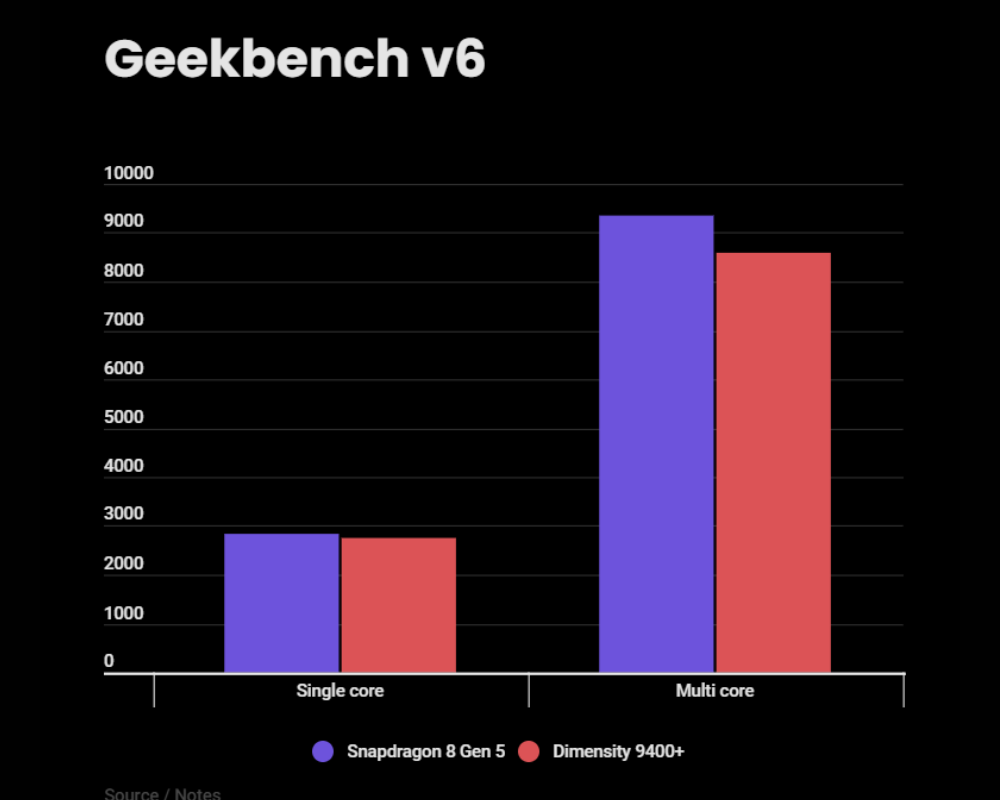
On Geekbench 6, the Snapdragon 8 Gen 5 pulls ahead in both single-core and multi-core tests, although the differences aren’t huge. The single-core score is up by 3%, and the multi-core score is 8% higher than that of the Dimensity 9400 Plus.
| Snapdragon 8 Gen 5 | Dimensity 9400 Plus | |
| Single core | 2,837 | 2,753 |
| Multi core | 9,352 | 8,590 |
AnTuTu score
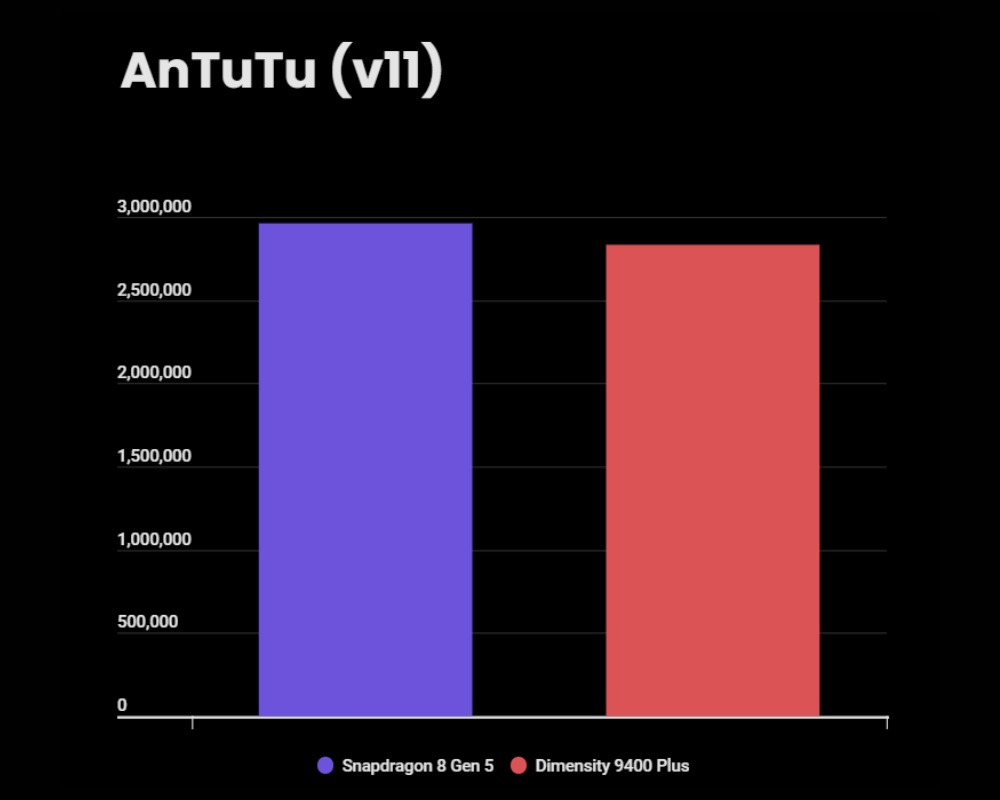
The Snapdragon 8 Gen 5 achieves about a 4% higher AnTuTu score than the Dimensity 9400 Plus. But this doesn’t offer much clarity unless you look at the breakdown of the total AnTuTu score.
| Snapdragon 8 Gen 5 | Dimensity 9400 Plus | |
| AnTuTu score | 2,961,236 | 2,832,547 |
| CPU | 914,878 | 853,898 |
| GPU | 974,402 | 1,012,010 |
| Memory | 382,729 | 377,443 |
| UX | 689,228 | 589,197 |
The Snapdragon chip still maintain an edge over the Dimensity 9400+ in CPU performance with a 7% higher score, but the GPU score favors the Dimensity chip, which gets about a 4% higher score.
Looking at the benchmark scores, the Snapdragon 8 Gen 5 feels like a more performance-friendly option, but that alone doesn’t tell the complete picture. One should also consider other key metrics, such as camera capabilities and connectivity upgrades, to make an informed decision.
Snapdragon 8 Gen 5 vs Dimensity 9400 Plus: Key differences
CPU, GPU, & NPU
Both chipsets feature an all-big-core CPU design, but differ notably in CPU clusters and peak performance. The Snapdragon 8 Gen 5 utilizes Qualcomm’s custom-designed Oryon CPU, featuring a ‘2+6’ configuration. This includes two prime cores and six performance cores.
The Dimensity 9400 Plus features a tiered ‘1+3+4’ CPU configuration, consisting of one Cortex-X925 prime core, three Cortex-X4 performance cores, and four Cortex-A720 performance cores. The CPU has a peak frequency of 3.73 GHz, while the Snapdragon 8 Gen 5 reaches 3.8 GHz. The latter also excels in higher speeds on secondary scores.
For gaming and other graphics-intensive tasks, the Snapdragon 8 Gen 5 features an Adreno 829 GPU with a full suite of Snapdragon Elite Gaming features, including Snapdragon Adaptive Performance Engine 4.0 and Qualcomm FPS 3.0, further optimizing game performance and power efficiency.
The Dimensity 9400 Plus uses a 12-core Arm Immortalis-G925 GPU, paired with many game-related features, including MediaTek Frame Rate Converter 2.0+ and MediaTek Adaptive Gaming Technology (MAGT) 3.0, to deliver excellent gaming performance and stability. MediaTek says the chip delivers PC-grade ray tracing capabilities.
Turning to AI capabilities, the Snapdragon 8 Gen 5 features an upgraded Hexagon NPU that delivers 46% faster performance than its predecessor (8 Gen 3). This is the first Qualcomm chip to embed hardware matrix acceleration into the Oryon CPU, enabling the CPU to execute matrix-intensive AI subtasks without offloading everything to the NPU. The 8 Gen 5 also supports contextually-aware agentic AI that can learn and adapt to offer personalized assistance.
The Dimensity chip features the MediaTek NPU 890, which supports new generative and agentic AI models. Specifically, it has full support for the DeepSeek-R1-Distill (1.5B/7B/8B) model with on-device processing.
Camera
The Snapdragon 8 Gen 5 inherits many of the camera capabilities from the top-tier 8 Elite Gen 5 chip. It includes a 20-bit Triple AI ISP, up to 320MP camera support, and 4K video recording at 120fps. On top of a robust ISP pipeline, the chip uses AI to process data frame by frame in real time for accurate optimizations. The chip also supports real-time tone control, Night Vision 3.0 for low-light environments, and Snapdragon Audio Sense for HDR audio recording without noise.
In contrast, the Dimensity 9400 Plus features an Imagiq 1090 ISP that promises to offer “DSLR-like experience.” It also supports up to 320MP camera resolution and 4K video recording at 120fps, and adds features such as Full-range HDR zoom, Gen-AI Telephoto, and Lightning Snapshot Camera.
Connectivity
While both chipsets offer cutting-edge connectivity features, there are several key differences worth paying attention to. The Snapdragon 8 Gen 5 supports both sub-6GHz and mmWave bands, but the Dimensity 9400 Plus focuses primarily on sub-6GHz. The official product page doesn’t mention mmWave support.
The Snapdragon chip also has an edge in peak download speed, supporting up to 10Gbps, while the Dimensity 9400 Plus can reach up to 7Gbps on a 5G connection. On Wi-Fi connection, though, the Dimensity chip offer a higher peak speed of 7.3Gbps (vs. 5.8Gbps on the 8 Gen 5).
The Snapdragon 8 Gen 5 natively integrates Ultra Wideband (UWB) along with AI-powered proximity solutions to help you find lost items. It also integrates many features to improve the connectivity stability and power efficiency. The Dimensity chip also includes many connectivity enhancements, including Triple Band Triple Concurrency and phone-to-phone Bluetooth connections up to 10km.


Comments