
Add GIZMOCHINA as Preferred Source on Google
MediaTek has completely transformed its Dimensity lineup, and the new Dimensity 9500 proves it. The latest Dimensity flagship goes toe-to-toe with the absolute best from Qualcomm and Apple. On the flip side, while Samsung’s Exynos line has historically struggled, the Exynos 2600 feels like a massive leap forward rather than just another boring annual refresh.
The Exynos 2600 is the company’s first smartphone processor to feature an “all-big” CPU design, allowing the chip to unlock higher performance. It’s also the world’s first smartphone chipset fabricated using a 2nm process, further adding to performance and efficiency. Historically, MediaTek chips have outperformed Exynos chips, but this time, the battle looks more intense.
Let’s compare them to see whether the advanced node and all-big CPU design can help the Exynos 2600 beat MediaTek’s rival, the Dimensity 9500.
Here’s the spec sheet to begin with:
| Dimensity 9500 | Exynos 2600 | |
|---|---|---|
| Announced | September 2025 | December 2025 |
| Process node | 3nm (TSMC) | 2nm (Samsung) |
| CPU cores | 8-core | 10-core |
| CPU configuration | 1 x 4.21 GHz (C1-Ultra) 3 x 3.5 GHz (C1-Premium) 4 x 2.7 GHz (C1-Pro) | 1 x 3.8 GHz (C1-Ultra) 3 x 3.25 GHz (C1-Pro) 6 x 2.75 GHz (C1-Pro) |
| GPU | Immortalis Mali-G1 Ultra MP12 ray tracing support MediaTek HyperEngine Gaming Technology | Exynos Xclipse 960 GPU ray tracing support Exynos Neural Super Sampling Heat Path Block (HPB) |
| NPU | MediaTek NPU 990 | AI engine with 32K MAC NPU |
| Memory | LPDDR5X, up to 5.3 GHz | LPDDR5X |
| Storage | UFS 4.1 | UFS 4.1 |
| Camera | MediaTek Imagiq 1190 ISP up to 320MP single camera up to 8K video recording real-time semantic segmentation support | up to 320MP single camera up to 108MP single camera (30fps) up to 64MP+32MP dual cameras (30fps) up to 8K video recording real-time semantic segmentation support |
| Connectivity | integrated 5G modem (3GPP R17) download speed: up to 7.4 Gbps Wi-Fi 7 (peak speed: 7.3 Gbps) Bluetooth 6.0 | Exynos 5410 modem download speed: up to 14.79 Gbps upload speed: up to 4.9 Gbps Wi-Fi 7 Bluetooth 6.0 |
Dimensity 9500 vs Exynos 2600: Benchmark numbers
Note: To obtain the benchmark results, the tests were performed using these devices:
– Vivo X300 Pro (Dimensity 9500)
– Galaxy S26 Plus (Exynos 2600)
Geekbench score
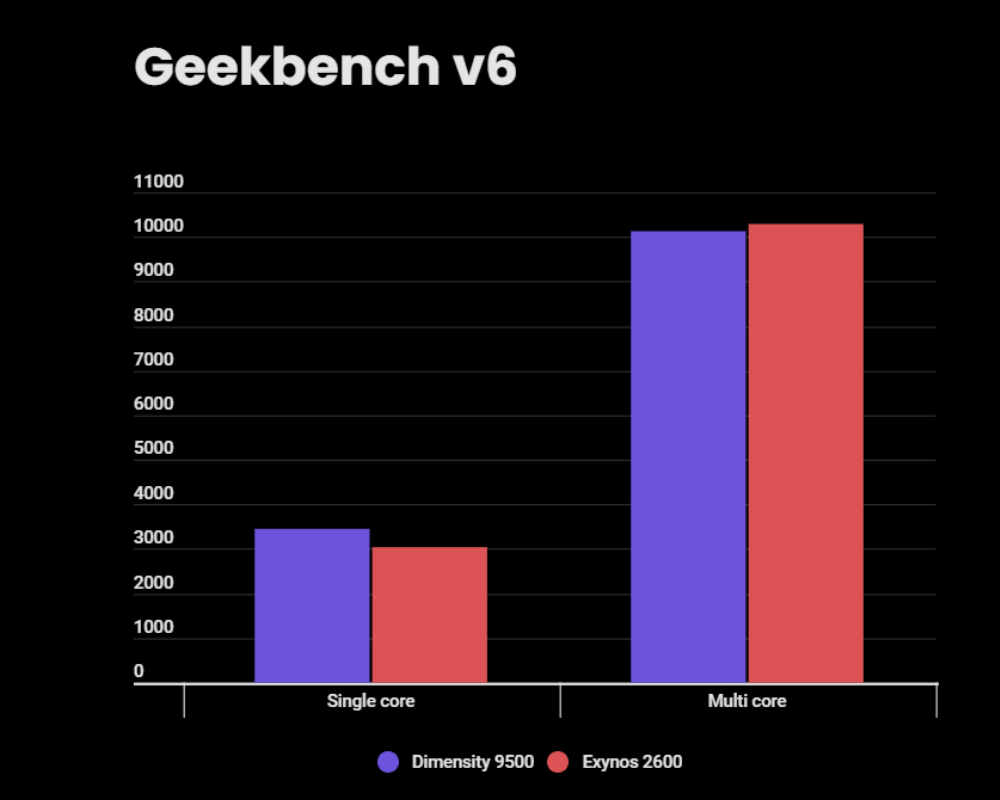
In the Geekbench 6 CPU test, the Dimensity 9500 achieves a 13% higher single-core score. In the multi-core test, however, the Exynos 2600 is ahead, but the gap is just too small to create a major difference.
| Dimensity 9500 | Exynos 2600 | |
| Single core | 3,452 | 3,040 |
| Multi core | 10,128 | 10,290 |
AnTuTu score
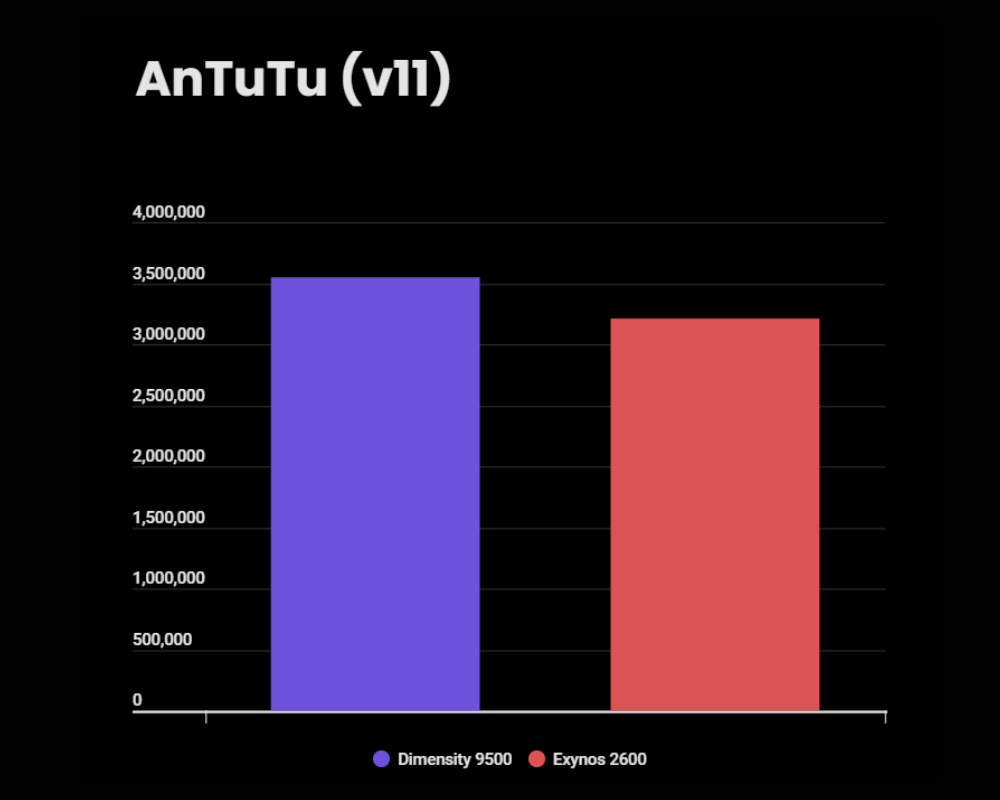
The Dimensity 9500 puts up a strong total on AnTuTu, scoring over 3.5 million points, whereas the Exynos 2600 scores 3.2 million points. While it shows the Dimensity chip is stronger, it’s the breakdown of the AnTuTu score that offers more clarity.
The all-big 10-core CPU on the Exynos chip gets about 3.6% higher AnTuTu score than the Dimensity 9500’s 8-core CPU. However, the latter bounces back strongly in the GPU test with a 16% higher score.
| Dimensity 9500 | Exynos 2600 | |
| AnTuTu score | 3,548,426 | 3,210,573 |
| CPU | 1,028,694 | 1,065,772 |
| GPU | 1,413,659 | 1,212,568 |
| Memory | 385,723 | 413,700 |
| UX | 720,349 | 518,533 |
3DMark score
Wild Life Extreme Test
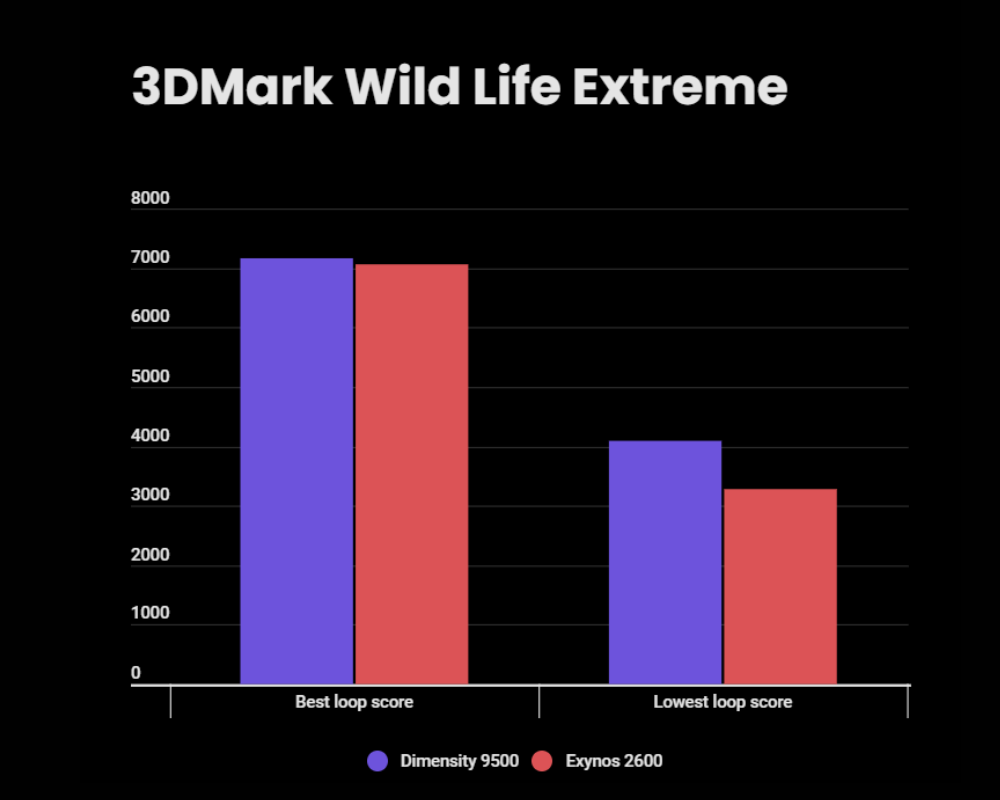
The 3DMark benchmark also confirms that the Dimensity 9500 has a more powerful GPU. There isn’t a big difference in the best loop score, but the Dimensity chip has a much better lowest loop score. This means higher gaming stability on the Dimensity 9500-powered smartphone.
| Dimensity 9500 | Exynos 2600 | |
| Best loop score | 7,163 | 7,061 |
| Lowest loop score | 4,092 | 3,280 |
| Stability | 57% | 46.4% |
In all benchmark tests we’ve run so far, the Dimensity 9500 is more powerful than the Exynos 2600. But there’s more than just the performance. It’s also important to understand the differences in camera capabilities, connectivity, and other key aspects.
Dimensity 9500 vs Exynos 2600: Key differences that matter
Performance
CPU
The Dimensity 9500 utilizes TSMC’s cutting-edge 3nm node, whereas the Exynos 2600 is manufactured using Samsung’s 2nm process. Besides, their CPU configurations also differ. The Dimensity chip has an 8-core layout, featuring one C1-Ultra, three C1-Premium, and four C1-Pro cores.
In contrast, the Exynos 2600 has two additional CPU cores but skips the C1-Premium cores. The 10-core setup includes one C1-Ultra, three C1-Pro, and six C1-Pro cores.
Even with fewer CPU cores, the Dimensity 9500 outperforms the Exynos 2600 in some benchmark tests. That’s because of higher clock speeds and the performance-friendly C1-Premium cores.
GPU
The Dimensity 9500 features a 12-core Mali-G1 Ultra graphics unit, offering superior performance and stability compared to the Xclipse 960 GPU on the Exynos 2600. But when it comes to ray tracing performance, the Exynos chip shines.
The Dimensity chip is widely praised for cooler thermals. On the other hand, Exynos chips have faced major overheating issues, but the latest Exynos 2600 dramatically improves this by introducing the Heat Path Block (HPB). It’s a hardware component located directly over the hottest areas of the main processing unit.
Furthermore, the Dimensity 9500 offers a full suite of MediaTek HyperEngine Gaming Technology, improving latency, frame rates, and power consumption. The Exynos chip benefits from Samsung’s partnership with AMD, which focuses on optimizing game engines like Unity and Unreal for this architecture.
NPU
The Dimensity 9500 comes with an upgraded MediaTek NPU 990 with agentic AI capabilities. MediaTek says it’s twice as powerful as the previous generation, with 56% better power efficiency, and is designed to handle complex, multi-step tasks in the background. The new NPU can generate 4K images from text.
The Exynos 2600 also brings major NPU upgrades compared to the Exynos 2500, including 113% faster generative AI performance and significantly reduced power consumption and latency. The NPU also helps with resolution upscaling and frame generation.
Camera
Both chipsets boast high-end camera features, but there are several key things to note. The Dimensity 9500 integrates an NPU-assisted 30fps focus-tracking engine, ensuring a clear shot in every frame. It also has a powerful denoise technology for 200MP photo captures.
The Exynos 2600 focuses on real-time element recognition and severe low-light optimization, backed by its on-device AI enhancements. It integrates an AI-based Visual Perception System (VPS) that allows the ISP to recognize detailed elements within images and videos in real time.
The Exynos chip also features Deep Learning Video Noise Reduction (DVNR) to enhance clarity in low-light conditions and supports the Advanced Professional Video (APV) codec.
Connectivity
The Dimensity 9500 has an integrated 5G modem, whereas the Exynos 2600 relies on a separate, external component for connectivity. Both chips offer robust, modern connectivity features, but there’s a big difference in the download speed.
On a 5G connection, the Dimensity chip can reach up to 7.4Gbps of download speed, while the Exynos chip can reach 2X of that, up to 14.79Gbps. The Dimensity chip excels in peak Wi-Fi 7 speeds, offering up to 7.3Gbps (versus 4.9Gbps on the Exynos 2600).




Comments