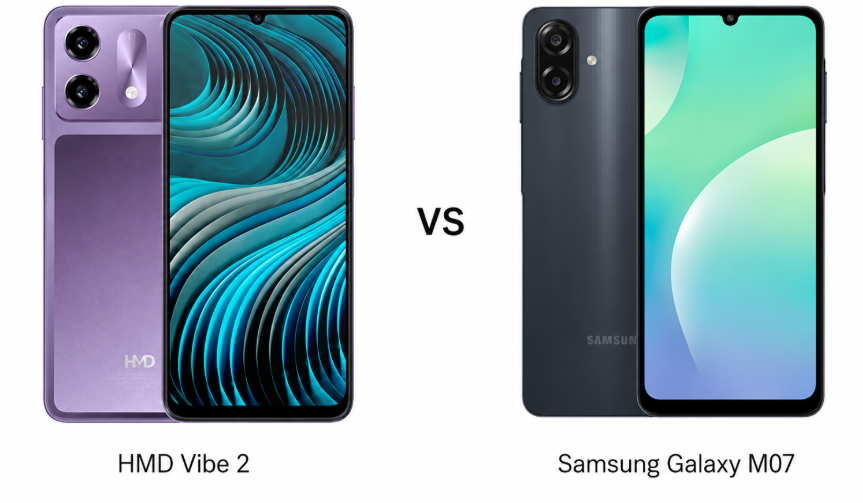
Budget smartphones are becoming far more competitive in 2026, and the HMD Vibe 2 vs Samsung Galaxy M07 comparison proves just how much buyers can now expect under ₹12,000. One phone focuses on delivering a smoother entertainment experience with a massive battery and 120Hz display, while the other leans toward long-term reliability, software support, and overall value. Both devices target users who want solid everyday performance without stretching their budget too far, but their priorities feel completely different once the real-world experience is considered.
Major Features:
Feature
HMD Vibe 2
Samsung Galaxy M07
Winner
Display
6.75-inch IPS LCD, 120Hz
6.7-inch PLS LCD, 90Hz
HMD Vibe 2 – Smoother scrolling and gaming experience
Resolution
720 × 1600 pixels
720 × 1600 pixels
Tie – Similar sharpness and clarity
Processor
Unisoc T8200
MediaTek Helio G99
Galaxy M07 – More stable and proven real-world performance
RAM & Storage
Up to 6GB RAM, 128GB storage
4GB RAM, 64GB storage
HMD Vibe 2 – More memory and storage flexibility
Software
Android 16
Android 15 with 6 major updates
Galaxy M07 – Excellent long-term software support
Main Camera
50MP dual camera
50MP dual camera with PDAF
Galaxy M07 – Better image processing and focus performance
Selfie Camera
8MP
8MP
Galaxy M07 – More balanced selfie tuning
Battery
6000mAh
5000mAh
HMD Vibe 2 – Longer battery endurance
Charging
18W wired
25W wired
Galaxy M07 – Faster charging speeds
Build Features
Plastic body
IP54 splash resistance
Galaxy M07 – Better durability for daily use
Audio Jack
Yes
Yes
Tie – Both retain the 3.5mm headphone jack
Expandable Storage
microSD support
Dedicated microSD slot
Galaxy M07 – Dedicated slot is more convenient
Connectivity
Bluetooth 5.0
Bluetooth 5.3
Galaxy M07 – Newer wireless connectivity
Price
Priced around ₹11,000
Priced around ₹7,500
Galaxy M07 – Much stronger value for money
Overall Experience
Entertainment-focused
Balanced and practical
Galaxy M07 – Better overall package for most buyers
Disclaimer: Specs are based on available data. Actual performance may vary. Verify details from official sources before buying.
The HMD Vibe 2 and Samsung Galaxy M07 both target budget buyers, but they approach design differently. The HMD Vibe 2 feels more rugged with its thicker frame and larger battery-focused build. It has a simple plastic construction with a side-mounted fingerprint sensor and a practical layout that suits users who prefer durability over slim styling. The Samsung Galaxy M07, meanwhile, looks cleaner and slightly more modern thanks to its slimmer body and IP54 splash resistance. That added protection gives it a more reliable everyday feel, especially for users who travel frequently or use their phone outdoors often.
Display Quality
HMD offers a 120Hz IPS LCD panel, which immediately feels smoother while scrolling social media or gaming. Animations appear more fluid, and the higher refresh rate adds extra polish despite the HD+ resolution. Samsung counters with a 90Hz PLS LCD panel that delivers decent brightness and balanced colors, though it does not feel as responsive as the Vibe 2. Samsung’s display tuning still feels slightly more refined for casual streaming and general use.
Verdict
The HMD Vibe 2 wins for smoother visuals and a more entertainment-focused display experience, while the Galaxy M07 feels more polished and practical for daily handling.
2. Specifications Including Battery
Performance
The HMD Vibe 2 is powered by the newer Unisoc T8200 chipset, paired with up to 6GB RAM. Day-to-day performance feels surprisingly solid for the price, especially during multitasking and casual gaming. Apps open quickly, and the 120Hz display helps the phone feel faster than its hardware might suggest. Samsung uses the MediaTek Helio G99, which remains one of the strongest chipsets in the budget segment. It delivers stable gaming performance and dependable thermal management, making it more consistent during longer gaming sessions. Samsung also has a major advantage with six Android upgrades, which adds long-term value rarely seen at this price.
Battery and Charging
The HMD Vibe 2 packs a huge 6000mAh battery that comfortably lasts beyond a full day. Heavy users will appreciate the extra endurance, especially for streaming or gaming. However, its 18W charging feels slow by current standards. The Galaxy M07 uses a smaller 5000mAh battery but supports faster 25W charging, making quick top-ups more convenient during busy days.
Verdict
The HMD Vibe 2 feels stronger for battery-focused users, while the Galaxy M07 delivers a better balance of stable performance, software longevity, and faster charging.
3. Camera
Main and Secondary Lenses
Both phones feature a 50MP primary camera, but Samsung appears slightly more refined in image processing. The Galaxy M07 captures more balanced colors and better dynamic range in daylight shots. Details remain sharp enough for social media uploads, and Samsung’s tuning helps photos look more natural without appearing overly processed. The HMD Vibe 2 performs reasonably well in bright lighting and can capture decent detail, but color consistency occasionally feels less polished. Its secondary camera setup also feels more basic overall.
Low-light photography is limited on both devices, which is expected at this price range. Still, Samsung manages shadows and highlights slightly better, making nighttime images look cleaner in comparison.
Selfie Camera
Both smartphones include an 8MP selfie camera capable of handling video calls and casual selfies. Samsung again delivers more balanced skin tones and slightly sharper edge detection. The HMD Vibe 2 keeps selfies softer, though some users may prefer that smoother look for social sharing.
Verdict
The Galaxy M07 takes the lead in overall camera consistency and image tuning, while the HMD Vibe 2 remains good enough for casual photography and everyday content creation.
4. Pricing
The HMD Vibe 2 is priced around ₹11,000 ($130), placing it in the upper budget category. For that price, buyers get a large 6000mAh battery, a 120Hz display, and more RAM options. It clearly focuses on users who want a feature-packed experience without spending too much. The Samsung Galaxy M07 is priced around ₹7,500 ($80), making it significantly cheaper while still offering a capable Helio G99 chipset, IP54 protection, and Samsung’s excellent software support policy.
Is the Price Justified?
The HMD Vibe 2 feels justified for buyers who prioritize battery life and smoother display performance. It offers a more premium experience in a few noticeable areas despite the higher cost. The Galaxy M07, however, stands out as one of the stronger value-for-money options in the entry-level market. Samsung’s long-term software support alone adds surprising value at this price point.
Verdict
The Galaxy M07 delivers stronger overall value for budget-conscious buyers, while the HMD Vibe 2 feels worth paying extra for users who care more about display smoothness and battery endurance.
Disclaimer: Prices are approximate and may vary based on country, region, launch timing, and applicable taxes. Always check whether the listed price is for a China unit or a global/international variant when purchasing
5. Conclusion
The HMD Vibe 2 focuses on delivering a big-battery entertainment experience with its 120Hz display and larger power capacity. It feels designed for users who spend long hours gaming, streaming, or scrolling through social apps. The Galaxy M07 takes a more balanced approach by combining stable performance, cleaner software support, IP54 protection, and faster charging at a much lower price. Samsung’s long update commitment also makes the device feel more future-ready than most phones in this segment.
Both phones succeed in different areas, which makes the comparison more interesting than expected. The HMD Vibe 2 feels more exciting on paper, especially for multimedia users, while the Galaxy M07 quietly delivers a smarter long-term package for everyday buyers.
Verdict
Choose the HMD Vibe 2 for battery life, smoother visuals, and a more entertainment-focused experience. Choose the Samsung Galaxy M07 for better overall value, software longevity, balanced cameras, and dependable everyday usability.
Disclaimer: This comparison is based on the specifications provided and is intended for general informational purposes. Actual performance, camera results, battery life, and overall experience may vary depending on real-world usage, software updates, and individual preferences.
We use cookies on our website to give you the most relevant experience by remembering your preferences and repeat visits. By clicking “Accept”, you consent to the use of ALL the cookies.
This website uses cookies to improve your experience while you navigate through the website. Out of these, the cookies that are categorized as necessary are stored on your browser as they are essential for the working of basic functionalities of the website. We also use third-party cookies that help us analyze and understand how you use this website. These cookies will be stored in your browser only with your consent. You also have the option to opt-out of these cookies. But opting out of some of these cookies may affect your browsing experience.
Necessary cookies are absolutely essential for the website to function properly. This category only includes cookies that ensures basic functionalities and security features of the website. These cookies do not store any personal information.
Any cookies that may not be particularly necessary for the website to function and is used specifically to collect user personal data via analytics, ads, other embedded contents are termed as non-necessary cookies. It is mandatory to procure user consent prior to running these cookies on your website.


Comments