As an Amazon Associate, Gizmochina earns from qualifying purchases. Links on this page may earn us a commission at no extra cost to you.
DJI has been ruling the pocket camera market with almost no real competition. Its Osmo Pocket series has become the go-to tool for vloggers, travelers, and content creators who want smooth, high-quality video in a compact package.
Now, Insta360 wants a share of that market, and its latest attempt at it is the new Insta360 Luna Ultra. Announced recently, the camera directly targets Osmo Pocket users. Here’s everything you need to know about how these two cameras stack up.
Before diving into the details, let’s quickly explain what each camera is.
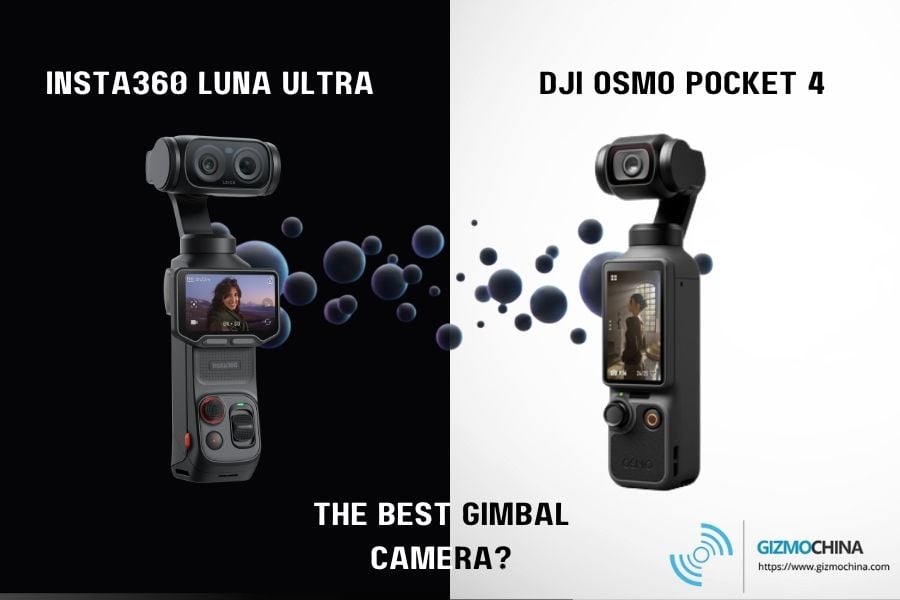
The DJI Osmo Pocket 4 is DJI’s latest compact gimbal camera. It sits on a small handheld stick with a motorized gimbal that keeps footage smooth and stable, even while you are walking or moving. It has a built-in touchscreen and is designed for people who want to shoot great video without carrying heavy gear.
Insta360 Luna UltraDJI Osmo Pocket 4
The Insta360 Luna Ultra is Insta360’s answer to that, and then some. It is the company’s first dedicated gimbal camera made in partnership with the famous camera brand Leica. Insta360 says this camera is not just another pocket camera. It is a step up in almost every way, designed for creators who want more power, more flexibility, and better image quality.
Both cameras follow a similar design. They have a small body with a gimbal camera on top. But the Luna Ultra adds some clever tricks.
The Luna Ultra features a detachable 2-inch OLED touchscreen. What makes this special is that you can remove the screen and use it as a remote control from up to 20 metres away. This is a huge deal for solo creators who film themselves. Instead of walking back to check your framing every few minutes, you can just glance at the remote in your hand.
The Osmo Pocket 4 also has a 2-inch OLED screen, but it stays fixed to the camera body. It can flip between horizontal and vertical orientations, which is handy for quickly switching between landscape and portrait video.
Both cameras are compact and lightweight enough to slip into a pocket or bag. The Luna Ultra weighs just over 200 grams. Neither camera is bulky, which is the whole point of this category.
2. Camera Specs and Video Quality
The Luna Ultra is built around a 1-inch sensor that can shoot 8K video at 30 frames per second. It has two lenses: a wide-angle lens with an f/1.8 aperture (which means it performs well in low light) and a dedicated telephoto lens with up to 12x zoom, including 6x lossless zoom.
It also supports Dolby Vision recording, 10-bit video capture, and up to 14 stops of dynamic range, meaning it captures a lot of detail in both bright and dark areas of a scene.
The Leica partnership also means the Luna Ultra benefits from Leica’s color science, which is known for producing natural, accurate, and beautiful colors.
The DJI Osmo Pocket 4 is also a capable camera, built on DJI’s years of experience in this space. It is a strong performer with its own stabilization and image processing technology. However, the standard Osmo Pocket 4 uses a single camera lens, while the Luna Ultra comes with a dual-lens system as standard.
It is worth noting that DJI is expected to release a Pocket 4 Pro with a dual-lens system in the coming weeks, which would make the comparison more direct. But right now, the Luna Ultra already has the dual-camera advantage.
3. AI and Tracking Features
The Luna Ultra uses Deep Track 5.0, Insta360’s subject-tracking technology. This lets the camera automatically follow a person or object as they move through the frame. It also supports features like Active Zoom Tracking and Smart Framing, which adjusts the composition of your shot automatically.
The Osmo Pocket 4 uses DJI’s ActiveTrack system, which is also well-regarded and has been refined through several generations of DJI products. Both systems work in a similar way. You point the camera at your subject, tap to lock on, and the camera will keep them in frame as they move.
Moreover, the Luna Ultra has built-in wireless microphone integration, which means it is designed from the ground up to work seamlessly with wireless mics.
4. Storage and Battery
The Luna Ultra comes with 47GB of internal storage and supports microSD cards up to 1TB. Insta360 claims the battery can last up to four hours.
The Pocket 4 has 107GB of actual useable storage, while also supporting a 1TB microSD card. The battery can last about four hours, like Luna Ultra.
5. Availability
The Luna Ultra is available right now, priced at $769 in the US, and comes in white or black.
The DJI Osmo Pocket 4, on the other hand, is not officially on sale in the US. In December 2025, the FCC (the US body that regulates electronics) blocked DJI from receiving equipment authorization. This means DJI cannot officially sell new products in the United States. US consumers who want a Pocket 4 would need to buy it through unofficial channels, which means no full warranty or ecosystem support.
This is a massive opening for Insta360. With DJI effectively blocked in the US, the Luna Ultra steps into a market with very little competition at this price point.
Outside the US, the Pocket 4 launched at around £445 in the UK, and DJI still has a strong presence in many global markets. But for US-based creators, the Luna Ultra is clearly the more practical and sensible choice right now.
For more daily updates, please visit our News Section.
We use cookies on our website to give you the most relevant experience by remembering your preferences and repeat visits. By clicking “Accept”, you consent to the use of ALL the cookies.
This website uses cookies to improve your experience while you navigate through the website. Out of these, the cookies that are categorized as necessary are stored on your browser as they are essential for the working of basic functionalities of the website. We also use third-party cookies that help us analyze and understand how you use this website. These cookies will be stored in your browser only with your consent. You also have the option to opt-out of these cookies. But opting out of some of these cookies may affect your browsing experience.
Necessary cookies are absolutely essential for the website to function properly. This category only includes cookies that ensures basic functionalities and security features of the website. These cookies do not store any personal information.
Any cookies that may not be particularly necessary for the website to function and is used specifically to collect user personal data via analytics, ads, other embedded contents are termed as non-necessary cookies. It is mandatory to procure user consent prior to running these cookies on your website.