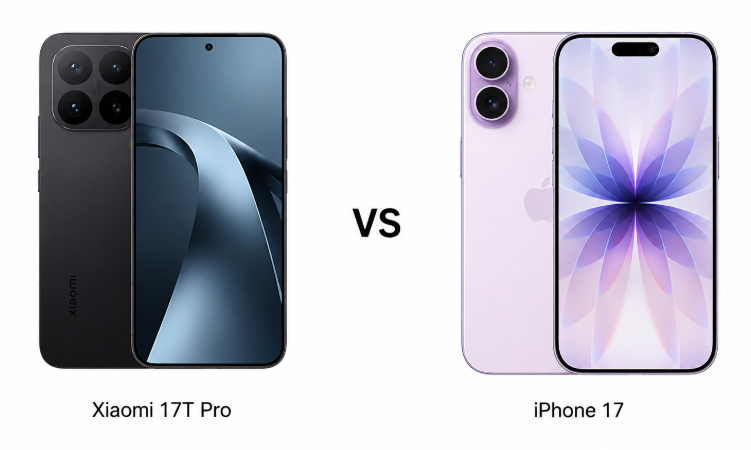
Xiaomi 17T Pro and iPhone 17 represent two very different visions of a modern flagship smartphone. One focuses on delivering cutting-edge hardware, massive battery life, and feature-packed specifications, while the other relies on refined software, ecosystem integration, and Apple’s signature user experience. With both devices competing in a similar price range, the real question is whether premium hardware or polished optimization offers the better overall value.
Major Features:
Category
Xiaomi 17T Pro
iPhone 17
Winner
Build Quality
Gorilla Glass 7i
Ceramic Shield 2
Apple – Tougher screen protection
Display
144Hz AMOLED
120Hz LTPO OLED
Xiaomi – Smoother and more feature-rich panel
Brightness
3500 nits peak
3000 nits peak
Xiaomi – Higher peak brightness
Performance
Dimensity 9500
A19
Apple – Better optimization and efficiency
RAM
Up to 16GB
8GB
Xiaomi – More multitasking headroom
Storage
Up to 1TB
Up to 512GB
Xiaomi – Higher storage option
Main Camera
50MP Wide
48MP Wide
Xiaomi – Larger sensor advantage
Zoom Camera
50MP 5x Periscope
No dedicated telephoto
Xiaomi – Dedicated optical zoom lens
Ultrawide Camera
12MP
48MP
Apple – Higher-resolution ultrawide shots
Selfie Camera
32MP
18MP AF Camera
Apple – Better autofocus and consistency
Video Recording
8K, Log Recording
Dolby Vision 4K
Tie – Different strengths for creators
Battery
7000mAh
3692mAh
Xiaomi – Much larger battery capacity
Wired Charging
100W
Fast Charging
Xiaomi – Significantly faster charging
Wireless Charging
50W
25W MagSafe
Xiaomi – Faster wireless charging
Biometrics
Fingerprint Scanner
Face ID
Apple – More seamless authentication
Connectivity
IR Blaster
UWB, Satellite Features
Apple – More advanced connectivity tools
Audio
Hi-Res Audio, Dolby Atmos
Stereo Speakers
Xiaomi – Richer audio feature set
Software
Android 16, HyperOS 3
iOS 26
Apple – Better ecosystem integration
Value for Money
Priced around ₹75,000
Priced around ₹83,000
Xiaomi – More flagship hardware for less money
Disclaimer: Specs are based on available data. Actual performance may vary. Verify details from official sources before buying.
The Xiaomi 17T Pro and iPhone 17 approach design from different directions. Xiaomi focuses on a premium flagship experience with Gorilla Glass 7i protection on both sides, an aluminum frame, and an IP68 rating for dust and water resistance. The phone also includes an under-display fingerprint scanner, dual SIM flexibility, and an infrared blaster. The iPhone 17 counters with Ceramic Shield 2 protection, an aluminum frame, IP68 certification, Face ID, satellite communication features, and Apple’s tightly integrated hardware ecosystem. Xiaomi feels more feature-packed, while Apple’s design philosophy prioritizes simplicity and consistency.
Display Quality
Xiaomi delivers a large AMOLED panel with a 144Hz refresh rate, Dolby Vision, HDR10+, extremely high peak brightness, and 3840Hz PWM dimming. The iPhone 17 offers a smaller LTPO Super Retina XDR OLED display with adaptive 120Hz refresh rate, excellent color accuracy, HDR support, and an anti-reflective coating. Xiaomi’s display appears more impressive on paper, especially for gaming and multimedia, while Apple’s panel often provides a more refined and natural viewing experience.
Verdict
The Xiaomi 17T Pro wins on display specifications and feature richness. The iPhone 17 remains appealing for users who prefer a cleaner interface and Apple’s polished display tuning.
2. Specifications Including Battery
Performance
The Xiaomi 17T Pro is powered by the MediaTek Dimensity 9500 chipset paired with up to 16GB RAM and UFS 4.1 storage. This combination is designed for demanding gaming, multitasking, and long-term performance. The iPhone 17 uses Apple’s A19 processor with 8GB RAM and NVMe storage. Despite having less RAM, Apple’s optimization allows apps and games to run exceptionally smoothly. Xiaomi offers greater hardware flexibility, while Apple continues to maximize efficiency through software and hardware integration.
Battery and Charging
Battery capacity is a major advantage for Xiaomi. Its massive 7000mAh silicon-carbon battery is paired with 100W wired charging and 50W wireless charging, making battery anxiety almost irrelevant. The iPhone 17 features a 3692mAh battery with fast wired charging and 25W MagSafe wireless charging. Apple’s efficiency helps extend endurance, but Xiaomi’s battery and charging hardware operate on an entirely different level. Frequent travelers and heavy users are likely to appreciate the extra convenience.
Verdict
The Xiaomi 17T Pro delivers stronger specifications overall, particularly in battery technology, charging speed, and memory options. The iPhone 17 excels through optimization but trails in raw hardware value.
3. Camera
Main and Secondary Lenses
The Xiaomi 17T Pro features a versatile triple-camera system consisting of a 50MP main sensor, a 50MP periscope telephoto camera with 5x optical zoom, and a 12MP ultrawide lens. Leica tuning, advanced HDR processing, 8K recording, and professional video modes add further appeal. The iPhone 17 uses a dual-camera setup with 48MP main and 48MP ultrawide sensors. Apple’s image processing consistently delivers natural colors, excellent dynamic range, and reliable video quality. However, the absence of a dedicated telephoto camera limits its flexibility compared to Xiaomi.
Selfie Camera
Xiaomi includes a 32MP front camera capable of 4K recording and HDR10+ support. The iPhone 17’s front camera benefits from autofocus, Dolby Vision HDR recording, and Face ID hardware. While Xiaomi provides higher resolution, Apple continues to lead in selfie video consistency and ecosystem integration.
Verdict
The Xiaomi 17T Pro offers greater photographic versatility thanks to its dedicated periscope zoom lens and advanced video features. The iPhone 17 remains a strong choice for users who prioritize reliable point-and-shoot results and industry-leading video processing.
4. Pricing
The Xiaomi 17T Pro is priced around ₹75,000, while the iPhone 17 is priced around ₹83,000. Despite costing less, Xiaomi offers a larger and faster display, a significantly bigger battery, faster wired and wireless charging, more RAM options, and a dedicated telephoto camera. On pure hardware specifications, the Xiaomi package appears exceptionally aggressive for its price segment.
The iPhone 17 commands a higher price largely because of Apple’s ecosystem, long-term software support, strong resale value, and seamless integration with other Apple devices. For users already invested in Apple services, the premium may feel justified. However, buyers focused strictly on specifications and features will likely find Xiaomi’s offering more compelling.
Verdict
From a value-for-money perspective, the Xiaomi 17T Pro provides more flagship hardware while costing less. The iPhone 17 justifies its price primarily through ecosystem advantages and software experience rather than raw specifications.
Disclaimer: Prices are approximate and may vary based on country, region, launch timing, and applicable taxes. Always check whether the listed price is for a China unit or a global/international variant when purchasing.
5. Conclusion
The Xiaomi 17T Pro stands out with its 144Hz AMOLED display, 7000mAh silicon-carbon battery, 100W charging, Leica-tuned cameras, 5x periscope zoom lens, and higher RAM configurations. These features make it particularly attractive for gamers, power users, and photography enthusiasts seeking maximum hardware value.
The iPhone 17 differentiates itself through the A19 chip, Face ID, satellite connectivity, Apple Pay integration, long software support, and seamless interaction with the broader Apple ecosystem. The overall experience feels highly polished, with optimization often compensating for seemingly modest hardware specifications.
Verdict
For buyers seeking the strongest hardware package and overall value, the Xiaomi 17T Pro emerges as the more impressive smartphone. Its display, battery, charging, and camera versatility create a well-rounded flagship experience. The iPhone 17 remains an excellent choice for users committed to iOS and Apple’s ecosystem, but when comparing specifications, features, and price alone, Xiaomi delivers the stronger proposition.
Disclaimer: This comparison is based on the specifications provided and is intended for general informational purposes. Actual performance, camera results, battery life, and overall experience may vary depending on real-world usage, software updates, and individual preferences.
We use cookies on our website to give you the most relevant experience by remembering your preferences and repeat visits. By clicking “Accept”, you consent to the use of ALL the cookies.
This website uses cookies to improve your experience while you navigate through the website. Out of these, the cookies that are categorized as necessary are stored on your browser as they are essential for the working of basic functionalities of the website. We also use third-party cookies that help us analyze and understand how you use this website. These cookies will be stored in your browser only with your consent. You also have the option to opt-out of these cookies. But opting out of some of these cookies may affect your browsing experience.
Necessary cookies are absolutely essential for the website to function properly. This category only includes cookies that ensures basic functionalities and security features of the website. These cookies do not store any personal information.
Any cookies that may not be particularly necessary for the website to function and is used specifically to collect user personal data via analytics, ads, other embedded contents are termed as non-necessary cookies. It is mandatory to procure user consent prior to running these cookies on your website.





Comments