As an Amazon Associate, Gizmochina earns from qualifying purchases. Links on this page may earn us a commission at no extra cost to you.
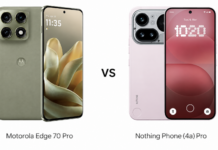
Motorola’s Edge 70 Pro+ and Nothing’s Phone (4a) Pro target buyers who want premium features without entering flagship price territory. Both devices offer high-refresh-rate AMOLED displays, telephoto cameras, and large batteries, but they take different approaches. Motorola focuses on performance, battery endurance, and durability, while the Nothing device emphasizes design, software experience, and its distinctive Glyph-inspired lighting system. Choosing between them depends on whether raw hardware or a more unique user experience matters more.
The Motorola Edge 70 Pro+ uses an eco-leather back paired with a plastic frame, creating a comfortable in-hand feel that resists fingerprints and offers a more practical everyday experience. It also brings stronger durability credentials with IP68/IP69 protection and MIL-STD-810H certification, making it a better choice for users who prioritize toughness and reliability.
The Nothing Phone (4a) Pro takes a more premium visual approach with an aluminum unibody construction and its signature mini-LED lighting system on the rear. The design stands out immediately and feels more distinctive than most smartphones in this segment. For buyers who value aesthetics and uniqueness, the Nothing device has a stronger visual appeal.
Display Quality
Both phones feature 144Hz AMOLED panels with HDR10+ support and excellent color reproduction. The Nothing offers a slightly larger display and thinner bezels, creating a more immersive viewing experience. However, the Motorola counters with higher brightness capabilities, making outdoor visibility more impressive under direct sunlight.
Verdict
The Nothing Phone (4a) Pro feels more premium and distinctive, but the Motorola Edge 70 Pro+ wins overall thanks to its superior durability and brighter display performance.
2. Specifications Including Battery
Performance
The Motorola Edge 70 Pro+ is powered by the MediaTek Dimensity 8500 Extreme chipset paired with fast UFS 4.1 storage. It delivers stronger processing power, faster app launches, and better sustained performance during gaming and multitasking. The hardware feels closer to upper-tier flagship devices than a traditional mid-range smartphone.
The Nothing Phone (4a) Pro uses the Snapdragon 7 Gen 4 chipset with UFS 3.1 storage. Daily performance remains smooth and responsive, and Nothing OS 4.1 provides a clean software experience. However, demanding workloads and heavy gaming sessions reveal the performance gap between the two devices.
Battery and Charging
Battery life is a major strength of the Motorola thanks to its massive 6500mAh battery. Combined with 90W wired charging and wireless charging support, it offers excellent convenience and endurance. The Nothing device provides respectable battery life with its 5080mAh global and 5400mAh Indian variants, but its 50W charging is noticeably slower and lacks wireless charging.
Verdict
The Motorola Edge 70 Pro+ clearly leads in performance, battery capacity, charging speed, and overall hardware capability, making it the stronger long-term performer.
3. Camera
Main and Secondary Lenses
Both phones feature a 50MP main camera and a 50MP periscope telephoto lens with 3.5x optical zoom, creating a surprisingly close contest. Motorola gains an advantage with its 50MP ultrawide camera, which captures more detail and flexibility than Nothing’s 8MP ultrawide sensor. This difference becomes noticeable in landscape photography and group shots.
Video recording is another area where Motorola pulls ahead. Support for 4K recording up to 120fps provides more creative flexibility, while Nothing is limited to 4K at 30fps. The Nothing device still produces attractive images with strong contrast and HDR processing, particularly in daylight conditions.
Selfie Camera
Motorola includes a 50MP autofocus selfie camera capable of 4K recording. The Nothing offers a 32MP front camera limited to 1080p video. The Motorola setup delivers sharper results and more versatility for content creators and video callers.
Verdict
The Motorola Edge 70 Pro+ offers a more complete camera package, particularly due to its superior ultrawide camera, stronger video capabilities, and higher-quality selfie setup.
4. Pricing
The Motorola Edge 70 Pro+ is priced around $570 (₹48,000), while the Nothing Phone (4a) Pro is priced around $500 (₹40,000). The price gap is noticeable but not excessive, considering the hardware differences between the two devices.
For the additional cost, the Motorola delivers a more powerful chipset, larger battery, faster charging, wireless charging support, stronger durability ratings, brighter display output, and a more capable camera system. These upgrades affect daily usage and are not merely specification-sheet advantages.
The Nothing Phone (4a) Pro remains attractive for buyers seeking a distinctive design and a clean software experience while saving money. It provides a balanced package that covers most essentials without feeling compromised. However, when comparing pure hardware value, the Motorola stretches the budget further.
Verdict
The Nothing Phone (4a) Pro offers solid value at its price, but the Motorola Edge 70 Pro+ justifies its higher cost with meaningful upgrades across nearly every major category.
Disclaimer: Prices are approximate and may vary based on country, region, launch timing, and applicable taxes. Always check whether the listed price is for a China unit or a global/international variant when purchasing.
5. Conclusion
The Motorola Edge 70 Pro+ stands out through its large 6500mAh battery, 90W charging, wireless charging support, advanced durability certifications, brighter display, and stronger overall camera system. It is designed for users who prioritize performance, endurance, and versatility.
The Nothing Phone (4a) Pro differentiates itself with its aluminum unibody construction, unique mini-LED rear lighting system, clean Nothing OS interface, and lower entry price. It delivers a more distinctive personality than many competitors and appeals to buyers looking for something visually different.
Verdict
Both devices are strong contenders in the upper mid-range segment, but the Motorola Edge 70 Pro+ emerges as the better all-around smartphone. Its superior performance, battery life, charging capabilities, durability, and camera versatility provide tangible advantages in everyday use.
Nothing Phone (4a) Pro remains a compelling alternative for users who prioritize design and software experience, but for most buyers, the Motorola offers the more complete package and the stronger overall value proposition.
Disclaimer: This comparison is based on the specifications provided and is intended for general informational purposes. Actual performance, camera results, battery life, and overall experience may vary depending on real-world usage, software updates, and individual preferences.
We use cookies on our website to give you the most relevant experience by remembering your preferences and repeat visits. By clicking “Accept”, you consent to the use of ALL the cookies.
This website uses cookies to improve your experience while you navigate through the website. Out of these, the cookies that are categorized as necessary are stored on your browser as they are essential for the working of basic functionalities of the website. We also use third-party cookies that help us analyze and understand how you use this website. These cookies will be stored in your browser only with your consent. You also have the option to opt-out of these cookies. But opting out of some of these cookies may affect your browsing experience.
Necessary cookies are absolutely essential for the website to function properly. This category only includes cookies that ensures basic functionalities and security features of the website. These cookies do not store any personal information.
Any cookies that may not be particularly necessary for the website to function and is used specifically to collect user personal data via analytics, ads, other embedded contents are termed as non-necessary cookies. It is mandatory to procure user consent prior to running these cookies on your website.



Comments