
Add GIZMOCHINA as Preferred Source on Google
Leaked photos have given us a rare peek inside what looks like Apple’s Private Cloud Compute server hardware, and it appears to be running on the company’s own M5 silicon.
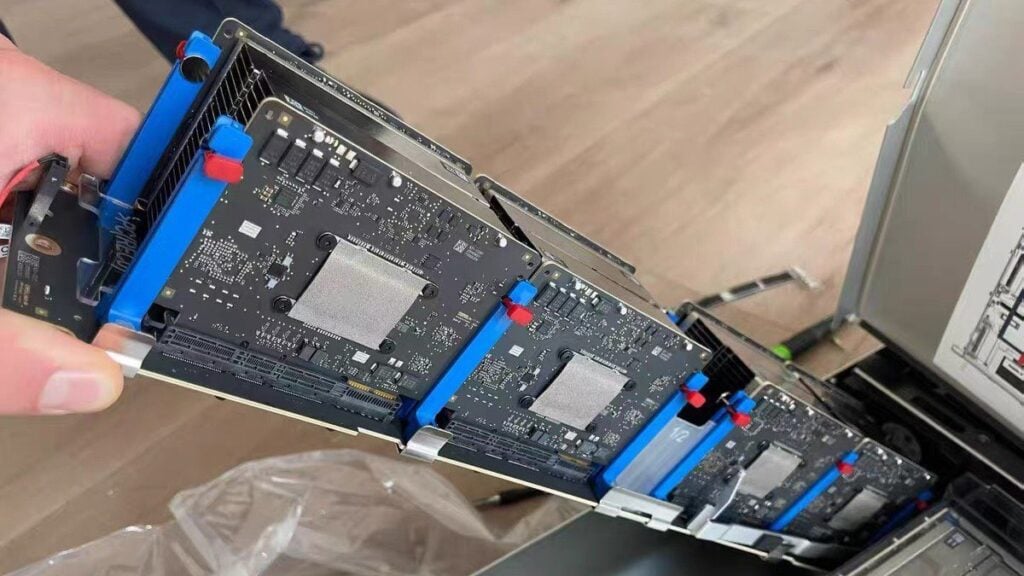
Images shared by X user @hsuchingpo show a rack-mount enclosure packed with multiple compute modules. Each module sits on a PCIe-style card with blue ejector latches, clearly designed so technicians can hot-swap them. A service diagram visible in the photos lists 14 numbered board positions, each with its own Apple part number (APN).

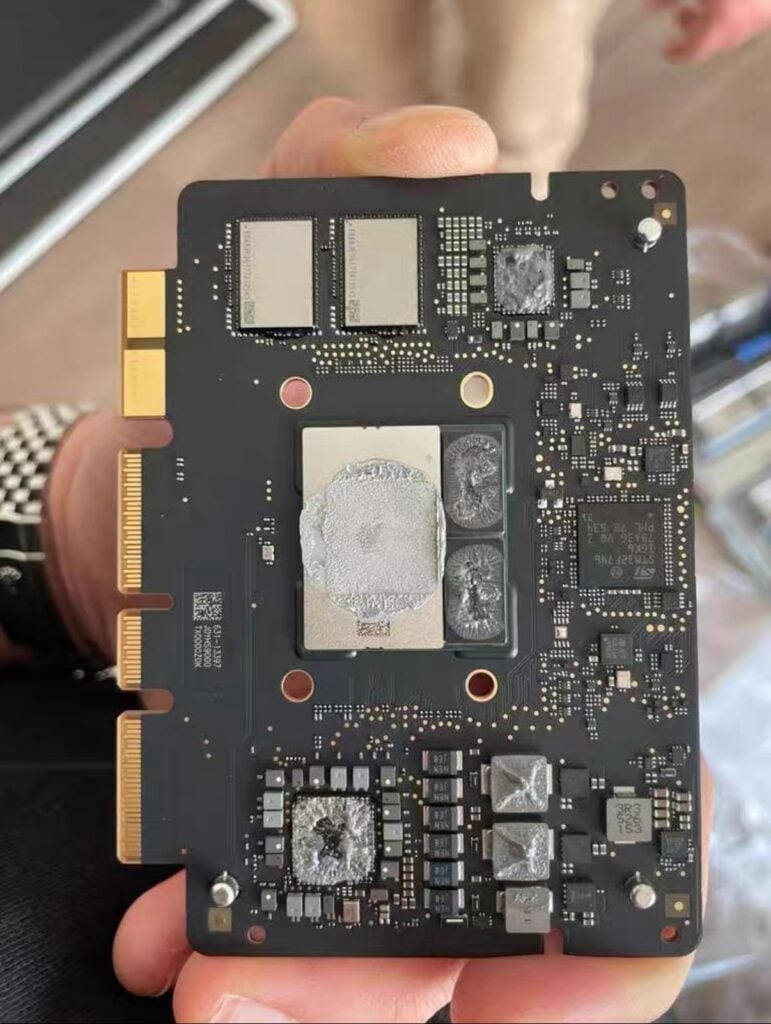
A close-up of one module shows a single M5 package under thermal paste, with VRM circuitry along the lower edge of the board and a gold edge connector that plugs into the backplane. The board itself has an Apple-style part-number sticker that reads 631-13397.
A wider shot of the chassis reveals a fully populated server blade. The compute modules are lined up across carrier bars, with each bar holding eight boards. Two of these rows are visible, connected by a central heat-pipe manifold. The service diagram taped inside the lid (listing positions 0 through 13 with unique APNs) points to a modular setup meant for field replacement rather than a fixed, single-board design. It’s possible the full chassis can hold more modules than the two rows shown, or the diagram might not line up perfectly with a symmetrical layout.
While the M5 isn’t as powerful as Apple’s higher-end workstation chips like the M3 Ultra in terms of raw multi-core processing, its higher efficiency means multiple units can be packed densely into one enclosure without major thermal headaches. Apple’s Private Cloud Compute setup relies on device-class silicon instead of traditional server processors, essentially extending the company’s on-device privacy approach to larger-scale AI work in the cloud.
While the photos could be showing an engineering or pre-production configuration, they give us one of the clearest public looks yet at how Apple may be building its secure cloud AI systems.
Don’t miss a thing! Join our Telegram community for instant updates and grab our free daily newsletter for the best tech stories!
For more daily updates, please visit our News Section.
(Source)




Comments