Advertisement

Add GIZMOCHINA as Preferred Source on Google

As an Amazon Associate, Gizmochina earns from qualifying purchases. Links on this page may earn us a commission at no extra cost to you.

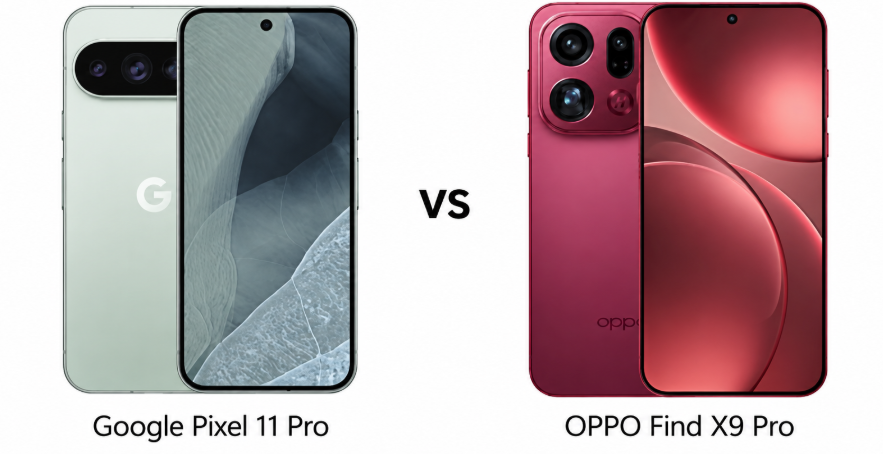
Google Pixel 11 Pro and OPPO Find X9 Pro take very different approaches to the premium Android phone. The Pixel focuses on computational photography, clean software, long-term updates, and Google’s custom Tensor platform, while OPPO pushes hardware with a huge battery, faster charging, and an unusually capable 200MP telephoto camera.

This comparison matters because both phones sit around the same flagship price range, yet prioritize different strengths. The Pixel 11 Pro looks more appealing for software longevity and photography, while the Find X9 Pro is built for buyers who want maximum hardware value. The better choice ultimately depends on whether refinement or raw hardware flexibility matters more.
Major Features:

CategoryGoogle Pixel 11 ProOPPO Find X9 ProWinner
Design & BuildGlass front/back, aluminum frame, IP68Glass front/back, aluminum frame, IP68/IP69OPPO — stronger water resistance
Display6.3-inch LTPO OLED, 120Hz, HDR10+, 3600 nits peak6.78-inch LTPO AMOLED, 120Hz, Dolby Vision, HDR10+, HDR Vivid, 3600 nits peakOPPO — larger display and broader HDR support
PerformanceTensor G6, 12GB/16GB RAMDimensity 9500, 12GB/16GB RAMOPPO — more powerful hardware configuration
StorageUp to 1TB, UFS 4.xUp to 1TB, UFS 4.1OPPO — UFS 4.1 storage
Main Camera50MP, f/1.7, OIS50MP, f/1.5, OISOPPO — wider f/1.5 aperture
Telephoto48MP, 5x optical zoom200MP, 3x optical zoomOPPO — higher-resolution telephoto
Ultrawide48MP, 123°50MP, 120°OPPO — higher resolution
Selfie Camera42MP ultrawide, PDAF50MP, PDAFOPPO — higher resolution
VideoUp to 8K at 30fpsUp to 4K at 120fps, Dolby Vision, LOGGoogle — 8K recording
Battery4,850mAh7,500mAhOPPO — much larger battery
Wired Charging30W80WOPPO — much faster charging
Wireless Charging25W magnetic, Qi2.250WOPPO — higher wireless charging speed
Software SupportAndroid 17, up to 7 major OS updatesAndroid 16, up to 5 major OS updatesGoogle — longer software support
Unique FeaturesUWB, Satellite SOS, bypass charging, Qi2.2IR port, IP69, reverse wireless chargingGoogle — more distinctive ecosystem features
PricePriced around $1,100 / ₹120,000Priced around $1,000 / ₹100,000OPPO — lower price
OverallBetter software longevity and 5x zoomBetter battery, charging and hardware valueOPPO — better overall value
Disclaimer: Specs are based on available data. Actual performance may vary. Verify details from official sources before buying.

1. Design and Display

Build and Feel

Both phones use premium glass construction with aluminum frames and Gorilla Glass Victus 2 protection on the front. They also offer IP68 water and dust resistance, while the Find X9 Pro adds IP69 protection for greater resistance to high-pressure water jets. Both feature ultrasonic in-display fingerprint sensors and stereo speakers. The OPPO feels more feature-packed from a durability perspective, although the Pixel’s design remains more understated and cohesive.

The Pixel 11 Pro also offers UWB, which expands its potential for device tracking and ecosystem features. OPPO counters with an infrared port, making the Find X9 Pro more useful as a universal remote. Neither phone has a headphone jack. For everyday flagship use, both are well equipped, but OPPO delivers a slightly broader hardware feature set.

Display Quality

The Pixel 11 Pro has a 6.3-inch LTPO OLED panel with a 120Hz refresh rate, HDR10+, and up to 3,600 nits peak brightness. Its higher pixel density should produce exceptionally crisp text and images, while adaptive refresh rates help balance smoothness and efficiency. It is particularly well suited to users who prefer a compact flagship screen.

The Find X9 Pro counters with a larger 6.78-inch LTPO AMOLED display supporting Dolby Vision, HDR10+, HDR Vivid, 1 billion colors, and 3,600 nits peak brightness. Its 2,160Hz PWM dimming can also be easier on sensitive eyes. For movies and gaming, OPPO’s larger canvas feels more immersive, while Pixel wins for compact usability.

Verdict

OPPO Find X9 Pro wins the display section for its larger panel, Dolby Vision, richer format support, and high-frequency PWM dimming. Pixel remains preferable for buyers who value a smaller flagship screen.

2. Specifications Including Battery

Performance

The Pixel 11 Pro uses Google’s Tensor G6, built on a 3nm process, paired with up to 16GB RAM and UFS 4.x storage. Its seven-core design is optimized around Google’s software and AI workloads rather than headline specifications alone. The phone should therefore feel particularly well integrated for everyday tasks, photography processing, and Pixel-exclusive AI features.

The Find X9 Pro uses the 3nm Dimensity 9500 with an octa-core CPU, Arm G1-Ultra graphics, up to 16GB RAM, and faster UFS 4.1 storage. On paper, its configuration is more performance-oriented and better suited to demanding gaming and sustained workloads. OPPO has the stronger hardware proposition here, especially for users who prioritize raw performance.

Battery and Charging

Battery capacity is one of the biggest differences. The Pixel 11 Pro packs a 4,850mAh battery with 30W wired charging and 25W magnetic wireless charging. It also supports reverse wired charging and bypass charging. Google’s software optimization should help, but the charging hardware is conservative for a modern flagship.

OPPO dramatically raises the bar with a 7,500mAh silicon-carbon battery, 80W wired charging, and 50W wireless charging. It also supports 10W reverse wireless charging. The difference is substantial in practical terms, giving the Find X9 Pro much greater endurance potential and faster top-ups. OPPO clearly feels more practical for heavy users.

Verdict

OPPO Find X9 Pro wins comfortably, combining a much larger battery with 80W wired and 50W wireless charging. Pixel’s charging features are useful, but OPPO offers substantially better hardware value.

3. Camera

Main and Secondary Lenses

The Pixel 11 Pro combines a 50MP main camera, 48MP 5x periscope telephoto, and 48MP ultrawide. Google adds features such as Best Take, Zoom Enhance, Pixel Shift, Ultra HDR, and multi-zone laser autofocus. The long 5x optical zoom is particularly useful for distant subjects and complements Pixel’s computational photography approach.

The Find X9 Pro uses a 50MP f/1.5 main camera, 200MP 3x periscope telephoto, and 50MP ultrawide. Its large telephoto sensor and high resolution give it considerable cropping flexibility, while Hasselblad color calibration and LOG video target enthusiasts. OPPO has the more ambitious camera hardware, but Pixel’s processing could produce more consistently polished results.

Selfie Camera

Google equips the Pixel 11 Pro with a 42MP ultrawide selfie camera featuring PDAF and 4K video recording at up to 60fps. The wider field of view makes it particularly useful for group selfies and video calls, while autofocus should improve consistency compared with fixed-focus alternatives.

OPPO uses a 50MP wide selfie camera with PDAF, a 21mm equivalent field of view, and 4K recording at up to 60fps. It offers strong hardware on paper, while gyro-EIS adds stabilization for video. OPPO’s higher-resolution sensor is appealing, but Pixel’s ultrawide framing gives it greater flexibility. Both are strong selfie systems.

Verdict

The Pixel 11 Pro wins for computational photography and its versatile 5x zoom, while OPPO offers stronger camera hardware. For predictable point-and-shoot results, Pixel has the edge.

4. Pricing

The Pixel 11 Pro is priced around $1,100 or ₹120,000, while the OPPO Find X9 Pro is priced around $1,000 or ₹100,000. That gives OPPO a meaningful price advantage despite offering a larger battery, faster charging, and a 200MP periscope telephoto camera.

The gap becomes more significant when the hardware is considered as a package. Pixel’s premium is easier to understand if long-term software support, Google’s ecosystem, and computational photography are priorities. However, buyers primarily comparing specifications get considerably more hardware from OPPO for less money. On pure hardware value, the Find X9 Pro looks difficult to beat.

Is the price justified? 

The Pixel 11 Pro can justify its higher price through seven major Android updates, Google’s software experience, AI features, and camera processing. Those advantages matter to buyers intending to keep a phone for many years rather than upgrading frequently.

The Find X9 Pro offers five major Android updates, which is still substantial, but falls behind Google’s commitment. However, its stronger charging system, enormous battery, premium camera hardware, and broader feature set make its lower price especially compelling. OPPO delivers more physical hardware for the money, while Pixel makes a stronger case through software longevity.

Verdict

The OPPO Find X9 Pro offers better value for money, thanks to its lower price and substantially stronger battery and charging hardware. Pixel earns its premium through software longevity and camera processing.

Disclaimer:
Prices are approximate and may vary based on country, region, launch timing, and applicable taxes. Always check whether the listed price is for a China unit or a global/international variant when purchasing.

5. Conclusion

The Pixel 11 Pro stands out with seven major Android updates, Tensor G6 processing, UWB, satellite SOS, magnetic Qi2.2 wireless charging, and Google’s computational photography features. Its 5x periscope also gives it a different imaging strategy from OPPO’s high-resolution 3x telephoto. It is the more software-focused flagship, designed around Google’s ecosystem and long-term ownership.

The Find X9 Pro answers with a 7,500mAh silicon-carbon battery, 80W wired charging, 50W wireless charging, IP69 protection, an IR blaster, and a 200MP periscope camera. Its hardware package is unusually aggressive for the price. For demanding users, frequent travelers, gamers, and anyone prioritizing endurance, OPPO offers more immediately useful hardware.

Verdict

Overall winner: OPPO Find X9 Pro. Its bigger battery, faster charging, versatile camera hardware, stronger durability, and lower price make it the more compelling all-round flagship. Pixel 11 Pro remains the better choice for long-term software support and computational photography.


FAQs

1. Which phone has the better camera, Pixel 11 Pro or Find X9 Pro?
The Pixel 11 Pro offers stronger computational photography, while OPPO provides more ambitious camera hardware and a 200MP telephoto.

2. Is the Pixel 11 Pro faster than the Find X9 Pro?
The Find X9 Pro has the stronger performance-focused chipset configuration, making it the better choice for demanding workloads and gaming.

3. Which phone has better battery life?
The Find X9 Pro should deliver longer battery life thanks to its significantly larger 7,500mAh battery.

4. Which phone offers better value for money?
The Find X9 Pro offers better value with a lower price and a stronger overall hardware package.

5. Should you buy the Pixel 11 Pro or Find X9 Pro?
Choose the Pixel for software longevity and Google’s camera processing; choose OPPO for battery, charging, performance, and hardware value.

Disclaimer: Prices, specifications, and availability may vary by region and retailer. Recommendations in this article are based on editorial opinion, feature-based value, and market positioning at the time of writing. Readers are advised to do their own research before making a purchase.

Read More:

Comments