Add GIZMOCHINA as Preferred Source on Google
Honor launched the Magic 9 Pro Max in China today, a week after Vivo introduced the X500 Pro Max. It is also the second China flagship this week built around more than one 200MP camera, following the Oppo Find X10 Pro Max.
On paper, the Honor Magic 9 Pro Max and Vivo X500 Pro Max share a lot. Both use 2nm flagship chips, 200MP periscope telephoto cameras, optional teleconverter accessories, and batteries over 8,000mAh. However, the two companies have taken different approaches in several areas, especially cameras, video recording, displays, and accessories. Here’s how the Honor Magic 9 Pro Max compares with the Vivo X500 Pro Max.
1. Design and Build
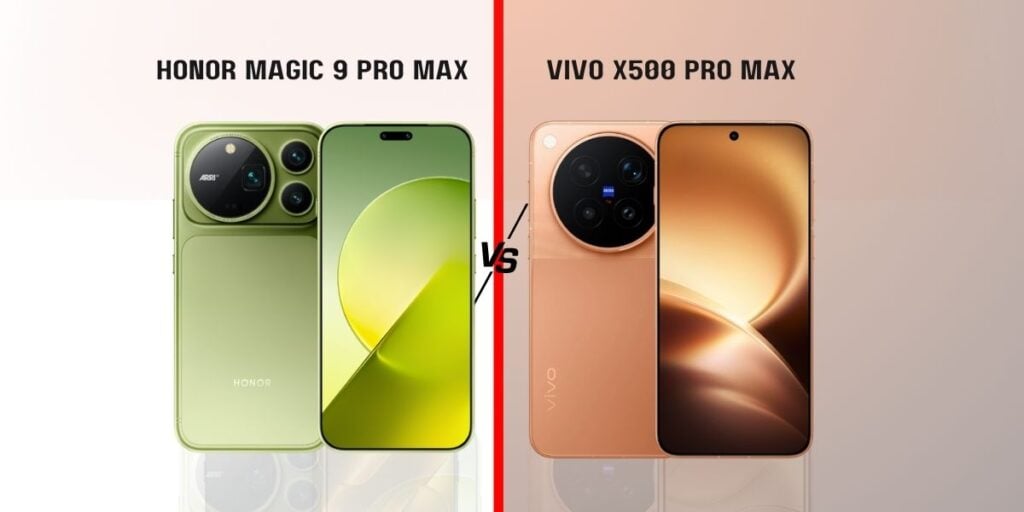
Honor has moved away from the round camera island used on some of its earlier Magic phones. The Magic 9 Pro Max instead has an asymmetric camera plateau inspired by ARRI cinema cameras, with a precision-cut metal texture around the lens ring.
The phone uses a unibody all-metal design with a seamless-splice finish and comes in Moss Green, Silver Halide, and Shadow Black. It has IP68, IP69, and IP69 ratings. Honor also uses what it calls Giant Rhino Glass on the front. The company says it offers 25 times the drop resistance, 15 times the scratch resistance, and three times the wear resistance of ordinary glass, based on its own lab testing.
The Vivo X500 Pro Max keeps a large circular Zeiss camera ring. Vivo likes to define it as a “pancake” lens design, with a knurled texture around the edge. Three of the four launch colors use a “Tidal Cold Carved” glass back, while the frame is made from aviation-grade aluminum. It carries IP68 and IP69 ratings but does not have the IP69K certification listed by Honor.
2. Display
The Honor Magic 9 Pro Max has a 6.8-inch LTPO OLED panel with a variable refresh rate from 1Hz to 120Hz. Honor quotes a peak brightness of 10,000 nits, with 6,000 nits at a 20% window and a minimum brightness of 1 nit.
The display also uses a 5,600-layer silicon nitride coating that brings reflectivity down to 1.5%. It has TÜV Rheinland low-reflection certification, while PWM dimming runs at 4,320Hz. Honor says the phone is also the first to receive TÜV Rheinland’s Global Eye Protection 6.0 certification.
Vivo has a slightly larger 6.85-inch BOE Q11 display with a 3168 × 1440 resolution and 507 ppi. It supports adaptive refresh rates from 1Hz to 144Hz, although Vivo notes that 144Hz is available for gaming.
The X500 Pro Max reaches 4,400 nits at a 20% window and 2,000 nits globally. Honor therefore has the higher 20% window brightness figure. Vivo, meanwhile, gives more attention to color accuracy, with chip-level Demura calibration, a sunlight color-compensation algorithm, and an ambient light sensor that adjusts brightness in 0.3-lux steps.
3. Camera
Main camera
The two phones share several camera specifications. Both main cameras use a 1/1.28-inch sensor, an f/1.57 aperture, a 24mm-equivalent focal length, and three-axis gimbal-style stabilization.
The biggest difference is the sensor resolution. Honor uses a 200MP main sensor with CIPA 8.0 stabilization. Its product page notes that the full 200MP resolution is available through the Ultra-HD shooting mode.
Meanwhile, Vivo is using a 50MP Blueprint 900 sensor developed with Sony, rated at CIPA 7.0. Since the two sensors have the same physical size, Vivo’s lower-resolution sensor has larger individual pixels, while Honor’s 200MP sensor gives users more room for cropping.
Vivo claims 17EV of dynamic range, although its footnote says that figure applies when shooting in Log mode. The company also says the sensor is the first to support 4K 120fps DCG HDR video. Honor does not provide a comparable dynamic range figure for its main camera.
Telephoto
Both phones use 200MP periscope telephoto cameras with 1/1.4-inch sensors and an 85mm-equivalent focal length. The apertures are also close, with f/2.6 on the Honor and f/2.67 on the Vivo.
Honor’s telephoto sensor is reportedly a Samsung S5KHPE, while Vivo uses a Samsung HP0 sensor as part of its Blueprint system. Honor rates its telephoto at CIPA 8.0, compared with CIPA 7.0 for Vivo.
Vivo lists a 15cm macro mode and offers several features for long-distance shooting. It claims up to 30x zoom and has a telephoto tracking mode that keeps a moving subject centered between 10x and 30x. The tracking feature is coming through a software update.
Vivo also lists what it calls the first active anti-fog system for a phone lens. The feature is designed for cold-weather situations such as skiing.
Honor takes a slightly different route by pairing the 200MP periscope camera with additional telephoto accessories.
Teleconverters and accessories
Honor sells two teleconverters separately. The G200 weighs 88g and provides a 200mm equivalent focal length, while the G500 reaches a 500mm equivalent. Reports say the G500 can reach 1,000mm when combined with digital zoom.
The company also sells a SmallRig cage kit with mounting points for accessories such as lights and microphones. At the top of the lineup are the Photography Master Kit and the 10,999-yuan Master Photographer Package. Honor notes that the teleconverters and imaging accessories are not included with the base phone.
Vivo’s Zeiss G2 Ultra teleconverter reaches roughly 400mm equivalent and works with a stage mode designed for concert lighting. The company also sells a Creator Set and a magnetic 3.92-inch Smart Screen. The screen attaches to the back of the phone, is 5.65mm thick, and lets users frame shots using the rear cameras.
Ultra-wide and selfie cameras
Both phones use 50MP ultra-wide cameras with f/2.0 apertures. Vivo specifies a 1/2.75-inch sensor with autofocus, while Honor does not list the sensor size of its ultra-wide camera.
Honor also adds a 3D depth-sensing module for its 3D face unlock system. Vivo instead uses a laser focus sensor with 1,536 points arranged across a 48 × 32 grid.
The front cameras are different. Honor’s Agile Eye selfie camera uses a 55MP 1/2.74-inch sensor with a 1:1 square format. It can capture photos and video in 1:1, 16:9, or 9:16 without requiring you to rotate the phone. Honor calls it the first square selfie camera on an Android phone. Vivo uses a more conventional 50MP front-facing camera.
4. Imaging chip and color
Honor has added its own H1 imaging chip, built on a 6nm process and rated at 18.8 TOPS per watt. It handles RAW-domain noise reduction, and Honor calls the combination of the H1 chip with its two 200MP cameras a dual-chip imaging system.
Vivo instead puts more of its camera processing around the Dimensity 9600 Pro and Blueprint 900 sensor rather than using a separate imaging chip.
Color processing is another major difference between the two phones. Honor has built its camera pipeline around ARRI’s LogC3 curve and ARRI color science. The company lists 87 official ARRI Looks, although a footnote says users need to download the complete set from Honor or ARRI’s website and import them into the camera app.
Some launch coverage has mentioned 14 Looks being built in, so the exact selection available on the phone may vary by region.
Honor also has a Movie Live mode that records a 2.39:1 ultra-wide 4K live photo for three seconds after the shutter is pressed. Its AI Color Tracking feature can copy a look from a reference image.
Vivo offers a broader set of video recording options. The X500 Pro Max supports 4K 240fps slow motion, 4K 120fps 10-bit Log, 4K 120fps subject tracking, and 4K 60fps cinematic portraits.
Later updates are set to add 8K native live photos and a 4K 960fps super slow-motion mode. Vivo also supports 3D LUT imports and offers cinematic color styles such as Sunlight Film and Cool Silver Halide.
Honor’s product page does not list comparable frame-rate specifications, so those details will be worth checking in real-world reviews.
5. Performance
The Honor Magic 9 Pro Max runs on Qualcomm’s Snapdragon 8 Elite Extreme Gen 6. The chip is based on a 2nm process with a maximum clock speed of 5.01GHz. Honor quotes performance gains of 13% for the CPU, 44% for the GPU, and 35% for the NPU compared with the previous generation, based on Qualcomm’s figures.
In contrast, the Vivo X500 Pro Max uses MediaTek’s Dimensity 9600 Pro, which is also built on a 2nm process. It uses a 2+3+3 all-big-core design. MediaTek claims a 17% increase in single-core performance and a 61% reduction in peak multi-core power consumption.
Both phones are available with 12GB or 16GB of RAM and up to 1TB of storage.
6. Battery and Charging
Honor has equipped the Magic 9 Pro Max with an 8,800mAh Qinghai Lake blade battery. The company calls it the first battery of this capacity in a candy-bar flagship. It uses 40% silicon content and has an energy density of 1,000Wh/L. As for charging, you get 100W over a cable and 80W wirelessly, while Honor also lists 50W wireless car charging for compatible vehicles.
Vivo uses an 8,000mAh battery with more than 25% silicon content. It supports 90W wired charging and 40W wireless charging. Vivo says the 40W wireless speed requires its own 50W vertical charger. Vivo also advertises cold-weather operation, which ties in with the anti-fog system on its telephoto camera.
On paper, Honor has the larger battery and faster charging in both wired and wireless charging.
7. Software and Security
Honor’s MagicOS software includes YOYO, which gets its own AI button on the phone’s frame. A single press can record video highlights, while YOYO can handle recurring tasks and proactive reminders.
Honor’s Connect app also links the phone with devices such as the iPhone, Apple Watch, and Mac. For biometric security, the Magic 9 Pro Max combines 3D face recognition with a 3D ultrasonic fingerprint sensor. Honor says it is the only phone to combine both systems.
Vivo uses its Little V assistant for multi-step tasks and has an Atomic Workbench that can keep up to five apps running in the foreground.
The X500 Pro Max also has a 3D ultrasonic fingerprint sensor, but it does not list the same 3D face recognition system as Honor. The 1TB model additionally supports BeiDou satellite messaging.
8. Price and Availability
Honor has priced the Magic 9 Pro Max at 6,499 yuan (about $968) for the 12GB/256GB model. The 12GB/512GB version costs 6,999 yuan (about $1,043), while the 16GB/512GB and 16GB/1TB versions cost 7,499 yuan (about $1,117) and 8,499 yuan (about $1,266), respectively.
The Master Photographer Package costs 10,999 yuan (about $1,639). Sales began in China on launch day.
Vivo starts at 6,999 yuan (about $1,044) for the 12GB/256GB model. The 16GB/512GB version costs 8,499 yuan, while the 12GB/1TB model costs 8,999 yuan.
The 16GB/1TB Creator’s Package with satellite messaging costs 12,999 yuan.
There is some overlap between the two lineups. At 8,499 yuan, Honor offers 1TB of storage, while Vivo provides 512GB. Honor’s starting price is also 500 yuan lower than Vivo’s.
Honor says a global launch is coming, with reports pointing to Europe in November or December. US availability remains uncertain. Vivo has confirmed that the X500 series is heading to Singapore.
9. Honor Magic 9 Pro Max vs Vivo X500 Pro Max: Which one is for you?
The Honor Magic 9 Pro Max has a 200MP main camera, a 200MP periscope telephoto, ARRI-based color processing, a separate imaging chip, a larger battery, faster charging, and a wider selection of camera accessories. Its G200 and G500 teleconverters also give users more options for long-distance shooting.
The Vivo X500 Pro Max takes a different approach with its 50MP main camera, 200MP periscope telephoto, Zeiss imaging system, and a longer list of published video recording modes. It also offers features such as 30x zoom, telephoto tracking, and an active anti-fog system.
The two phones also have different strengths outside the camera department. Honor has the higher display brightness figures, a larger battery, faster charging, and a lower starting price, while Vivo offers a slightly larger display, a 144Hz gaming mode, and additional camera and video features.
For more daily updates, please visit our News Section.
Stay ahead in tech! Join our Telegram community and sign up for our daily newsletter of top stories!