Add GIZMOCHINA as Preferred Source on Google
As an Amazon Associate, Gizmochina earns from qualifying purchases. Links on this page may earn us a commission at no extra cost to you.
Phone cameras have become good enough that the interesting differences are no longer always about which one has the bigger sensor or the higher megapixel count. Sometimes, it comes down to what each company thinks you should be able to do with that hardware.
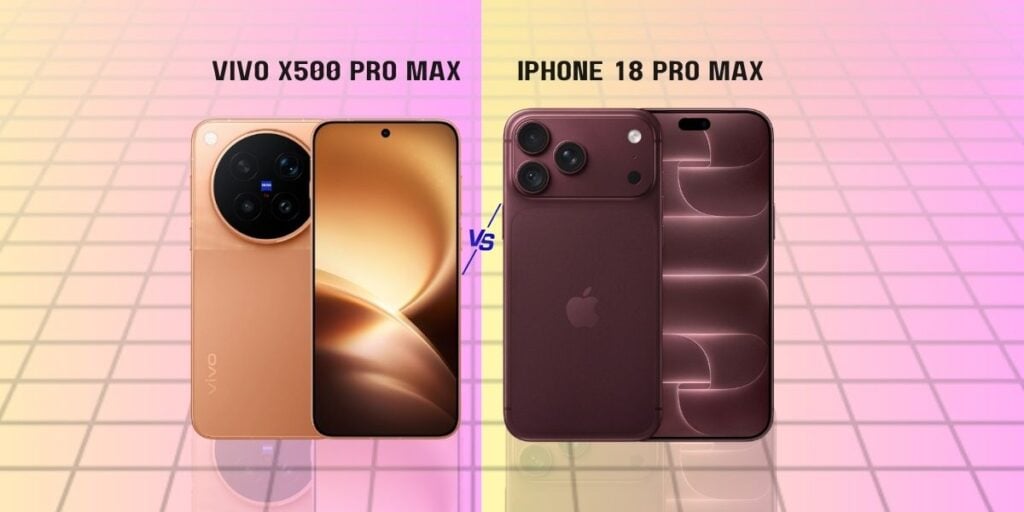
That becomes pretty clear with the Vivo X500 Pro Max and iPhone 18 Pro Max. Both sit near the top of their respective lineups, but they arrive at the camera problem from very different places. Vivo has built a phone around a particularly ambitious telephoto system, while Apple has changed something much closer to the starting point of a photo: how much light the main camera lets in.
Neither approach tries to solve the same problem. One gives you more reach when your subject is far away, while the other gives you more control over the way a scene is captured. And once you look beyond the cameras, the differences continue through the displays, processors, batteries, software, and even the way the two companies talk about their phones.
So rather than treating this as another Android-versus-iPhone comparison, it’s more interesting to look at what Vivo and Apple are actually doing differently with their flagship cameras.
1. Zeiss lens ring vs Apple’s usual restraint
The Vivo X500 Pro Max has a large circular camera ring with Zeiss branding and a knurled texture around the edge. Vivo has made the camera module a major part of the phone’s design rather than trying to hide it, and it makes sense to do so considering what it brings to the table. The frame is made from aviation-grade aluminum, while the phone carries IP68 and IP69 ratings.
The iPhone 18 Pro Max keeps Apple’s aluminum unibody design, with Ceramic Shield 2 on the front. Apple says it is three times more scratch-resistant than the glass used on the iPhone 16 Pro. The rear also uses Ceramic Shield and includes MagSafe. The phone is IP68 rated, weighs around 240 grams, and is roughly 9mm thick.
2. 144Hz gaming vs Apple’s brightness mystery
The Vivo X500 Pro Max has a 6.85-inch BOE Q11 display with a 3168 × 1440 resolution and 507 ppi. Its refresh rate can adjust between 1Hz and 144Hz, although the 144Hz mode is intended for gaming rather than regular use.
The display can reach 4,400 nits at a 20% window and 2,000 nits across the full screen. Vivo also uses chip-level Demura calibration, a sunlight compensation system, and an ambient light sensor that can measure down to 0.3 lux.
The iPhone 18 Pro Max has a slightly larger 6.9-inch Super Retina XDR display with ProMotion up to 120Hz. Apple says it is brighter than the previous generation and has better anti-reflection, although it hasn’t provided specific brightness figures for those improvements. The redesigned Dynamic Island can now display three Live Activities at the same time while still handling Face ID.
3. Vivo goes all-in on the telephoto, while Apple adds more camera control

This is where the two phones really separate. The Vivo X500 Pro Max uses a 50MP Blueprint 900 main sensor co-developed with Sony. It is a 1/1.28-inch sensor with an f/1.57 aperture and a 24mm equivalent focal length. It also gets 3-degree “TrueDynamic” gimbal-style stabilization and Zeiss T* coating.
Vivo claims up to 17EV of dynamic range in Log mode and says the sensor is the first to support 4K 120fps DCG HDR video. The ultra-wide camera is a 50MP sensor with an f/2.0 aperture. The bigger story, however, is the telephoto camera.
The phone has a 200MP Zeiss APO telephoto lens paired with a 1/1.4-inch Blueprint x Samsung HP0 sensor. It offers an 85mm equivalent focal length, an f/2.67 aperture, and a 15cm macro mode.
The camera supports up to 30x zoom and has a telephoto tracking mode that can keep a moving subject centered between 10x and 30x. That feature will be added through a software update. Vivo has also introduced what it describes as the first active anti-fog system for a phone camera lens, designed for cold and humid conditions such as ski slopes.
There’s also an optional Zeiss G2 Ultra teleconverter that takes the effective focal length to around 400mm. Vivo also sells a magnetic 3.92-inch Smart Screen accessory that attaches to the back of the phone and can be used to frame shots with the rear cameras.
On the contrary, instead of giving the main camera extreme reach, the iPhone 18 Pro Max adds a variable aperture to its 48MP Fusion Main camera. It’s the first time an iPhone has offered this feature.
The aperture can switch between ƒ/1.48 for low-light shots, ƒ/1.8 as the default setting, ƒ/2.8 for more depth, and ƒ/4.0 for maximum depth. The ƒ/4.0 setting can also create a starburst effect around point light sources. The main camera covers 24mm and 48mm equivalents.
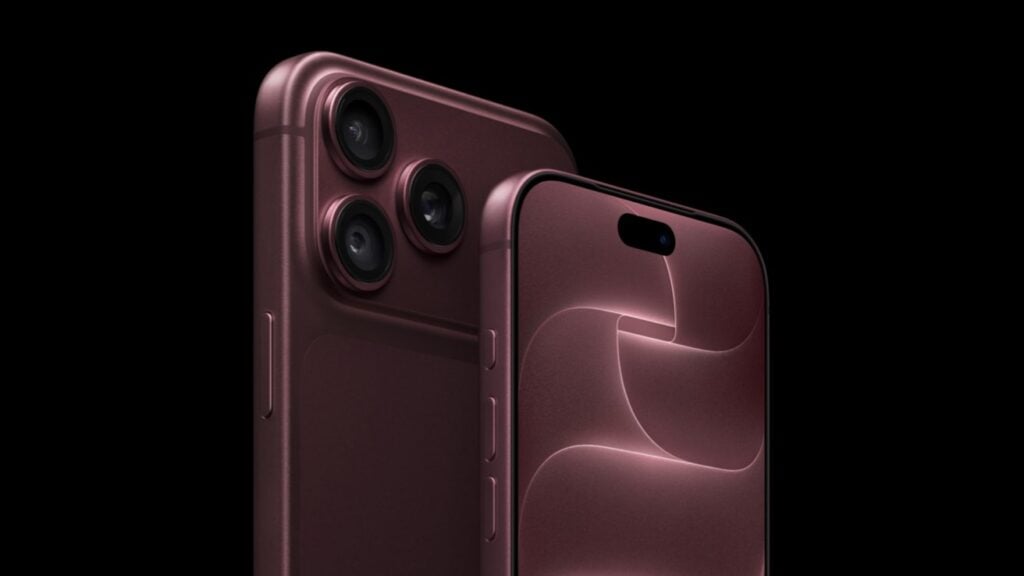
The 48MP Ultra Wide camera offers a 13mm equivalent focal length with an ƒ/2.2 aperture. The 48MP Telephoto camera covers 100mm and 200mm equivalents at ƒ/2.8, giving the phone up to 8x optical-quality zoom and a 16x total optical range.
Apple is also adding more manual controls. Pro controls let users adjust aperture, shutter speed, and white balance directly in the Camera app, along with a histogram. Photographic Styles 3 adds controls for texture and grain.
Another new feature is Apple Reference Image, which cryptographically signs what the camera sensor captured so users can later check whether an image has been edited. The feature isn’t available at launch in China, while capture-only restrictions apply in the EU.
The front camera is an 18MP Center Stage sensor that can automatically widen the frame when more people enter the shot.
4. Lots of video modes vs more editing options
Vivo has packed the X500 Pro Max with a long list of video features. It supports 4K 240fps slow motion, 4K 120fps 10-bit Log, 4K 120fps subject tracking, and 4K 60fps cinematic portraits. A future update will add 8K native Live Photos and a 4K 960fps super-slow-motion mode. The phone also includes several cinematic color profiles, including Sunlight Film, Cool Silver Halide, and Parisian Afterglow, along with support for importing 3D LUTs.
Apple’s video features are more about what users can do after recording. Cinematic mode effects can now be added to video recorded at up to 60fps, while 4K time-lapse gets Dolby Vision HDR.
Audio Mix can also separate music from background noise instead of only separating voices. For more serious video work, Apple still offers ProRes RAW, Apple Log 2, genlock, and 4K 120fps Dolby Vision.
5. Dimensity’s efficiency gains vs A20 Pro’s new design
The Vivo X500 Pro Max is powered by MediaTek’s Dimensity 9600 Pro, a 2nm chip with a 2+3+3 all-big-core design. MediaTek claims 17% higher single-core performance and a 61% reduction in peak multi-core power draw compared with the previous generation. Vivo also adds gaming features such as native 144fps gaming and 120fps ray tracing in supported titles.
The iPhone 18 Pro Max uses Apple’s A20 Pro, which is also built on a 2nm process. It has a 6-core CPU, 50% more memory bandwidth than the A19 Pro, and a 7-core GPU that Apple rates as up to 40% faster.
Apple has also changed the chip packaging. The die now sits next to the memory instead of having the memory stacked with it. This removes the memory from the thermal path and lets the chip sit directly against a new vapor chamber with three times the surface area of the previous generation.
Apple says the new design can deliver up to 40% better sustained performance. The phone also has a new N1 chip for Wi-Fi 7, Bluetooth 6, and Thread. The C2 modem offers faster uploads than the C1X while using 15% less power.
6. Vivo gives you the battery capacity; Apple gives you the runtime
The Vivo X500 Pro Max has an 8,000mAh battery, or 7,800mAh rated capacity, with more than 25% silicon content. It supports 90W wired charging and 40W wireless charging. There’s a catch with the wireless charging speed: reaching 40W requires Vivo’s own 50W vertical charger.
Apple doesn’t usually disclose battery capacity and instead gives battery-life figures. The iPhone 18 Pro Max offers up to 45 hours of video playback on eSIM-only models, which Apple calls its biggest battery-life increase on an iPhone.
The extra internal space created by removing the physical SIM tray also helps with the battery. Apple rates general use at up to 30 hours per charge, while wired charging can reach 50% in around 15 minutes with a compatible adapter.
7. Price and availability
The iPhone 18 Pro Max starts at $1,299 for 256GB. It is already available in more than 65 countries and regions, with another 20 markets scheduled to receive it by late September.
The Vivo X500 Pro Max starts at 6,999 yuan, or about $1,044, for the 12GB/256GB model in China. The 12GB/1TB version costs 8,999 yuan. Vivo also offers a 16GB/1TB Creator’s Package for 12,999 yuan, or about $1,940. This version includes satellite messaging.
Vivo has confirmed that the X500 series will launch in Singapore, but there is currently no US launch planned.
8. Which one makes more sense?
The Vivo X500 Pro Max and iPhone 18 Pro Max take very different approaches to phone photography. Vivo has built much of its camera hardware around the 200MP telephoto, with long-range zoom, tracking, macro shooting, an anti-fog system, and an optional teleconverter.
Apple is going with a variable-aperture main camera and expanded manual controls. It also adds tools for editing, recording, and checking the history of captured images.
The choice therefore comes down largely to the kind of photography and video work you do, along with which phone’s wider features and availability fit your needs.
For more daily updates, please visit our News Section.
Stay ahead in tech! Join our Telegram community and sign up for our daily newsletter of top stories!