
Add GIZMOCHINA as Preferred Source on Google
Qualcomm and MediaTek have unveiled their most powerful smartphone chipsets, and they actually bring major upgrades. The switch to a 2nm node is itself a big deal, as the last three years have been on 3nm. This should deliver huge gains across the board, and the hardware-level upgrades make them a lot more promising.
What we weren’t ready for was another name change from Qualcomm, as the new chip is called Snapdragon 8 Elite Extreme Gen 5. Perhaps Qualcomm thought adding “Extreme” would make it sound a lot more premium. MediaTek didn’t go as far as Qualcomm with the name scheme, but it also introduced a Pro moniker, the Dimensity 9600 Pro.
Let’s look at what the latest Qualcomm and MediaTek chips have to offer, and how they stack up against each other.
Here’s the spec sheet to begin with:
| Snapdragon 8 Elite Extreme Gen 6 | Dimensity 9600 Pro | |
|---|---|---|
| Announced | September 2026 | September 2026 |
| Process node | TSMC’s 2nm (N2P) | TSMC’s 2nm (N2P) |
| CPU cores | 8-core | 8-core |
| CPU cores | 2 x 5.0 GHz — Prime 6 x 4.0 GHz — Performance | 2 x 4.55 GHz — C2-Ultra 3 x 4.35 GHz — C2-Pro 3 x 3.1 GHz — C2-Pro |
| GPU | Adreno 850 with AI matrix cores Adreno Neural Fusion 18MB of Adreno HPM | Mali-G2 Ultra NX MP12 AI-assisted neural upscaling engine |
| NPU | Qualcomm Hexagon NPU Dual Micro NPUs Dual Always-Sensing ISPs Qualcomm Personal Scribe | Dual NPU architecture MediaTek NPU 1090 + Super Efficient NPU 2.0 Up to 30 billion parameters |
| Memory | LPDDR5x, LPDDR6 up to 5300 MHz | LPDDR6 up to 5333 MHz |
| Storage | UFS 4.1, UFS 5.0 | UFS 4.1, UFS 5.0 |
| Camera | Qualcomm Spectra Triple AI-ISP (20-bit) Up to 320MP single camera 8K/60fps video recording 4K/240fps slow-mo video recording Advanced Professional Video (APV) codec | MediaTek Imagiq 1290 ISP Up to 200MP single camera 8K/60fps video recording 4K/60fps HDR recording with content-aware semantic processing 4K/120fps with EIS 4K/240fps slow-mo recording |
| Connectivity | Snapdragon X105 5G modem Download speed: 14.8 Gbps (peak) Upload speed: 4.2 Gbps (peak) Wi-Fi 8 (peak speed: 11.6 Gbps) Bluetooth 6.0 | 3GPP Release-17 5G modem Download speed: more than 7.4 Gbps Wi-Fi 7 (peak speed: 7.3 Gbps) Bluetooth 6.2 |
Snapdragon 8 Elite Extreme Gen 6 Extreme vs Dimensity 9600 Pro: Benchmark numbers
Note: The benchmark tests were carried out using the Xiaomi 18 Pro Max (powered by the Snapdragon 8 Elite Extreme Gen 6) and Vivo X500 Pro Max (powered by the Dimensity 9600 Pro).
Geekbench score
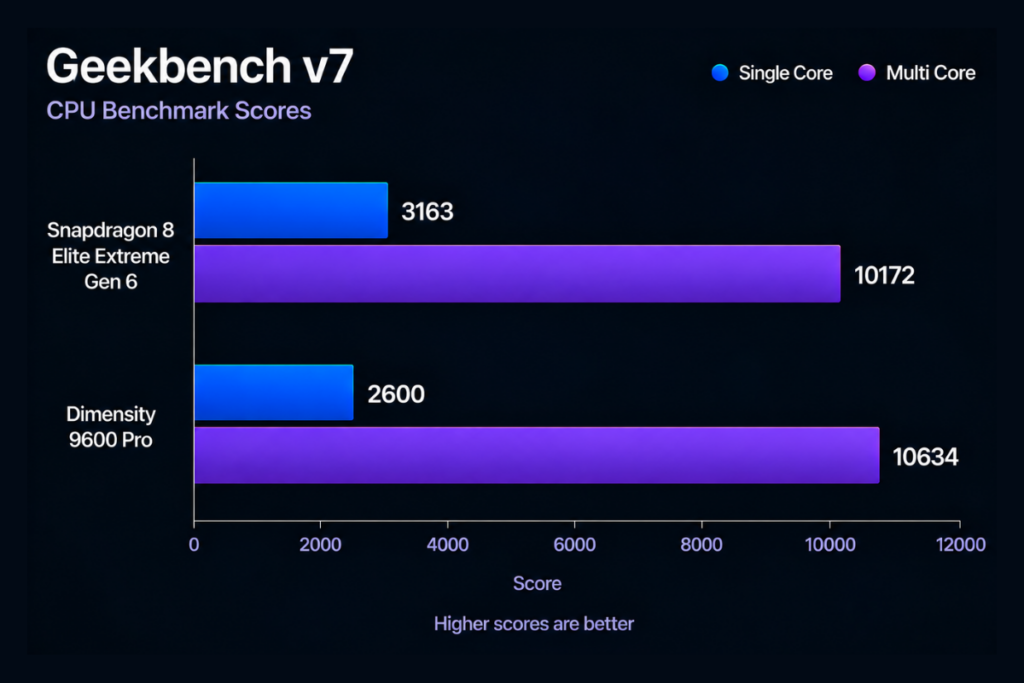
In the CPU testing on Geekbench 7, the Xiaomi 18 Pro Max, powered by the Snapdragon 8 Elite Extreme Gen 6 SoC, pulled off 3,163 single-core points, while the Dimensity 9600 Pro-powered Vivo X500 Pro could only reach 2600. That’s a solid 21% gain for the Snapdragon chipset.
The Dimensity chip bounces back in multi-core performance, posting a total score of 10,634. This is about 4% higher than the Snapdragon 8 Elite Extreme Gen 6’s 10,172 points.
The multi-core difference isn’t huge, but what little advantage exists favors the Dimensity chip. However, the Snapdragon chip delivers a solid advantage in multi-core performance, which should deliver a much bigger impact.
| Snapdragon 8 Elite Extreme Gen 6 | Dimensity 9600 Pro | |
|---|---|---|
| Single core | 3,163 | 2,600 |
| Multi core | 10,172 | 10,634 |
AnTuTu score
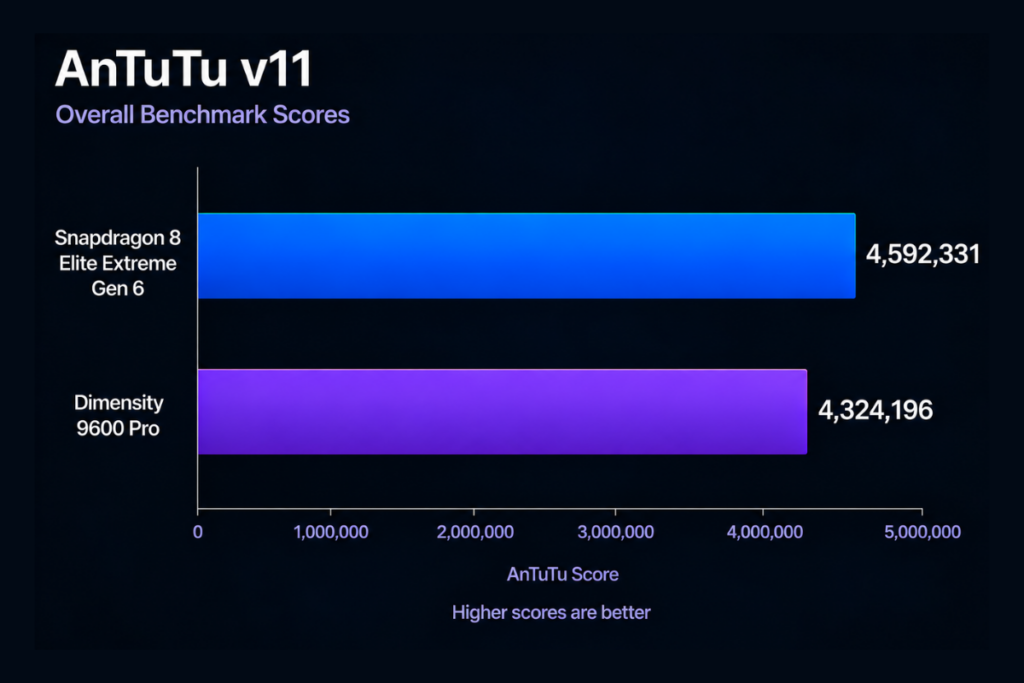
The Snapdragon 8 Elite Extreme Gen 6 is still ahead of the Dimensity 9600 Pro on AnTuTu, but the lead is just 6%. The Snapdragon chip pulls off nearly 4.6 million AnTuTu scores, while the Dimensity chip has scored about 4.32 million.
The breakdown of the AnTuTu score reveals a rather clearer picture.
The Snapdragon 8 Elite Extreme Gen 6 posts a 7% lead in the CPU score, but the GPU test leans more towards the Dimensity 9600 Pro with a 5% higher score. The memory and UX performance, though, strongly backs the Snapdragon chip.
| Snapdragon 8 Elite Extreme Gen 6 | Dimensity 9600 Pro | |
|---|---|---|
| AnTuTu score | 4,592,331 | 4,324,196 |
| CPU | 1,226,866 | 1,138,784 |
| GPU | 1,762,900 | 1,858,369 |
| Memory | 627,667 | 494,845 |
| UX | 974,898 | 832,198 |
The real upgrades these 2nm flagships have to offer
The CPU deliver massive efficiency gains
The Snapdragon 8 Elite Extreme Gen 6 and Dimensity 9600 Pro are the first 2nm chips from their respective brands, and that’s a massive upgrade. It brings huge power efficiency gains, allowing Qualcomm to push the peak clock speed to 5 GHz for the first time on a mobile chipset.
Qualcomm uses the same 2+6 core configuration, with six performance cores now running at up to 4.0 GHz. The chipmaker claims a massive 37% gain in power efficiency, along with a 13% better CPU performance.
MediaTek continues to use ARM’s latest cores, but it’s making a major shift in the CPU configuration to reach higher peak performance. The latest chip trades one low-performance core with a prime core, now featuring a 2+3+3 setup. The two C2-Ultra prime cores clock at up to 4.55 GHz. The remaining six C2-Pro performance cores are split into two groups, with three of them running at up to 4.35 GHz and the other three at up to 3.1 GHz.
MediaTek touts a 17% faster single-core and a 15% faster multi-core performance, alongside a 37% more efficient single-core and a massive 61% uplift in multi-core power usage.
The GPU gets dedicated neural cores
The Snapdragon 8 Elite Extreme Gen 6 introduces a fundamental shift by moving AI processing directly onto the GPU silicon. Previous generation chips must move the data out of the Adreno GPU and travel through high-speed interconnect to the Hexagon NPU for data processing and return to the graphics pipeline.
The latest Snapdragon flagship has dedicated AI blocks directly inside the GPU slices. So, the AI workloads no longer need to be routed to the NPU. Real-time neural rendering is executed completely on the Adreno 850 GPU, dramatically lowering the visual processing latency. Qualcomm claims a 44% improvement in GPU performance and a 40% increase in GPU power efficiency.
MediaTek’s approach is different. The Dimensity 9600 Pro retains ARM’s standard graphics pipeline and instead upgrades the interconnected bus and cache coherence across the whole SoC. It treats the NPU 1090 as a centralized hub that feeds real-time AI assistance to the GPU, CPU, and ISP simultaneously.
MediaTek says the new flagship SoC delivers 27% higher peak performance and 24% improved power efficiency at peak performance. Plus, it offers 18% faster raytracing performance and natively supports 185+ fps gaming.
Imaging capabilities get a major boost
Both 2nm flagships introduce major generational upgrades to their image signal processors (ISPs). The Snapdragon 8 Elite Extreme Gen 6 features a new 20-bit ISP that, for the first time, supports triple 64MP cameras with zero shutter simultaneously.
The chip pushes mobile videography to the next level by adding support for 8K/60fps recording and ultra slow-motion 4K/240 fps recording. It adds native hardware acceleration for the Advanced Professional Video (APV) codec.
MediaTek has also been making consistent upgrades to the imaging capability of Dimensity chips. The latest flagship enables 8K/60fps recording and 4K/240fps slow-motion recording just like the Qualcomm chip. Plus, it boasts a massive 17EV (exposure value) imaging range.
Smartphones like the Xiaomi 18 Pro Max and Vivo X500 Pro Max are already flaunting the 2nm flagships from Qualcomm and MediaTek, but those are currently limited to China. In the coming days, some of them will go global, and the next year should bring dozens of phones powered by these chipsets.




Comments