Add GIZMOCHINA as Preferred Source on Google
Vivo raised the price of its V-series phones with the launch of the Vivo V80 in India. The phone starts at Rs 62,999 for the 8GB + 128GB model, while the 8GB + 256GB variant costs Rs 69,999. For comparison, the Vivo V70 launched at Rs 45,999 for the same 8GB + 256GB configuration, making the new model Rs 24,000 more expensive.
The price gap also changes where the V-series sits in the market. Vivo’s V-series has traditionally competed with Oppo’s F-series, but the V80’s pricing puts it closer to Oppo’s Reno lineup, as we discussed in our Oppo Reno 16 vs Vivo V70 comparison.
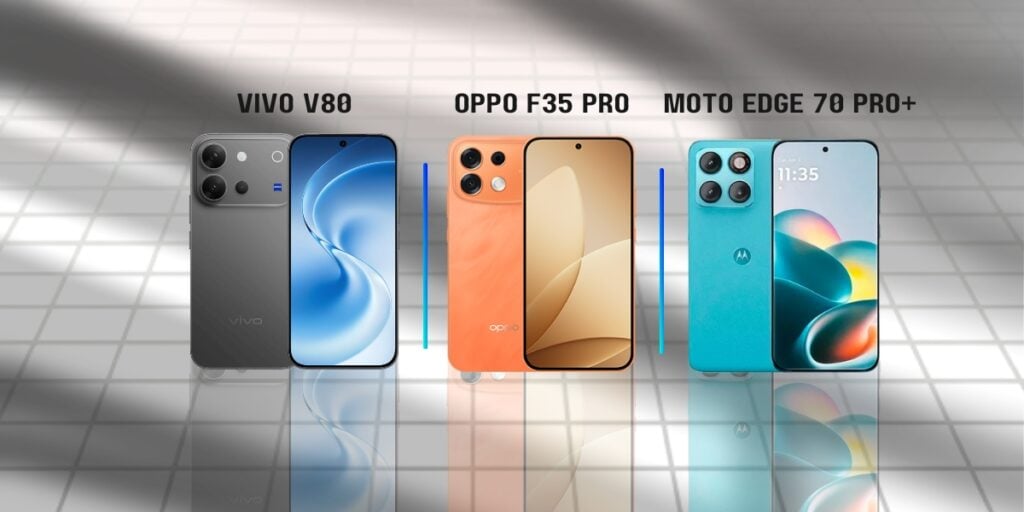
So, what does the extra money get you, and how does the V80 compare with phones in a similar price range? To find out, we’re comparing it with the recently launched Oppo F35 Pro and the Motorola Edge 70 Pro+, which sits in a similar segment to Oppo’s offering.
1. Price in India
| Phone | Variant | Launch price |
| Vivo V80 | 8GB + 128GB | Rs 62,999 |
| Vivo V80 | 8GB + 256GB | Rs 69,999 |
| Vivo V80 | 8GB + 512GB | Rs 79,999 |
| Oppo F35 Pro 5G | 6GB + 128GB | Rs 45,999 |
| Oppo F35 Pro 5G | 8GB + 128GB | Rs 49,999 |
| Oppo F35 Pro 5G | 8GB + 256GB | Rs 54,999 |
| Motorola Edge 70 Pro+ | 12GB + 256GB | Rs 47,999 |
Vivo is offering up to 10% instant cashback or an exchange bonus, depending on the retailer and payment method. Buyers also get Google One cloud storage at no extra cost, along with discounted V-Shield protection and extended warranty plans. Even with the full 10% discount, the base V80 costs around Rs 56,700.
Motorola lists an effective price of Rs 44,999 for the Edge 70 Pro+ after applicable offers. The Oppo F35 Pro 5G goes on sale on October 11 through Oppo’s stores, Flipkart, and Amazon. The Vivo V80 follows on October 13 through Vivo’s online store, Amazon, Flipkart, and retail outlets. Motorola’s phone has been available since June 11.
2. Design and display
The Motorola Edge 70 Pro+ is the thinnest and lightest of the three at 7.19mm thickness and 190g weight. It has a 6.8-inch AMOLED display with a 2772 x 1272 resolution, a 144Hz refresh rate and up to 5,200 nits of peak brightness. Its screen also supports HDR10+, 10-bit colour and 100% DCI-P3 coverage.
The Vivo V80 uses a smaller 6.59-inch AMOLED panel with a 2750 x 1260 resolution and a 144Hz refresh rate. It reaches 5,000 nits of local peak brightness and supports HDR10+, 4320Hz PWM dimming, and up to 1 nit of minimum brightness. However, the 144Hz refresh rate is available only in selected apps.
Oppo’s F35 Pro 5G sits between the other two in screen size, with a 6.77-inch AMOLED panel offering a 2772 x 1272 resolution and a maximum 144Hz refresh rate. Its peak brightness is rated at 3,600 nits, below the other two phones, but you’re unlikely to see a difference.
As for the build, the Edge 70 Pro Plus has a plastic frame, a Gorilla Glass 7i front, and three back finishes inspired by silk, twill and wood. The Vivo V80 has a glass back and includes a charger, case, and pre-applied screen protector in the box. Meanwhile, Oppo uses an aluminium alloy frame and a thicker body, measuring 8.4mm and weighing 210g.
3. Cameras
The camera is probably where the three phones differ the most. The Vivo V80 has three ZEISS-tuned rear cameras, including a 50MP Sony LYTIA 700V main sensor with optical image stabilisation (OIS) and a 50MP Sony IMX882 telephoto camera with 3x optical zoom. An 8MP ultrawide camera completes the setup. The telephoto camera also supports portrait photography with 85mm and 100mm framing options.
Its front camera is a 50MP unit with autofocus and a 92-degree field of view. The phone records 4K video at 60fps and includes cinematic colour styles, AI lighting effects, and portrait tools.
The Motorola Edge 70 Pro+ also has three 50MP rear cameras, but its telephoto camera offers 3.5x optical zoom through a periscope lens. Its 50MP ultrawide camera has a 122-degree field of view, compared with the 8MP ultrawide sensors on the Vivo and Oppo. Motorola also supports 4K video recording at 60fps with HDR10+, along with slow-motion recording at 4K and 120fps.
The Oppo F35 Pro hones a 50MP main camera with OIS and an 8MP ultrawide camera. It has no telephoto lens, although its 50MP front camera offers a wider 100-degree field of view than the Vivo’s selfie camera. Both front and rear cameras support 4K recording at 30fps.
So in the end, Vivo and Motorola have the advantage in zoom photography and higher-frame-rate 4K video.
4. Performance and battery life
Now, when it comes to raw power, Motorola has the strongest hardware on paper. The Edge 70 Pro+ runs on the MediaTek Dimensity 8500 Extreme, paired with 12GB of LPDDR5X RAM and UFS 4.1 storage. It also has a 4,600 mm² vapour chamber for cooling.
The Vivo V80 uses Qualcomm’s Snapdragon 7 Gen 4 with 8GB of LPDDR4X RAM and UFS 3.1 storage. Oppo’s F35 Pro 5G runs on the Dimensity 7360 Max, also with LPDDR4X RAM and UFS 3.1 storage. Both phones lack a memory card slot.
Battery capacity favours Oppo, whose phone packs an 8,000mAh battery and supports 80W wired charging. Vivo has a 7,200mAh battery with 90W charging, while Motorola uses a smaller 6,500mAh silicon-carbon battery with 90W wired and 15W wireless charging. Motorola also supports reverse wireless charging.
The three manufacturers use different testing methods for their battery-life claims, so their advertised endurance figures are not directly comparable. Still, Oppo has the largest battery, while Motorola is the only one here with wireless charging.
5. Software, durability and connectivity
The Vivo V80 ships with OriginOS 7 based on Android 17, and Vivo promises up to six years of security updates. Oppo’s F35 Pro 5G runs ColorOS 16.5, with three Android version upgrades and four years of security patches. Motorola ships the Edge 70 Pro+ with Android 16, three OS upgrades and five years of security updates.
All three phones have extensive water and dust resistance ratings. The Oppo carries IP66, IP68, IP69, and IP69K ratings, while Vivo has IP68 and IP69 protection. Motorola combines IP68 and IP69 ratings with MIL-STD-810H certification. These ratings do not make the phones immune to water damage, and none of the three warranties covers liquid damage.
Connectivity gives Motorola another advantage, with NFC, Wi-Fi 6E support listed on its specifications sheet, Bluetooth 5.4, and wireless audio support. Vivo also includes NFC, an infrared blaster, and stereo speakers. Oppo supports Wi-Fi 6 and an infrared remote but lacks NFC, which may matter to people who use contactless payments.
6. Which phone should you buy?
The Motorola Edge 70 Pro+ looks like the strongest overall value at Rs 47,999, or Rs 44,999 with offers. It combines the fastest chipset, 12GB of faster RAM, UFS 4.1 storage, a periscope telephoto camera, a 50MP ultrawide sensor, and wireless charging. Its smaller battery and plastic frame are the main trade-offs.
The Oppo F35 Pro 5G is the more affordable choice, starting at Rs 45,999. Its 8,000mAh battery, wide selfie camera, and extensive durability ratings make it worth considering, although the lack of a telephoto camera and NFC limits its appeal.
The Vivo V80 has a capable ZEISS-tuned camera system, a bright 144Hz display, 4K recording at 60fps, and a longer promised security-support period. However, its starting price of Rs 62,999 and top price of Rs 79,999 put it well above the other two.
Based on the specifications alone, the Motorola offers more hardware for the money, while the Oppo is a better fit for buyers who want a large battery without spending as much. The Vivo’s higher price is harder to justify unless its camera experience and software features prove worth the extra cost in real-world use.
For more daily updates, please visit our News Section.
Stay ahead in tech! Join our Telegram community and sign up for our daily newsletter of top stories!