
Add GIZMOCHINA as Preferred Source on Google
The OnePlus 16 brings a 9,000mAh battery, a 200MP main camera, and a display that can reach 185Hz in supported games. But the iQOO 16 has a few reasons to make OnePlus work for its place in the flagship race. It pairs the same generation of Snapdragon flagship processor with a dedicated Q4 gaming chip, a sharper 2K 165Hz display, and three 50MP rear cameras, including a periscope telephoto lens.
The differences aren’t just in the spec sheet. OnePlus has a bigger battery and a higher-resolution main camera, while iQOO, as usual, places more emphasis on gaming hardware and display resolution. Both phones also support 100W wired charging, so neither has an obvious advantage there. Here’s how the iQOO 16 and OnePlus 16 compare in performance, display, battery life, cameras, and gaming features.
1. Chip and cooling
You get the same processor in both phones. It’s a 2nm Snapdragon 8 Elite Extreme Gen 6 with two prime cores at up to 5GHz. The difference is in what each brand adds around it.
The iQOO 16 pairs the chip with iQOO’s Q4 gaming chip and a self-developed scheduler it calls the Monster Super Core Engine. iQOO says the Q4 improves performance by 15% over the Q3 chip in the iQOO 15.
The Q4 powers features such as real-time ray tracing in 10 popular games, plus super-resolution and frame generation. iQOO says hundreds of games support 165fps through frame generation, and a few titles, including Delta Force and Dark Zone, run at native 165fps.
The OnePlus 16 relies on a different setup. OnePlus has a gaming layer in the chip called the Wind Chaser Game Core. It also adds its three-chip esports system: a G3 network chip, a Lingxi T3 touch chip, and a P4 display chip. OnePlus targets 185fps in supported games, which is 20fps above the iQOO 16’s 165fps target. OnePlus says Delta Force held an average of 185fps for three hours in its lab.
As for cooling, the iQOO 16 has an 8,500mm² vapor chamber, three layers of graphite covering 29,453mm² and a large thermal gel layer. The OnePlus 16 uses a new-generation Glacier vapor chamber with a graphite layer rated at 2,100 W/m·K. OnePlus says its vapor chamber is 40% better and its thermal gel is 50% better than before. Both brands test in their own labs, so wait for independent thermal tests before you pick a side.
2. Display
The iQOO 16 has a 6.85-inch Samsung M16 AMOLED panel at 2K resolution (3168 x 1440), with a refresh rate of up to 165Hz. It reaches 10,000 nits of local peak brightness and about 2,800 nits full-screen, according to iQOO.
iQOO says more than 50 popular games run natively at 165Hz, and that the 165Hz mode works in more than 100 everyday apps once you turn it on in Developer Mode.
The OnePlus 16 has a smaller 6.78-inch BOE panel at 1.5K resolution. It supports 165Hz across the whole system, and up to 185Hz in supported games. OnePlus lists 2,000 nits of peak brightness, PWM dimming at 3,840Hz, and a minimum brightness of 1 nit. The screen carries TÜV Rheinland Eye Comfort 6.0 certification.
3. Battery and charging
The OnePlus 16 has a 9,000mAh battery, which is 600mAh larger than the iQOO 16’s 8,400mAh cell. We covered the OnePlus 16 battery details when OnePlus confirmed the figure.
The iQOO 16 uses fifth-generation silicon-anode technology, which iQOO claims offers 8.6 hours of 165fps gaming. Meanwhile, OnePlus 16 is rated for 8.1 hours of a MOBA game at 120fps and above, 23.8 hours of video playback, and 13.6 hours of navigation. The two brands use different games and test conditions, so you can’t compare those run times directly.
Charging favors the OnePlus 16 on the wireless side:
- Wired charging: Both phones support 100W. OnePlus rates a full charge from 1% at 52 minutes.
- Wireless charging: 50W on the OnePlus 16, 40W on the iQOO 16.
- Reverse charging: The OnePlus 16 supports 27W wired reverse charging for earbuds and watches.
- Bypass charging: Both phones can power the device directly from a charger during gaming. The iQOO 16 needs you to turn it on manually.
4. Cameras
The OnePlus 16 has the higher-resolution main sensor, and the iQOO 16 has the lower-resolution one with a slightly larger sensor than you might expect. Here’s a side-by-side comparison:
- Main camera: The iQOO 16 uses a 50MP sensor measuring 1/1.3 inches with an f/1.68 lens and CIPA 5.5 stabilization. iQOO says it gathers 79% more light than the iQOO 15 Ultra. The OnePlus 16 uses a 200MP sensor measuring 1/1.4 inches with optical stabilization, and lets you shoot at the full 200MP and crop afterward.
- Telephoto: Both phones have a 50MP periscope lens with 3x optical zoom and a 1/1.95-inch sensor. The iQOO 16 uses a Sony sensor with an f/2.65 lens. Both list 6x as lossless zoom, and iQOO adds 100x digital zoom.
- Ultra-wide: Both have a 50MP lens. The iQOO 16 uses a 1/2.75-inch sensor, and the OnePlus 16 lists a 116-degree field of view.
- Front camera: The OnePlus 16 has a 50MP autofocus camera, and the iQOO 16 has a 32MP camera.
On the software side, the iQOO 16 uses Vivo’s imaging tools, including the NICE 3.0 optical engine and a Humanistic Mode for street and portrait shots. The OnePlus 16 uses Oppo’s imaging system with a Master Mode for film-style tones and a text-prompt AI retouching tool. Both record 4K video, and the OnePlus 16 supports 4K at 120fps with Dolby Vision.
5. Gaming controls and connectivity
Both phones add custom hardware for touch, motion, and network.
- Touch: The iQOO 16 samples touch at up to 5,000Hz instantaneously and 500Hz for multiple fingers. The OnePlus 16 samples multi-finger touch at up to 520Hz. These apply only in select games.
- Gyroscope: The OnePlus 16 samples at 800Hz, against 500Hz on the iQOO 16.
- Network: The iQOO 16 uses a Wi-Fi enhancement chip with a side cellular antenna and a ring Wi-Fi antenna. iQOO claims 34% better Wi-Fi performance and 17% better cellular gaming antenna performance than the iQOO 15. The OnePlus 16 uses the G3 chip, which OnePlus says cuts cellular gaming latency by 42.1%.
- Haptics and audio: The iQOO 16 has a dual-axis vibration motor and symmetrical dual speakers. The OnePlus 16 has an X-axis linear motor and stereo speakers.
- Extras: The iQOO 16 supports a PC game emulator, a large-screen game mode, and an iQOO G1 gamepad, which is sold separately. The OnePlus 16 has a one-tap Gun God Mode for several shooters, and an optional gamepad.
6. Software and design
The iQOO 16 runs OriginOS 7, and the OnePlus 16 runs ColorOS 17. Both are based on Android 17, and both have ultrasonic fingerprint sensors.
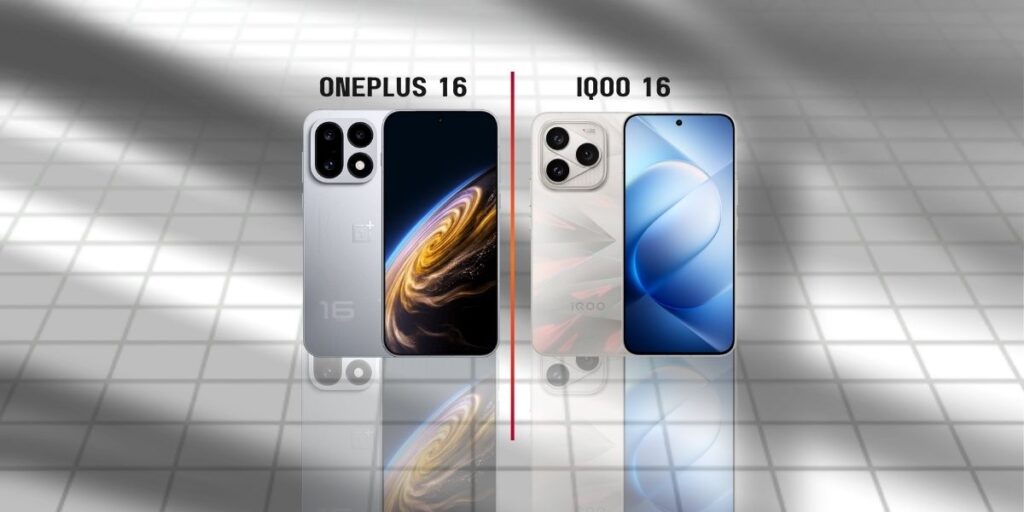
The designs differ more than the spec sheets suggest. The iQOO 16 has a transparent camera window with a robotic-arm look, and a laser-holographic finish on the Chasing Light color. It comes in Chasing Light, Track, and Legend.
The OnePlus 16 keeps the flat frame and square camera island of the OnePlus 15, and comes in Tomorrow Starlight, Mars Red, and a deep black. Only Tomorrow Starlight has the interstellar lighting effect. The OnePlus 16 has a stronger dust and water rating, with IP66, IP68, IP69, and IP69K, while the iQOO 16 has IP68 and IP69.
7. Price and availability
Both phones start at 5,999 yuan (about $896) for the 12GB+256GB model and top out at 8,499 yuan (about $1,270) for the 16GB+1TB configuration. By comparison, the OnePlus 16 is 2,000 yuan more expensive than the OnePlus 15’s 3,999 yuan starting price. The iQOO 16 has also seen a steep price increase, launching at 1,800 yuan more than its predecessor.
Neither phone has a confirmed global launch. OnePlus has stopped launching new phones in North America and Europe. The iQOO 16 has appeared at Europe’s EEC certification and on Geekbench, which suggests a wider release, but iQOO has not announced a date.
8. iQOO 16 vs OnePlus 16: Specs comparison
| Specification | iQOO 16 | OnePlus 16 |
| Processor | Snapdragon 8 Elite Extreme Gen 6 | Snapdragon 8 Elite Extreme Gen 6 |
| Display | 6.85-inch 2K AMOLED, 165Hz | 6.78-inch OLED, 1.5K resolution, up to 185Hz in supported games |
| Gaming chip | Dedicated Q4 gaming chip | No separate gaming chip specified |
| RAM and storage | Up to 16GB RAM, 1TB storage | Up to 16GB RAM, 1TB storage |
| Main camera | 50MP, 1/1.3-inch sensor | 200MP, 1/1.4-inch sensor |
| Telephoto camera | 50MP Sony periscope, 3x optical zoom | 50MP telephoto, 3x optical zoom |
| Ultrawide camera | 50MP | 50MP |
| Front camera | 32MP | 50MP |
| Battery | 8,400mAh | 9,000mAh |
| Wired charging | 100W | 100W |
| Wireless charging | 40W | 50W |
| Software | OriginOS 7 | Android 17 with ColorOS 17 in China |
For more daily updates, please visit our News Section.
Stay ahead in tech! Join our Telegram community and sign up for our daily newsletter of top stories!