
Add GIZMOCHINA as Preferred Source on Google
The Snapdragon 4 Gen 4 has quietly become a popular chipset in the lower mid-range segment because of skyrocketing chip prices. Built using a 4nm process, the chipset delivers reliable performance, modern connectivity stack, and strong power efficiency.
On the other hand, the Snapdragon 6s Gen 3 is built using an older 6nm node, but it has its own set of capabilities that are better when compared to the Snapdragon 4 Gen 4.
So, which one delivers the better value overall? Let’s dive into benchmark numbers and crucial hardware differences to find out.
Snapdragon 4 Gen 4 vs 6s Gen 3: Spec sheet
| Snapdragon 4 Gen 4 | Snapdragon 6s Gen 3 | |
|---|---|---|
| Announced | December 2025 | June 2024 |
| Process node | 4nm (Samsung) | 6nm (TSMC) |
| CPU | 2 x 2.3 GHz — Cortex-A78 6 x 2.0 GHz — Cortex-A55 | 2 x 2.3 GHz — Cortex-A78 6 x 2.0 GHz — Cortex-A55 |
| GPU | Adreno 613 1010 MHz frequency | Adreno 619 900 MHz frequency |
| NPU | Yes | Hexagon NPU |
| Memory | LPDDR5 up to 3.2 GHz speed | LPDDR4X up to 2.1 GHz speed |
| Storage | UFS 2.2, UFS 3.1 | UFS 2.2 |
| Camera | Qualcomm Spectra Dual ISP (12-bit) up to 108MP single camera up to 36MP single camera with zero shutter lag up to 16MP dual cameras with zero shutter lag up to 1080p video recording at 60fps 720p slow-mo video recording at 120fps | Qualcomm Spectra Triple ISP (12-bit) up to 108MP single camera up to 32MP single camera with zero shutter lag up to 1080p video recording at 60fps 720p slow-mo video recording at 120fps |
| Connectivity | Snapdragon 5G modem (sub-6 GHz) up to 2.5 Gbps download speed up to 0.9 Gbps download speed Wi-Fi 5, Wi-Fi 4 Bluetooth 5.1 | Snapdragon X51 5G modem (mmWave, sub-6 GHz) up to 2.5 Gbps download speed Wi-Fi 5, Wi-Fi 4 Bluetooth 5.2 |
Snapdragon 4 Gen 4 vs 6s Gen 3: Benchmark score
Note: The benchmark tests were carried out on the POCO M8 Power 5G (powered by the Snapdragon 4 Gen 4) and the POCO M7 Plus (powered by the Snapdragon 6s Gen 3).
Geekbench score (CPU)
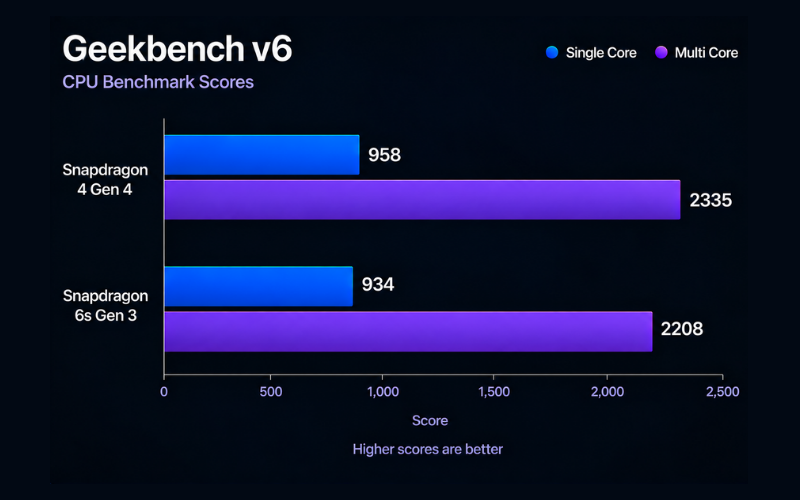
The POCO M8 Power 5G, powered by the Snapdragon 4 Gen 4, has scored 958 in the single-core test on Geekbench. It’s just 2.5% higher than 958 single-core points scored by the Snapdragon 6s Gen 3-powered Poco M7 Plus 5G.
Multi-core results don’t have a significant gap either. The Snapdragon 4 Gen 4 has scored 2208 points, while the Snapdragon 6s Gen 3 is just behind with a total of 2208 points — a modest different of 5.75%.
| Snapdragon 4 Gen 4 | Snapdragon 6s Gen 3 | |
|---|---|---|
| Single core | 958 | 934 |
| Multi core | 2,335 | 2,208 |
AnTuTu score
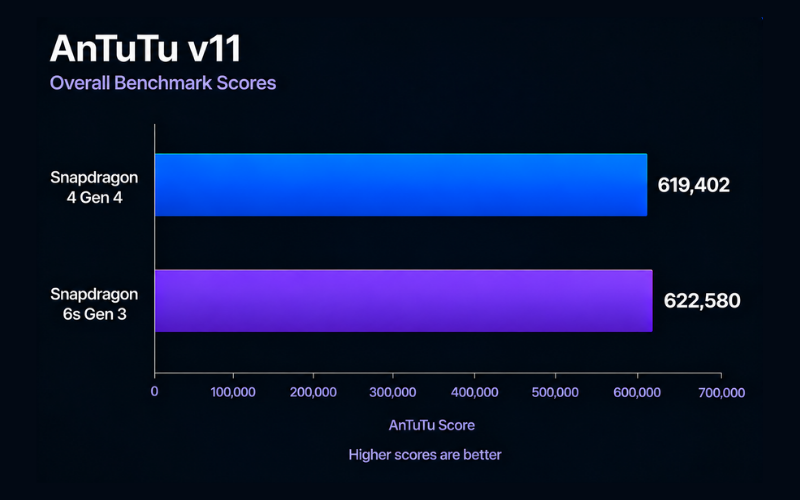
On AnTuTu v11, the Snapdragon 4 Gen 4-powered POCO M8 Power 5G has scored a total of 619,402 points. The POCO M7 Plus 5G, driven by the Snapdragon 6s Gen 3, gets a higher score — 622,580, though the different is very thin.
Things become a lot clearer when you look at the breakdown of the AnTuTu score.
| Snapdragon 4 Gen 4 | Snapdragon 6s Gen 3 | |
|---|---|---|
| AnTuTu score | 619,402 | 622,580 |
| CPU | 251,960 | 256,136 |
| GPU | 36,195 | 60,739 |
| Memory | 148,857 | 125,522 |
| UX | 182,390 | 180,184 |
The CPU scores are still pretty close as we saw on Geekbench, but the GPU scores bring a significant difference. The Snapdragon 6s Gen 3 delivers 67% better GPU score. The Snapdragon 4 Gen 4 pulls ahead in the memory performance with an 18% higher score, while the UX score is just 1% higher.
Benchmarks performance show the two Snapdragon chips have nearly similar CPU performance but the Snapdragon 6s Gen 3 shines when it comes to GPU. That should also mean it will deliver better gaming performance.
Let’s now look at the other aspects of the chips, such as camera capability and connectivity, to get a better picture.
1. Qualcomm denies Snapdragon 8 Elite Extreme Gen 6 overheating allegations on Galaxy S27 Ultra, but there’s a catch
2. Qualcomm beats Arm in high-stakes licensing dispute, yet walks away with just $2
Snapdragon 4 Gen 4 vs 6s Gen 3: Differences that matter
The Snapdragon 4 Gen 4 is built using Samsung’s 4nm node, whereas the 6s Gen 3 uses an older TSMC’s 6nm node. This gives the Snapdragon 4 Gen 4 an edge in power efficiency.
The CPU configurations are exactly the same. However, the GPU differences bring a rather bigger impact. The Snapdragon 4 Gen 4 has an entry-level Adreno 613 GPU, while the Snapdragon 6s Gen 3 brings a more robust Adreno 619 GPU.
Even though the 4 Gen 4 is built using a newer process node and supports faster memory, its graphics capabilities are heavily stripped down. That’s why it scores much lower on the above benchmarks.
In terms of imaging performance, both chips have a 12-bit ISP but the Snapdragon 4 Gen 4 supports data streams from three cameras simultaneously, which is limited to two on the 6s Gen 3. The 4 Gen 4 chip also benefits from zero shutter lag at higher resolution.
Both Snapdragon 4 Gen 4 and Snapdragon 6s Gen 3 have integrated 5G modems with up to 2.5Gbps of peak download speed. One key difference here is that the 4 Gen 4 lacks mmWave support, which enables faster speed over very short distances. It brings Bluetooth 5.1 standard, while the 6s Gen 3 has a newer Bluetooth 5.2.



Comments