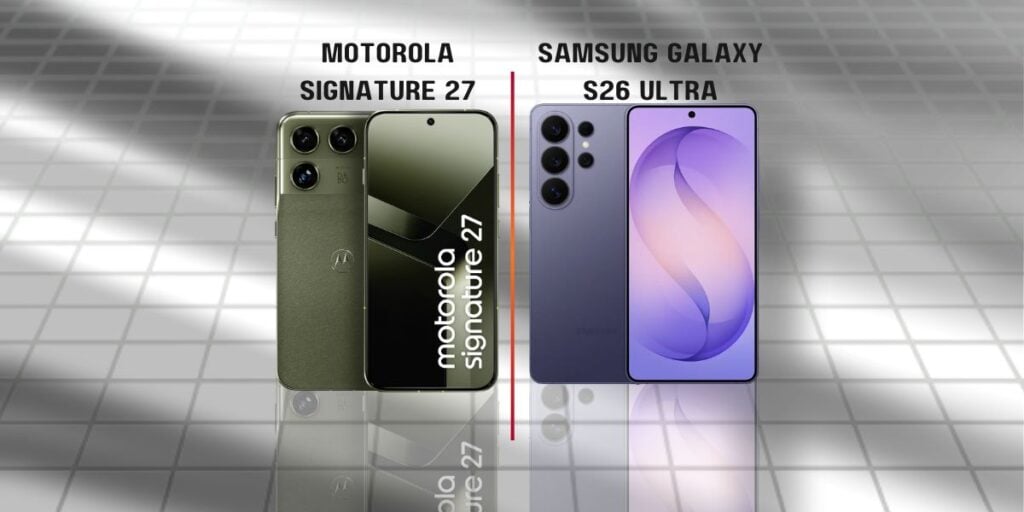
The Galaxy S26 Ultra has a stylus tucked into its frame and a screen that can keep people sitting next to you from reading over your shoulder. The Motorola Signature 27 has neither. Instead, it comes with a newer processor and a battery that’s 2,000mAh bigger. So while Samsung has a few tricks Motorola can’t match, the newer phone has some hardware advantages of its own.
The two phones are now competing at the same price, which makes the decision a little more interesting. Samsung brought out the Galaxy S26 Ultra in February with Qualcomm’s Snapdragon 8 Elite Gen 5, while Motorola Signature 27 arrived this month with the new Snapdragon 8 Elite Extreme Gen 6.
So, is it worth going with Motorola’s newer hardware, or does Samsung still give you more for your money? Let’s look at where the two phones differ.
1. Which phone is faster?
Motorola has the newer silicon, so no prize for guessing; it’s the better one here. According to Qualcomm, the Snapdragon 8 Elite Extreme Gen 6 inside the Signature 27 has 13% better CPU and 44% GPU performance than the Snapdragon 8 Elite Gen 5. Its prime cores can reach 5.01GHz.
Samsung’s Galaxy S26 Ultra isn’t exactly short on power, though. It runs a custom Snapdragon 8 Elite Gen 5 for Galaxy, a 3nm chip with a maximum clock speed of 4.74GHz. Samsung claims its CPU is up to 19% faster than last year’s model.
The company has also reworked the vapor chamber to help distribute heat more evenly, which should come in handy when the phone is under sustained load.
Motorola has made some changes on that front, too. The Signature 27’s ArcticMesh cooling system is 40% larger than the one in the original Motorola Signature. It combines diamond-infused thermal gel, liquid metal and a 3D vapor chamber to keep temperatures in check.
Of course, neither phone is likely to give you trouble with everyday apps, multitasking or browsing. The newer Snapdragon could make a bigger difference during long gaming sessions and demanding on-device AI tasks, but it’s better to go through real-world comparisons to see how much of an advantage it actually brings.
2. Which screen is better?
Samsung has the more detailed display, although Motorola has a few numbers of its own to put forward. The Galaxy S26 Ultra’s 6.9-inch Dynamic AMOLED 2X panel runs at 1,440 x 3,120 pixels, giving it around 500ppi. It also has an adaptive refresh rate that drops to 1Hz when a higher rate isn’t needed and climbs to 120Hz when you’re scrolling or playing games. Peak brightness is rated at 2,600 nits.
But resolution isn’t the only reason to look at Samsung’s screen. The built-in Privacy Display is arguably its more interesting addition. It makes the screen difficult to read from the sides, so people sitting next to you won’t easily see your messages or other private information. Samsung calls it the first feature of its kind on a smartphone.
Motorola goes with a 6.8-inch Extreme AMOLED Duo panel on the Signature 27. Its 1,264 x 2,780 resolution works out to around 449ppi, so it’s not quite as sharp as Samsung’s display. It does support Dolby Vision, however, and Motorola claims peak brightness of up to 12,000 nits.
For everyday use, both displays should be more than capable. Samsung has the advantage if you care about sharpness or regularly use your phone around other people. Motorola’s brightness claim is worth keeping an eye on, but we’d like to see more comparable measurements before concluding.
3. Who wins on cameras?
Samsung gives the Galaxy S26 Ultra four rear cameras, with a 200MP main sensor measuring 1/1.3 inches and paired with an f/1.4 lens. There’s also a 50MP ultrawide camera, while two telephoto cameras handle zoom. One has a 10MP sensor with 3x optical zoom, and the other is a 50MP periscope camera with 5x optical zoom. The selfie camera comes with a 12MP sensor.
Samsung also advertises up to 100x zoom, although the more interesting addition for video creators is support for the APV professional video codec. The Galaxy S26 Ultra is the first phone in the Galaxy lineup to include it.
Motorola has taken a different route with the Signature 27. Its main camera is a 50MP Sony LYTIA L910 sensor with LOFIC technology and optical image stabilization. Motorola says LOFIC helps retain details in bright and dark areas of the same image, something that can be useful in scenes with challenging lighting.
The 200MP sensor is actually on the periscope telephoto camera, which provides 3x optical zoom. It works alongside a 50MP ultrawide camera and a dedicated EVS Action Sensor for capturing fast-moving subjects in low-light conditions. For more distant shots, Motorola’s Super Zoom Pro can reach 100x using generative AI sharpening. The company also highlights a DXOMARK Gold label.
What’s interesting here is how differently the two companies have used their camera hardware. Samsung puts its highest-resolution sensor on the main camera and gives you two dedicated optical zoom options. Motorola saves the 200MP sensor for zoom photography and relies on a single 3x optical zoom level.
Neither setup is automatically better, and the specifications alone don’t tell us how the cameras compare in real-world photography. The Signature 27 has only recently reached buyers, so independent head-to-head tests are still limited. Those comparisons should give us a better idea of whether Motorola’s 200MP periscope can compete with Samsung’s dual-telephoto arrangement.
4. How long will each battery last?
This is one area where Motorola has a fairly straightforward advantage. The Signature 27 packs a 7,000mAh silicon-carbon battery, although its rated capacity is 6,790mAh. Samsung, on the other hand, has stuck with a 5,000mAh battery for the Galaxy S26 Ultra. That’s a 2,000mAh difference, or 40% more capacity for Motorola.
The gap continues when you plug the phones in. Motorola supports 90W wired charging and 50W wireless charging, while Samsung tops out at 60W wired and 25W wireless. Motorola claims a quick 12-minute charge can provide enough power for a day and advertises up to 77 hours of mixed-use battery life. You’ll have to buy its charger separately, though.
Samsung has kept the same battery capacity as the Galaxy S25 Ultra, but at least charging is faster this year. The S26 Ultra is the first phone in the Ultra series to support 60W wired charging. That’s an improvement, even if it still falls behind Motorola’s numbers.
5. What do they feel like in your hand?
Despite having a slightly larger screen, the Galaxy S26 Ultra is actually the lighter of the two. It measures 163.6 x 78.1 x 7.9mm and weighs 214g, compared with 162.01 x 77.04 x 7.99mm and 227g for the Motorola Signature 27. Motorola’s phone is a little shorter and narrower, but it’s also 13g heavier.
Samsung uses an aluminum frame and has revised the camera layout for this generation. The phone comes in Black, Cobalt Violet, Sky Blue, and White, with Silver Shadow and Pink Gold also available through Samsung’s website. It carries an IP68 rating for dust and water resistance.
Motorola has gone with different back finishes for its two color options. Pantone Coal Smoke comes with a Tactical Weave finish, while Pantone Capulet Olive has a brushed textile-style look. The Signature 27 also has IP68 and IP69 ratings, along with 14 MIL-STD-810H procedures across 16 categories, according to Motorola.
So there’s a bit of a trade-off here. Samsung’s phone is easier to carry around if weight matters to you, while Motorola puts more emphasis on durability certifications and gives buyers a couple of unusual finishes.
6. Which software is better?
Hardware aside, the software experience is another reason these phones feel quite different. The Galaxy S26 Ultra runs One UI 8.5 based on Android 16, with Galaxy AI and Samsung DeX included. But the feature that really separates it from Motorola is still the S Pen.
Having a stylus built into the phone means you can pull it out whenever you need to jot something down, annotate a document or sign a file. It’s a feature that won’t matter to everyone, but if you’ve grown used to having an S Pen around, there’s no direct replacement on the Signature 27.
Motorola ships its phone with Android 17, along with Gemini Intelligence and Motorola Qira. The latter can help users find and recall information across apps, although it requires a Motorola or Lenovo account and at least 12GB of RAM. The phone also includes RAM Boost, which can extend available memory up to 24GB.
There’s another first for Motorola here: the Signature 27 is the company’s first phone with Audio by Bang & Olufsen.
Both manufacturers are promising long-term support. Motorola advertises seven OS updates and up to seven years of security updates, while Samsung has maintained its existing update pledge. It’s worth checking the exact terms for your region before making a purchase.
7. What do they cost?
The Motorola Signature 27 is available in the US for $1,599.99, but there’s only one configuration to choose from: 12GB of RAM and 512GB of storage. It’s sold unlocked and supports Verizon, AT&T, and T-Mobile.
Meanwhile, you can get the S26 Ultra in varying options. The Galaxy S26 Ultra originally launched at $1,299.99, but its prices went up in October. The 256GB model now costs $1,399.99, the 512GB version is $1,599.99, and the 1TB option reaches $1,999.99. Even so, retailers such as Amazon and Best Buy have already started selling the phone below its revised list prices.
That makes the comparison a little awkward for Motorola. At 512GB, the two phones cost exactly the same, but Samsung’s flagship has been on the market long enough to pick up discounts. You can also spend $200 less by going with the 256GB Galaxy S26 Ultra. Motorola doesn’t currently give US buyers that option.
8. Motorola Signature 27 vs Galaxy S26 Ultra
| Specification | Motorola Signature 27 | Galaxy S26 Ultra |
| Chipset | Snapdragon 8 Elite Extreme Gen 6 (2nm) | Snapdragon 8 Elite Gen 5 for Galaxy (3nm) |
| Display | 6.8-inch Extreme AMOLED Duo | 6.9-inch Dynamic AMOLED 2X |
| Resolution | 1,264 x 2,780 | 1,440 x 3,120 |
| Peak brightness claim | Up to 12,000 nits | Up to 2,600 nits |
| Main camera | 50MP Sony LYTIA L910 | 200MP, f/1.4 |
| Telephoto | 200MP periscope, 3x | 10MP 3x and 50MP periscope 5x |
| Ultrawide | 50MP | 50MP |
| Battery | 7,000mAh | 5,000mAh |
| Wired charging | 90W | 60W |
| Wireless charging | 50W | 25W |
| Weight | 227g | 214g |
| Water and dust rating | IP68 and IP69 | IP68 |
| Software | Android 17 | One UI 8.5 on Android 16 |
| US starting price | $1,599.99 (12GB and 512GB) | $1,399.99 (256GB) |
FREE NEWSLETTER
Get Gizmochina Daily
Every morning: the phone and gadget news that matters, with our take. 4 minutes.