
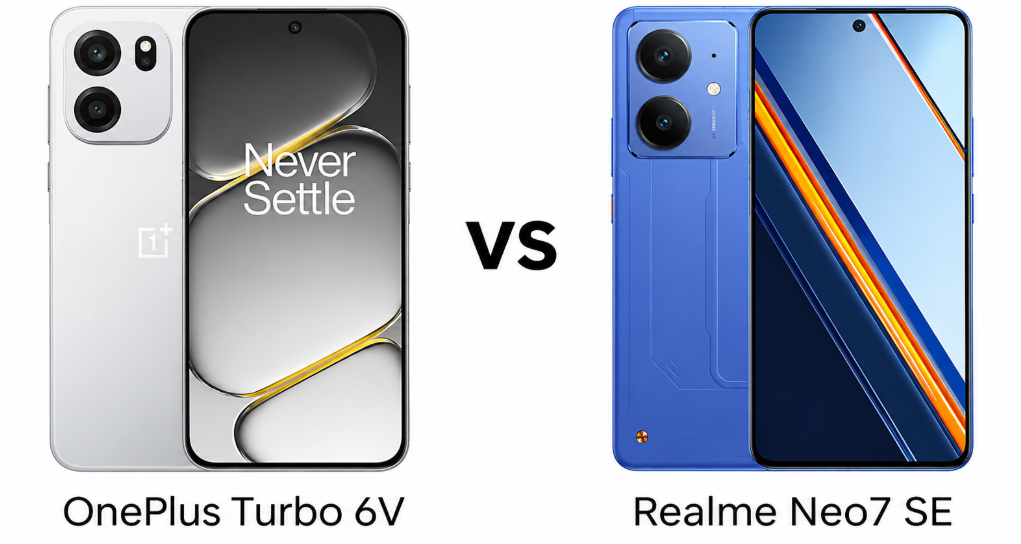
OnePlus Turbo 6V and Realme Neo7 SE target buyers who want flagship-inspired features without spending flagship money. Both combine powerful hardware, large batteries and durable builds, but they take different approaches to performance, display technology and everyday usability. The comparison becomes particularly interesting when considering their similar pricing and different strengths.
1. Major Features:
| Category | OnePlus Turbo 6V | Realme Neo7 SE | Winner |
|---|---|---|---|
| Display Type | AMOLED | LTPO OLED | Realme – LTPO technology and HDR support |
| Display Size | 6.78 inches | 6.78 inches | Tie – Same screen size |
| Resolution | 1272 × 2772 pixels | 1264 × 2780 pixels | OnePlus – Slightly higher resolution |
| Refresh Rate | 144Hz | 120Hz | OnePlus – Higher refresh rate |
| Peak Brightness | 1800 nits | 6000 nits | Realme – Higher peak brightness |
| PWM Dimming | 3840Hz | Not specified | OnePlus – Higher-frequency PWM dimming |
| Display Protection | Not specified | Crystal Armor glass | Realme – Dedicated screen protection |
| Operating System | Android 16, ColorOS 16 | Android 15, Realme UI 6.0 | OnePlus – Newer Android version |
| Processor | Snapdragon 7s Gen 4 | Dimensity 8400 Max | Realme – More powerful chipset |
| GPU | Adreno 810 | Mali-G720 | Realme – Stronger overall gaming platform |
| RAM | Up to 12GB | Up to 16GB | Realme – Higher RAM capacity |
| Storage | Up to 512GB | Up to 512GB | Tie – Same maximum capacity |
| Storage Type | UFS 3.1 | UFS 4.0 | Realme – Faster storage technology |
| Rear Camera | 50MP main + auxiliary sensor | 50MP main + 8MP ultrawide | Realme – Dedicated ultrawide camera |
| Main Camera OIS | Yes | Yes | Tie – Both support OIS |
| Rear Video | 4K@60fps | 4K@60fps | Tie – Same maximum recording resolution |
| Selfie Camera | 16MP | 16MP | Tie – Same resolution |
| Selfie HDR | Yes | Not specified | OnePlus – HDR support |
| Stereo Speakers | Yes | Yes | Tie – Both feature stereo speakers |
| Hi-Res Audio | Not specified | 24-bit/192kHz | Realme – Hi-Res audio support |
| Bluetooth | 5.4 | 5.4 | Tie – Same Bluetooth version |
| NFC | Yes | Yes | Tie – Both support NFC |
| Infrared Port | Yes | Yes | Tie – Both include an IR blaster |
| Water Resistance | IP68/IP69K | IP68/IP69 | OnePlus – Higher specified water-jet protection rating |
| Battery Capacity | 9000mAh | 7000mAh | OnePlus – Larger battery |
| Wired Charging | 80W | 80W | Tie – Same charging speed |
| Reverse Charging | 27W wired | Not specified | OnePlus – Reverse wired charging |
| Price | Around $300 / ₹25,000 | Around $250 / ₹22,000 | Realme – Lower starting price |
2. Design and Display
Build and Feel
The OnePlus Turbo 6V and Realme Neo7 SE share a similar design philosophy, prioritising durability and practical everyday use. Both feature IP68/IP69 protection against dust and water, making them more reassuring choices for users who frequently use their phones outdoors. OnePlus offers a slightly more substantial battery-focused design, while Realme keeps its construction relatively compact. Neither phone compromises on essential durability features, although Realme feels like the more conventional option. Both also feature dual Nano-SIM support, catering to users who need separate personal and work connections.
Display Quality
OnePlus equips the Turbo 6V with a 6.78-inch AMOLED display featuring a 144Hz refresh rate and 3840Hz PWM dimming. This gives it an advantage for smoother scrolling and potentially more comfortable viewing. The Realme Neo7 SE counters with a 6.78-inch LTPO OLED panel, supporting 120Hz, HDR and an impressive 6000-nit peak brightness. Its LTPO technology also offers greater refresh-rate flexibility, while Crystal Armor glass adds protection.
Verdict
OnePlus wins on refresh rate and PWM dimming, but Realme offers LTPO technology, HDR and substantially higher peak brightness, making its display more versatile overall.
3. Specifications Including Battery
Performance
The Realme Neo7 SE has a clear processing advantage with its MediaTek Dimensity 8400 Max chipset, paired with Mali-G720 graphics and faster UFS 4.0 storage. The OnePlus Turbo 6V uses the Snapdragon 7s Gen 4, supported by Adreno 810 graphics and UFS 3.1 storage. Although both offer configurations with up to 12GB RAM, Realme also provides a 16GB option. Its more powerful processor and faster storage make it the more convincing choice for demanding games, multitasking and sustained performance. OnePlus, however, runs Android 16 with ColorOS 16, giving it a newer software foundation.
Battery and Charging
Battery capacity is where OnePlus makes its strongest statement. The Turbo 6V packs a massive 9000mAh silicon-carbon battery, considerably larger than the Realme Neo7 SE’s 7000mAh unit. Both support 80W wired charging, but OnePlus adds 27W reverse wired charging, making it useful for powering accessories and other devices. Realme claims approximately 23 minutes to reach 50%, which is impressive considering its battery capacity. However, OnePlus has the advantage in endurance potential, particularly for users who prioritise fewer charging interruptions.
Verdict
Realme wins on processing power and storage speed, but OnePlus takes battery capacity, reverse charging and software generation, making this category a close contest.
4. Camera
Main and Secondary Lenses
The Realme Neo7 SE offers a more versatile rear camera arrangement, combining a 50MP primary sensor with an 8MP ultrawide camera. Its primary camera features optical image stabilisation, phase-detection autofocus and 4K video recording at up to 60fps. The OnePlus Turbo 6V also features a 50MP primary camera with OIS and PDAF, alongside a colour spectrum sensor. However, its secondary camera configuration does not provide the same dedicated ultrawide shooting flexibility. Realme is therefore the more practical option for landscape photography, group shots and wider compositions.
Selfie Camera
Both smartphones feature a 16MP front-facing camera with 1080p video recording at 30fps and gyro-EIS. The OnePlus Turbo 6V additionally includes HDR support for selfies, while Realme focuses on panorama functionality. Neither offers a significant hardware advantage in resolution, so differences in selfie quality will largely depend on image processing and software optimisation. For video calls, casual selfies and social media content, both should deliver a comparable experience. OnePlus has a slight advantage in its front-camera features.
Verdict
Realme wins the camera category with its dedicated 8MP ultrawide lens, giving users greater shooting flexibility. OnePlus delivers a capable primary camera but lacks equivalent versatility.
5. Pricing
The OnePlus Turbo 6V is priced around $300 / ₹25,000, while the Realme Neo7 SE is priced around $250 / ₹22,000. This creates a roughly ₹3,000 difference between the two smartphones, placing them in a competitive mid-range segment. Realme is the more affordable option, despite offering a stronger processor, faster UFS 4.0 storage and a dedicated ultrawide camera. OnePlus asks buyers to spend more for its substantially larger battery, higher refresh-rate display and reverse wired charging capabilities.
Verdict
Realme wins on value for money, offering more versatile hardware at a lower price. OnePlus is worth considering when battery endurance is the priority.
6. Conclusion
The OnePlus Turbo 6V stands out with its enormous 9000mAh silicon-carbon battery, 144Hz AMOLED display, 3840Hz PWM dimming and 27W reverse wired charging. These features make it particularly appealing to users who want extended battery life and additional charging flexibility. The Realme Neo7 SE has a different set of strengths, including its Dimensity 8400 Max processor, UFS 4.0 storage, LTPO OLED display and dedicated ultrawide camera. Its 16GB RAM configuration also gives it an advantage for buyers seeking higher memory capacity.
For everyday buyers, Realme delivers a more balanced package without requiring a higher investment. Its stronger processing capabilities, more versatile rear cameras and advanced display technology make it easier to recommend across different usage scenarios. OnePlus remains an interesting alternative, especially for users who prioritise battery endurance over raw performance. However, its higher asking price makes the overall decision less straightforward.
Verdict
Overall winner: Realme Neo7 SE
The Realme Neo7 SE wins overall with stronger performance, faster storage, a more versatile camera system, and better value. OnePlus Turbo 6V remains the battery endurance champion.
Disclaimer: Prices, specifications, and availability may vary by region and retailer. Recommendations in this article are based on editorial opinion, feature-based value, and market positioning at the time of writing. Readers are advised to do their own research before making a purchase.
Read More:
- OnePlus 16 vs OnePlus Ace 7 Pro: Which OnePlus Flagship Should You Buy?
- Anker Soundcore AeroClip 2 vs Galaxy Buds On: Which Open-Ear Earbuds Are Worth Buying?
- Redmi Band 4 vs Redmi Band 3: What Has Changed Between the Two Smart Bands?
FREE NEWSLETTER
Get Gizmochina Daily
Every morning: the phone and gadget news that matters, with our take. 4 minutes.




Comments