
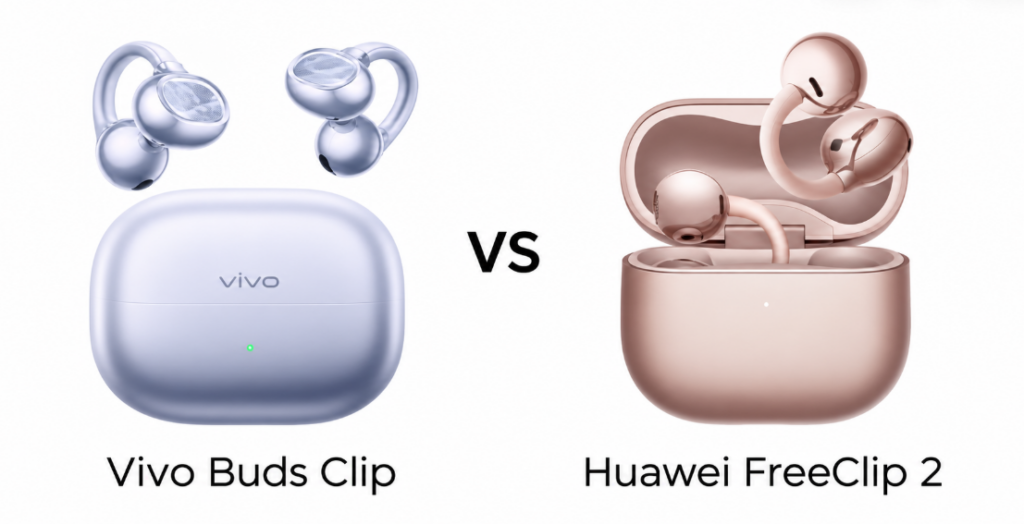
Open-ear clip-on earbuds are gaining attention as an alternative to traditional in-ear designs, offering a way to enjoy music and take calls without blocking the ear canal. The Vivo Buds Clip and Huawei FreeClip 2 follow this approach, combining lightweight construction with flexible ear hooks and open-ear audio. However, there are some notable differences between them. Vivo focuses on a larger driver, longer battery life and multi-device connectivity, while Huawei brings a dual-diaphragm driver, adaptive volume and stronger water resistance. Their prices also put them in different segments, making this comparison particularly interesting for buyers deciding how much to spend on a pair of clip-on earbuds.
1. Major Features:
| Category | Vivo Buds Clip | Huawei FreeClip 2 | Winner |
|---|---|---|---|
| Design | Open-ear clip-on | Open-ear clip-on | Tie – Similar open-ear design |
| Connector | Memory titanium alloy | Flexible clip-on design | Vivo – Memory titanium alloy connector |
| Earbud Weight | Not specified | 5.1g each | Huawei – Lightweight construction |
| Driver | 12mm | 10.8mm dual-diaphragm | Vivo – Larger driver |
| Spatial Audio | 4 modes | Multi-EQ sound effects | Vivo – Four spatial audio modes |
| Custom EQ | 10-band EQ | Custom EQ | Vivo – More detailed EQ control |
| Adaptive Volume | Not specified | Yes | Huawei – Adaptive volume adjustment |
| ANC | No | Not specified | Tie – No confirmed ANC advantage |
| Transparency | Natural open-ear awareness | Open-ear design | Tie – Both maintain environmental awareness |
| Microphones | Dual microphones + VPU | Bone acoustic sensor | Vivo – Dual-mic + VPU setup |
| Call Noise Cancellation | 2-mic + VPU AI | Yes | Vivo – VPU-based call noise cancellation |
| Water Resistance | IP55 | IP57 (earbuds), IP54 (case) | Huawei – Higher earbud water-resistance rating |
| Battery (Earbuds) | Up to 10 hours | Up to 9 hours | Vivo – 1 hour longer playback |
| Battery (With Case) | Up to 42 hours | Up to 38 hours | Vivo – 4 hours more total playback |
| Fast Charging | 10 min for 3 hours playback | Not specified | Vivo – Fast charging support |
| Wireless Charging | Yes, version-dependent | Yes, up to 3W | Huawei – Confirmed 3W wireless charging |
| Bluetooth | 5.4 | 6.0 | Huawei – Newer Bluetooth version |
| Multipoint | Tri-device connectivity | Dual-device connectivity | Vivo – Connects to three devices |
| Gaming Latency | Not specified | Not specified | Tie – No confirmed advantage |
| Controls | Tap, press and swipe | Double-tap, triple-tap and swipe | Vivo – More varied control gestures |
| Wear Detection | Yes | Infrared sensor | Tie – Both support wear detection |
| Remote Camera Control | Yes | Not specified | Vivo – Camera control support |
| Price | ~$90 / ₹8,300 | ~$200 / ₹18,000 | Vivo – Significantly cheaper |
2. Design and Comfort
Build & Fit
Both the Vivo Buds Clip and Huawei FreeClip 2 feature an open-ear clip-on design that rests around the ear without entering the ear canal. This construction allows users to listen to music while remaining aware of their surroundings.
Vivo uses a memory titanium alloy connector designed to provide flexibility and a secure fit. Huawei also follows a lightweight clip-on construction, with each FreeClip 2 earbud weighing just 5.1g. The design focuses on maintaining a comfortable fit during extended listening sessions.
Durability is another difference. The Vivo Buds Clip carries an IP55 rating, while Huawei offers IP57 protection for its earbuds, giving the FreeClip 2 better resistance against water and dust.
Controls & Usability
Vivo supports tap, press and swipe gestures, alongside wear detection and remote camera control. Huawei offers double-tap, triple-tap and swipe controls, with infrared-based wear detection.
Verdict
Both offer practical designs, but Huawei has an advantage in water resistance, while Vivo provides more varied controls and remote camera functionality.
3. Sound Quality
Driver Performance, Bass, Mids and Highs
The Vivo Buds Clip features a 12mm driver, while the Huawei FreeClip 2 uses a 10.8mm dual-diaphragm driver. Vivo’s larger driver gives it an advantage in size, while Huawei uses its dual-diaphragm arrangement to deliver its open-ear audio experience.
Vivo also offers four spatial audio modes and a 10-band custom EQ, allowing users to adjust the sound according to their preferences. These options provide greater flexibility when switching between different listening styles.
Huawei counters with multi-EQ sound effects and custom EQ support, along with adaptive volume that adjusts playback levels according to the surrounding environment. This is particularly useful for open-ear earbuds, where external sounds remain audible during music playback.
Codec Support & Audio Features
Vivo’s supplied specifications do not include confirmed codec information, so no codec advantage is assigned to either product. Both offer audio customisation, although Vivo provides more detailed spatial audio options through its four modes.
Verdict
Vivo has the advantage with its larger 12mm driver, four spatial audio modes and 10-band EQ. Huawei’s dual-diaphragm driver and adaptive volume make it a strong alternative, particularly for users who frequently listen in changing environments.
4. ANC and Transparency Modes
Noise Cancellation Quality
Neither product is positioned as a conventional ANC-focused pair of earbuds. Their open-ear clip-on construction allows users to remain aware of surrounding sounds instead of relying on sealed ear tips to block external noise.
The Vivo Buds Clip does not support ANC, focusing instead on call noise cancellation through its dual microphones and VPU bone-conduction microphone. This combination uses AI processing to reduce background noise during calls.
Huawei also includes call noise cancellation on the FreeClip 2, helping improve voice clarity during conversations. Its open-ear construction provides natural environmental awareness without requiring a dedicated transparency mode.
Ambient & Call Performance
For everyday calls, Vivo’s dual-microphone and VPU setup is an interesting feature, particularly for conversations in noisier environments. Huawei offers call noise cancellation alongside its additional bone acoustic sensor, giving it a more extensive sensor arrangement.
Neither model offers the traditional ANC and transparency switching experience found on conventional in-ear earbuds.
Verdict
Both prioritise environmental awareness and clearer calls over traditional noise isolation. Vivo has a more specifically detailed microphone configuration, while Huawei brings additional sensor technology.
5. Battery and Connectivity
Battery Life & Fast Charging
The Vivo Buds Clip offers up to 10 hours of playback on a single charge, extending to 42 hours with its charging case. Huawei FreeClip 2 provides up to 9 hours from the earbuds and 38 hours with the case.
Vivo therefore takes the lead in both standalone and combined battery life. Its fast-charging support is another advantage, providing up to three hours of playback from just 10 minutes of charging.
Huawei offers a more comprehensive charging setup, supporting USB Type-C wired charging and wireless charging at up to 3W. The charging case takes approximately 50 minutes to recharge through a wired connection.
Bluetooth Stability and Multipoint
Vivo uses Bluetooth 5.4 and supports simultaneous connections to three devices, while Huawei upgrades to Bluetooth 6.0 with dual-device connectivity. Vivo is more convenient for users switching between a phone, tablet and laptop, whereas Huawei offers the newer Bluetooth standard.
Verdict
Vivo wins on battery endurance, fast charging and multi-device connectivity. Huawei’s wireless charging and Bluetooth 6.0 support remain useful advantages.
6. Pricing
The price difference between these two open-ear earbuds is substantial. The Vivo Buds Clip costs approximately $90 (₹8,300), while the Huawei FreeClip 2 comes in at around $200 (₹18,000).
Vivo is considerably more affordable despite offering a larger 12mm driver, longer battery life, fast charging, three-device connectivity and four spatial audio modes. It also includes a 10-band EQ, remote camera control and a memory titanium alloy connector.
Huawei justifies its higher price with features such as Bluetooth 6.0, IP57-rated earbuds, adaptive volume, a dual-diaphragm driver and wireless charging up to 3W. Its additional sensors and customisable audio features also contribute to its premium positioning.
However, the price difference is difficult to overlook. Vivo delivers a strong combination of everyday features without requiring buyers to spend nearly twice as much.
Verdict: Vivo Buds Clip is the clear value winner, while Huawei FreeClip 2 is better suited to buyers willing to pay extra for its additional refinements.
7. Conclusion
The Vivo Buds Clip stands out with its 12mm driver, memory titanium alloy connector, four spatial audio modes, 10-band EQ and VPU-based call noise cancellation. Its 42-hour total battery life, 10-minute fast charging and three-device connectivity make it particularly practical for everyday use. Remote camera control is another useful addition.
Huawei FreeClip 2 brings a different set of strengths, including its 10.8mm dual-diaphragm driver, Bluetooth 6.0, adaptive volume, IP57 water resistance and wireless charging. Its lightweight 5.1g construction and extensive sensor arrangement further contribute to its appeal.
Verdict
The Vivo Buds Clip emerges as the more compelling overall package, particularly when its features are considered alongside its considerably lower price. It offers longer battery life, more flexible device connectivity and additional audio customisation.
Huawei FreeClip 2 remains a worthwhile premium alternative, especially for buyers who prioritise water resistance, adaptive volume and wireless charging.
Ultimately, Vivo Buds Clip offers better value for money, while Huawei FreeClip 2 brings a more premium feature set. The choice comes down to whether those additional refinements justify the considerable price difference.
Read More:
- iPad Mini 8 vs RedMagic Astra 2: Which Compact Tablet Is the Better Buy?
- iPad mini 8 (2026) vs iPad mini 7 (2024): Is the Upgrade Worth It?
- Huawei Enjoy 100 Pro Max vs Honor X60 Pro: Is the $70 Price Difference Worth It?
FREE DAILY NEWSLETTER
Joel Explains
What matters in phones and gadgets, before it reaches you. From Gizmochina’s editor-in-chief, every morning.
Join 1,500+ readers. One email a day, unsubscribe in one click.



Comments