As an Amazon Associate, Gizmochina earns from qualifying purchases. Links on this page may earn us a commission at no extra cost to you.
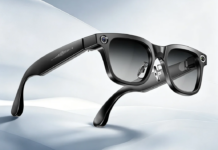
Most smart glasses are trying to become the next wearable AI device, with cameras, voice assistants, and displays packed into ordinary-looking frames. Finnish startup IXI has a different idea. Its glasses do not take pictures, show notifications, or answer questions. They simply adjust their lenses to help you see clearly at different distances.
The IXI autofocus glasses use liquid crystal technology and infrared eye tracking to switch between distance and reading prescriptions. The glasses have no camera or display, and although some headlines describe the technology as laser autofocus, IXI does not use lasers. Its tracking system relies on invisible infrared LEDs and photodiodes, consuming just 4 milliwatts of power.
This makes IXI an unusual name in a market increasingly associated with AI features. Meta and Samsung are building glasses around cameras and digital assistants, while IXI is betting that people who need vision correction might find automatically adjusting lenses useful enough on their own.
The startup emerged from stealth in April 2025 with $36.5 million in funding and demonstrated working lenses at CES in January 2026. Its CEO said a launch could happen within a year, putting the expected window around January 2027. With roughly two months left, however, several important details are still missing, including pricing, an exact release date, and regulatory approval.
The technology behind the glasses is quite different from the fixed lenses found in conventional eyewear. IXI uses liquid crystal layers sandwiched between conductive coatings. An electrical signal changes the optical properties of the lenses, allowing them to switch between different prescriptions.
When you look at something in the distance, the glasses use your distance prescription. As your eyes shift toward a nearby object, the lenses adjust to provide reading correction. The idea is to replace the need for separate reading glasses or the different viewing zones found in bifocals and progressive lenses.
There is also a fallback mechanism. If the battery runs out or the electronics stop working, the lenses return to their base state, which is typically configured for distance vision. That means users should not suddenly be left with an unsuitable reading prescription because the electronics have stopped responding.
Advertisement
2. Eye tracking without a camera
The glasses need to know when your eyes are shifting between near and distant objects, but they do not need a camera to do it.
Instead, small infrared LEDs positioned around the edges of the lenses send invisible light toward the eyes. Photodiodes measure the reflected light, allowing the system to detect eye convergence, gaze direction, and blinks. It can determine whether you are looking near or far, but it cannot identify the specific object you are viewing.
IXI has highlighted low power consumption as an important reason for using this approach. Its infrared tracking system draws just 4mW, making it easier to fit the necessary electronics into a conventional-looking glasses frame.
Advertisement
Privacy is another potential advantage, although IXI has not identified it as a specific reason for avoiding cameras. This is worth noting as camera-equipped wearables attract more attention. We recently reported that facial recognition technology turned up in the Meta smart glasses app years after Meta shut down its earlier facial recognition plans in 2021. Glasses that never capture images avoid that particular concern altogether.
IXI is taking a different route from Meta and Samsung
The smart glasses market is increasingly splitting into products that prioritize AI features and those that concentrate on specific everyday tasks. IXI clearly belongs to the latter group.
Meta’s glasses, for example, combine cameras with voice-controlled AI features. The Meta smart glasses starting at $299 do not have displays built into their lenses, but their cameras remain a central part of the experience.
IXI is making a much narrower bet. It does not need to convince people that they want another AI assistant. Instead, it needs to show that automatically adjusting prescription lenses can improve everyday vision enough to justify the price.
Market figures also need some context here. IDC’s numbers for display-free smart glasses include camera-equipped models, so they cannot tell us how large the market for completely camera-free glasses might be. There is no clear market estimate for that category yet.
Advertisement
3. Funding, manufacturing deals, and the expected launch
IXI has attracted considerable backing for a startup that is still developing its first product. It emerged from stealth in April 2025 after raising $36.5 million in a funding round led by Plural. However, reports differ on the total amount raised, with some putting the figure above $40 million and naming Amazon among the investors.
The company has also started laying the groundwork for manufacturing. On September 26, 2025, it announced a manufacturing deal with Finnsusp alongside a separate agreement with Swiss lens manufacturer Optiswiss.
By November 2025, IXI had shown a prototype weighing 22 grams. Around 360 people, estimated to be between 20 and 70 years old, participated in ergonomic testing. The glasses then appeared at CES in January 2026, where the CEO suggested that a commercial launch could happen within 12 months.
Advertisement
That puts January 2027 as the likely target, although IXI has yet to confirm an exact date. It has also kept quiet about pricing and the final weight of the retail version.
Battery life is another area where reports can be misleading. A frequently mentioned 20-hour figure belongs to rival Laclarée, not IXI. One report suggests IXI’s glasses need to be charged daily, but the company has not published a confirmed battery-life figure.
4. Who might actually want these glasses?
IXI is primarily targeting people with presbyopia, an age-related condition that makes it harder to focus on nearby objects. It typically begins around the age of 45 and is one of the reasons many people eventually need reading glasses or progressive lenses.
For someone who already wears progressives, the appeal is fairly easy to understand. Traditional progressive lenses divide the viewing area into different zones, and finding the right spot for reading can sometimes be inconvenient. IXI’s system could make that transition feel more natural by adjusting the prescription as your eyes move.
The company has also mentioned support for astigmatism correction, although the extent of that support remains unclear. It has not provided enough detail about how well the glasses will work for people with nearsightedness either.
Regulatory approval is another important hurdle. IXI has told one outlet that work on its regulatory pathway is progressing, but we could not find a CE mark on record. Until that process is clearer, the glasses should be viewed as a developing product rather than something ready for European consumers.
IXI is not the first company to experiment with autofocus eyewear, either. North’s Focals attempted something similar in the smart glasses market, selling for $600 before the company shut down. The glasses stopped working on July 31, 2020. Deep Optics also discussed consumer autofocus glasses back in 2016, although it said at the time that the technology was not close to reaching consumers. Elcyo is working on its own version, while ViXion already sells autofocus glasses, albeit in a bulkier design.
IXI now has funding, manufacturing partners, and working prototypes, but the difficult part is turning all of that into a reliable pair of everyday glasses. The idea is certainly different from the usual camera-and-AI formula. Whether people will pay a premium for glasses that quietly fix their vision, without doing much else, is the bigger question.
We use cookies on our website to give you the most relevant experience by remembering your preferences and repeat visits. By clicking “Accept”, you consent to the use of ALL the cookies.
This website uses cookies to improve your experience while you navigate through the website. Out of these, the cookies that are categorized as necessary are stored on your browser as they are essential for the working of basic functionalities of the website. We also use third-party cookies that help us analyze and understand how you use this website. These cookies will be stored in your browser only with your consent. You also have the option to opt-out of these cookies. But opting out of some of these cookies may affect your browsing experience.
Necessary cookies are absolutely essential for the website to function properly. This category only includes cookies that ensures basic functionalities and security features of the website. These cookies do not store any personal information.
Any cookies that may not be particularly necessary for the website to function and is used specifically to collect user personal data via analytics, ads, other embedded contents are termed as non-necessary cookies. It is mandatory to procure user consent prior to running these cookies on your website.