Spending around $30 on a Bluetooth tracker sounds simple enough, until you realize that the one you buy may not work with the phone you carry. Apple, Samsung, and Google now have competing item trackers at almost identical prices, but each relies on a different finding network.
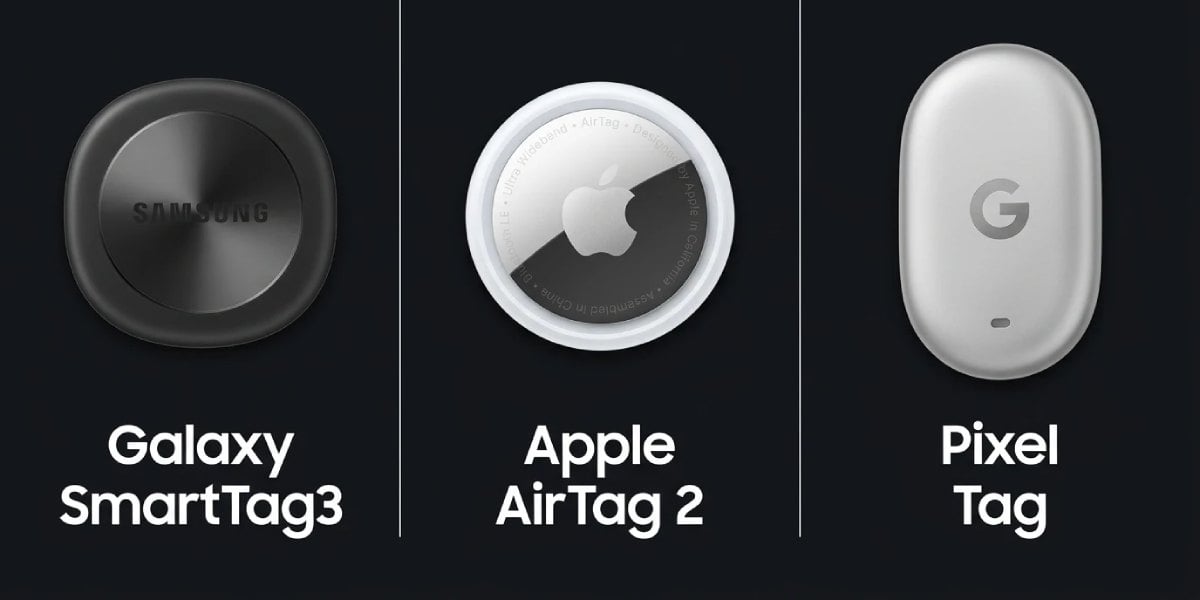
The Apple AirTag 2 arrived in January, followed by the Google Pixel Tag in August and the Samsung Galaxy SmartTag3 in September. All three now compete in roughly the same price range, with similar water resistance and replaceable batteries. Their differences become more noticeable when you look at network support, nearby finding features, and how well they work outside their respective ecosystems.
So which tracker should you buy? Here we are comparing Apple AirTag 2 versus Samsung Galaxy SmartTag3 versus Google Pixel Tag head-to-head.
1. Best for iPhone owners
If you already use an iPhone, there isn’t much reason to look elsewhere. The AirTag 2 connects to Apple’s Find My network, which uses nearby Apple devices to report a tracker’s location when it is outside your phone’s Bluetooth range. It requires an iPhone or iPad running iOS 26 or iPadOS 26 or later.
Apple has made some meaningful hardware changes over the original AirTag. Its second-generation Ultra Wideband chip extends Precision Finding range by up to 50%, while an upgraded Bluetooth chip helps nearby devices detect it from farther away. The speaker is also 50% louder, making it easier to hear when searching for something buried under a pile of clothes or tucked between sofa cushions.
There are a couple of other useful additions. Precision Finding now works from your wrist with an Apple Watch Series 9 or later, or an Apple Watch Ultra 2 or later. You can also share an AirTag with up to five other people, while the option to share an item’s location with participating airlines could be useful when a checked bag goes missing.
The hardware still has one familiar annoyance: no built-in keyring hole. You’ll need a separately purchased accessory if you want to attach it directly to your keys. Android compatibility is also limited. Android phones can detect unknown AirTags nearby and warn users about unwanted tracking, but they cannot register or track their own AirTag.
Pricing remains unchanged at $29 for one or $99 for a four-pack. There have already been discounts, with Android Authority reporting that Amazon dropped the price of a single AirTag 2 to $23 on October 30. If you own the original model, however, the improvements probably aren’t enough to justify replacing it.
2. Best for Galaxy owners
Samsung’s Galaxy SmartTag3 has one advantage that the other two trackers don’t: it can be used with both Galaxy phones and iPhones. That makes it an interesting option for households with mixed devices, although Galaxy owners get considerably more features.
The SmartTag3 is 35% smaller by volume and 33% lighter than the SmartTag2. It measures 31 x 31 x 8.2mm and weighs 9.15g. It also has a built-in attachment loop, so you don’t need an additional case just to put it on your keys or bag. The IP67 rating is retained.
Battery life is another reason to consider it. Samsung rates the tracker for up to 550 days in normal mode, increasing to 790 days with Power Saving mode enabled. That’s considerably longer than Google’s over-one-year estimate for the Pixel Tag. Apple doesn’t provide a specific battery-life estimate for the AirTag 2.
There is a catch with Samsung’s longer battery estimate, though. Power Saving mode disables some features, including Compass View, leaving basic Bluetooth LE finding available.
Galaxy phones also unlock the more advanced finding features. Compass View uses Ultra Wideband or Bluetooth Channel Sounding to guide you toward the tracker. Samsung rates Channel Sounding for distances of up to 60 meters under clear line-of-sight conditions, while UWB works at up to 20 meters. Channel Sounding is currently limited to the Galaxy Z Fold 8 Ultra, Galaxy Z Fold 8, Galaxy S26 Ultra, and Galaxy S26+.
You also get Place Notifications, which can alert you when a tagged item enters or leaves a designated area. However, Samsung currently lists this as a trial feature. Other alerts include Movement Detection Alert and Left Behind Alert.
Things are more limited on an iPhone. Through the SmartThings Find app, users can check the tracker’s location, share it, and use Search Nearby. Compass View, Ring Phone, and Left Behind Alert remain exclusive to Galaxy devices.
There has also been some confusion over Android compatibility. Samsung’s official compatibility information confirms support for Galaxy devices running Android 12 or later and iPhones running iOS 17 or later. Despite using Android, Pixel and other non-Samsung phones are not supported.
The SmartTag3 costs $29.99 for one or $99.99 for four. It launched in South Korea on October 7, followed by the US, with additional markets expected in 2027.
3. Best for Pixel and other Android phones
Google’s Pixel Tag has a fairly straightforward advantage over Samsung’s offering: it doesn’t require a Pixel phone. Any device running Android 9 or later can pair with it through Fast Pair, while Google’s Find Hub network handles tracking over longer distances.
That network draws on more than one billion Android devices, giving the tracker a large pool of devices that can help report its location. A single Pixel Tag costs $29.99 through the Google Store, while a four-pack is priced at $99.99.
For nearby searches, Google supports both Ultra Wideband and Bluetooth Channel Sounding. There are hardware requirements, though. Ultra Wideband precision finding needs a compatible Android phone with UWB, while Channel Sounding requires Android 16 and Bluetooth 6.0. Buying the tracker alone doesn’t guarantee access to its most precise finding features.
Google has also included a few conveniences that make the Pixel Tag more useful around the house. Pressing its button can ring a connected phone, even when the phone is set to silent. You can also ring the tracker from a Pixel Watch or ask Gemini through Pixel Buds to find it. Sharing is another advantage, with support for up to 10 people compared with five on the AirTag 2.
The physical design is noticeably different from the other two. At 28 x 46.1 x 5.4mm and 11.8g, the Pixel Tag has a slim, elongated shape that should fit more easily into a wallet. It carries an IP67 rating and uses a replaceable CR2032 battery, which Google rates for over one year. There is no built-in keyring hole, so you’ll need a separate holder if you want to attach it to your keys. The tracker comes in a single Fog color.
The main limitation is network compatibility. Find Hub is an Android service, so iPhone owners cannot use a Pixel Tag to track their belongings. Google’s battery-life and range figures are also manufacturer estimates, making independent testing worth watching. If you like the idea but want a different design, Motorola’s Moto Tag 2 is another option that works with the same network.
4. What if your household uses both iPhone and Android?
This is where choosing a tracker gets a little more complicated. If one person uses a Galaxy phone and another carries an iPhone, the SmartTag3 is the only one of these three that both can access. The iPhone user will miss out on some of its advanced features, but basic location tracking and sharing still work.
An iPhone-and-Pixel household doesn’t have the same convenience. AirTag 2 requires Apple’s ecosystem, while Pixel Tag relies on Android’s Find Hub. There is no single tracker among these three that both phones can fully use, so you may end up buying separate trackers for different family members.
There is at least some cross-platform protection against unwanted tracking. iPhones can warn users about unfamiliar Google Pixel Tags moving with them, while Pixel phones can detect nearby unknown Apple AirTags.
One last thing worth checking before buying is your phone’s hardware. Features such as Compass View on the SmartTag3 and Bluetooth Channel Sounding on the Pixel Tag depend on specific chipsets and newer software versions. An older phone may still track the tag just fine, but you won’t necessarily get the more precise locating features that make these newer models interesting.
5. Price and specifications compared
| Feature | Apple AirTag 2 | Samsung Galaxy SmartTag3 | Google Pixel Tag |
|---|---|---|---|
| Price | $29 (single), $99 (four-pack) | $29.99 (single), $99.99 (four-pack) | $29.99 (single), $99.99 (four-pack) |
| Finding network | Find My | Galaxy Find Network (SmartThings Find) | Find Hub |
| Compatibility | iPhone and iPad running iOS or iPadOS 26 or later | Galaxy phones and iPhones | Android 9 or later |
| Close-range finding | Second-gen Ultra Wideband | Ultra Wideband and Bluetooth Channel Sounding on supported Galaxy phones | Ultra Wideband and Bluetooth Channel Sounding |
| Battery | Replaceable CR2032 coin cell | Replaceable CR2032, up to 550 days (790 days in Power Saving mode) | Replaceable CR2032, over one year claimed |
| Water and dust resistance | IP67 | IP67 | IP67 |
| Keyring attachment | No built-in loop | Built-in loop | No built-in loop |
| Availability | On sale since January 26 | Korea on October 7, followed by the US | On sale since November 11 |
FREE DAILY NEWSLETTER
Joel Explains
What matters in phones and gadgets, before it reaches you. From Gizmochina’s editor-in-chief, every morning.
Join 1,500+ readers. One email a day, unsubscribe in one click.