Large-screen Android tablets have become serious productivity and entertainment machines, and both the OnePlus Pad 4 and OPPO Pad 5 Pro target users who want flagship performance without stepping into laptop territory. While these tablets share the same Snapdragon 8 Elite Gen 5 chipset, several differences in display quality, charging speed, software experience, and ecosystem integration could influence your decision. Here’s a detailed comparison.
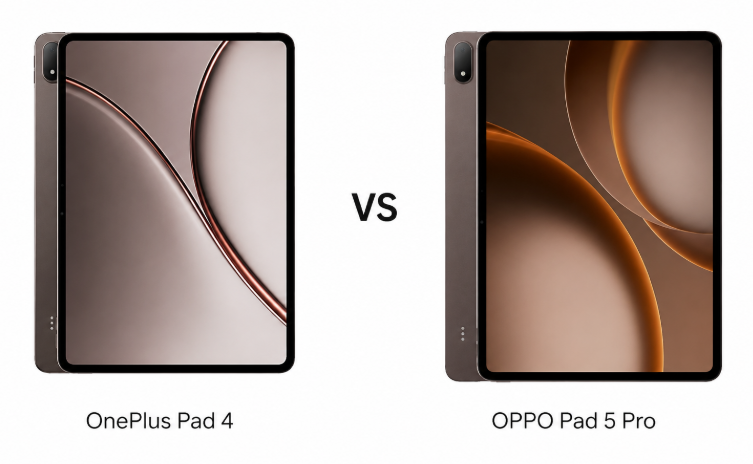
The OnePlus Pad 4 and OPPO Pad 5 Pro are almost identical in terms of physical design. Both feature slim 5.9mm bodies, weigh 672g, and use premium aluminum construction that feels solid and durable. The OnePlus model adds a glass front panel and retains stylus support, while OPPO includes both stylus and keyboard support as standard ecosystem features.
Despite their similarities, the OnePlus Pad 4 feels slightly more premium thanks to its cleaner OxygenOS-focused approach and refined finish. OPPO’s keyboard integration, however, may appeal more to productivity-focused buyers.
Display & Multimedia
Both tablets feature large 13.2-inch LCD panels with a 144Hz refresh rate and brightness levels reaching 1000 nits. However, the OnePlus Pad 4 gains a notable advantage with Dolby Vision support and a higher 2400 × 3392 resolution, delivering sharper visuals and better HDR content support.
Multimedia performance is excellent on both devices thanks to their eight-speaker audio systems, but OnePlus adds Hi-Res Audio certification, making movies and streaming content slightly more immersive.
Verdict
The hardware designs are nearly identical, but the OnePlus Pad 4 offers a superior display package thanks to its higher resolution, Dolby Vision support, and Hi-Res audio capabilities. For entertainment and content consumption, it holds a small but noticeable lead.
2. Performance and Software
Processor & UI Smoothness
Performance is effectively identical on both tablets. Each uses Qualcomm’s Snapdragon 8 Elite Gen 5 processor paired with the Adreno 840 GPU and UFS 4.1 storage. Everyday responsiveness, gaming performance, and heavy workloads are handled effortlessly.
High-refresh-rate displays combined with flagship silicon ensure smooth navigation and fast app launches. Whether editing videos, playing demanding games, or handling large documents, neither tablet struggles.
The main difference comes down to software preference. OnePlus ships OxygenOS 16, which is generally viewed as cleaner and less cluttered. OPPO’s ColorOS 16 offers more customization options and deeper feature integration for users already invested in OPPO products.
Productivity & Multitasking
Both tablets are well-suited for multitasking, offering large displays and flagship hardware. OPPO gains a slight edge with broader memory configurations, including a 16GB RAM variant, which may benefit power users running multiple apps simultaneously.
OnePlus counters with a more streamlined interface that often feels lighter during daily use.
Verdict
Raw performance is essentially tied. The decision comes down to software preference: OxygenOS feels cleaner and more focused, while ColorOS offers greater customization and an optional 16GB RAM configuration for demanding multitaskers.
3. Battery and Accessories
Battery Life
Battery capacity is identical at 13,380mAh, meaning both tablets are capable of lasting through long workdays, extended media sessions, and gaming marathons.
Efficiency should also be similar since both devices share the same processor and display size. Real-world endurance is expected to be excellent regardless of which tablet you choose.
The biggest difference appears when charging. The OnePlus Pad 4 supports 80W wired charging, while the OPPO Pad 5 Pro tops out at 67W. Although both recharge quickly, OnePlus users will spend slightly less time connected to a charger.
Stylus, Keyboard & Ecosystem
Both tablets support stylus accessories, making them useful for note-taking and creative work. OPPO places a stronger emphasis on productivity with official keyboard support and deeper integration within its ecosystem.
OnePlus benefits from its growing ecosystem but remains more focused on delivering a clean and straightforward tablet experience.
Verdict
Battery life is likely a draw, but the OnePlus Pad 4 wins on charging speed. OPPO earns points for productivity accessories and ecosystem features, making this section surprisingly close.
4. Camera & Media
Rear and Front Camera
Tablet cameras are rarely a buying priority, and these two devices prove that point. Both feature identical 13MP rear cameras and 8MP front-facing cameras.
For document scanning, video calls, and occasional photography, both perform adequately. Image quality should be very similar due to the matching hardware setup.
The front camera remains sufficient for online meetings, virtual classes, and casual video calls, while the rear camera is more useful for productivity tasks than serious photography.
Video & Audio Quality
Video recording capabilities are identical, with support for 4K recording at 30fps and gyro-EIS stabilization. Neither tablet offers a meaningful advantage in camera functionality.
Audio performance is more impressive. Both devices feature powerful eight-speaker systems capable of delivering loud and immersive sound. However, OnePlus gains a slight edge through Hi-Res Audio support and Dolby Vision-enhanced media playback.
For streaming services, movies, and gaming, OnePlus creates a slightly richer multimedia experience.
Verdict
Camera performance is effectively identical, but the OnePlus Pad 4 offers a marginally better media package thanks to Dolby Vision support and Hi-Res audio enhancements.
5. Pricing
The OnePlus Pad 4 is expected to cost approximately $700 (₹60,000), while the OPPO Pad 5 Pro is expected to launch around $650 (₹59,000).
For a relatively small price difference, buyers receive very similar hardware. OPPO offers more RAM options and productivity-focused features, while OnePlus provides a stronger display experience and faster charging.
Verdict
The OPPO Pad 5 Pro delivers slightly better value on paper thanks to its lower price and wider memory options. However, the OnePlus Pad 4 justifies its small premium through display upgrades, Dolby Vision support, and faster 80W charging.
6. Conclusion
OnePlus Pad 4
Higher-resolution display
Dolby Vision support
80W fast charging
Hi-Res Audio
Cleaner OxygenOS experience
OPPO Pad 5 Pro
Lower starting price
Up to 16GB RAM option
Strong keyboard ecosystem
More customization through ColorOS
Verdict
OnePlus Pad 4 is the better overall tablet for most buyers. Its sharper display, Dolby Vision support, faster charging, and cleaner software experience create a more polished flagship package.
OPPO Pad 5 Pro remains an excellent alternative for users who prioritize productivity accessories, higher RAM configurations, and slightly better value. However, for entertainment, everyday use, and long-term satisfaction, the OnePlus Pad 4 takes the win by a narrow margin.
We use cookies on our website to give you the most relevant experience by remembering your preferences and repeat visits. By clicking “Accept”, you consent to the use of ALL the cookies.
This website uses cookies to improve your experience while you navigate through the website. Out of these, the cookies that are categorized as necessary are stored on your browser as they are essential for the working of basic functionalities of the website. We also use third-party cookies that help us analyze and understand how you use this website. These cookies will be stored in your browser only with your consent. You also have the option to opt-out of these cookies. But opting out of some of these cookies may affect your browsing experience.
Necessary cookies are absolutely essential for the website to function properly. This category only includes cookies that ensures basic functionalities and security features of the website. These cookies do not store any personal information.
Any cookies that may not be particularly necessary for the website to function and is used specifically to collect user personal data via analytics, ads, other embedded contents are termed as non-necessary cookies. It is mandatory to procure user consent prior to running these cookies on your website.


Comments