Advertisement

The premium tablet market is becoming more competitive, with OnePlus pushing into high-end territory while Apple continues to dominate the professional segment. The OnePlus Pad 4 focuses on delivering a massive display, flagship Snapdragon performance, and huge battery life at a lower price. Meanwhile, the iPad Pro 11 (2025) offers Apple’s latest M5 chip, a premium OLED display, and deep integration with the Apple ecosystem. Here’s how they compare.
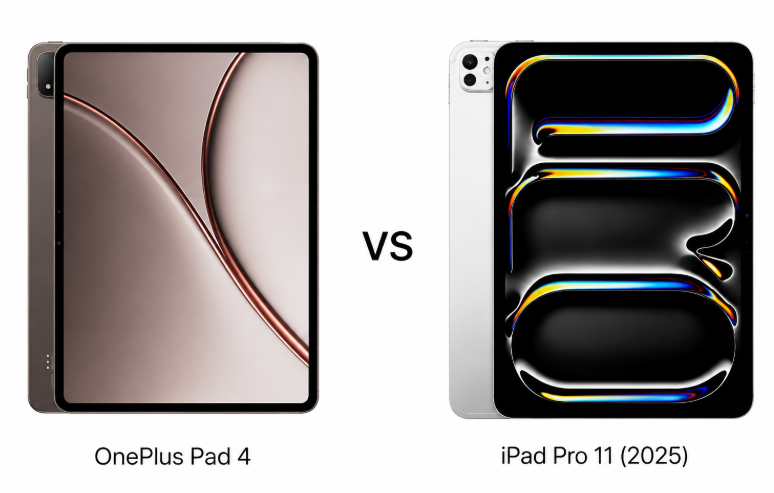
Major Features:

FeatureOnePlus Pad 4iPad Pro 11 (2025)Winner
DesignAluminum body, 5.9mm, 672gAluminum body, 5.3mm, 444giPad Pro 11 – Thinner and significantly lighter
Display Size13.2-inch IPS LCD11-inch Tandem OLEDOnePlus Pad 4 – Much larger workspace
Display Quality144Hz, Dolby Vision, 1000 nitsTandem OLED, 120Hz, HDR10, Dolby Vision, 1600 nits peakiPad Pro 11 – Superior OLED visuals and HDR
Resolution2400 × 3392 pixels1668 × 2420 pixelsOnePlus Pad 4 – Higher resolution and sharper image
Refresh Rate144Hz120HzOnePlus Pad 4 – Smoother scrolling and gaming
ProcessorSnapdragon 8 Elite Gen 5Apple M5iPad Pro 11 – Desktop-class performance
GPU PerformanceAdreno 840Apple 10-core GPUiPad Pro 11 – Stronger graphics capabilities
RAM8GB / 12GB12GB / 16GBiPad Pro 11 – More memory on higher-end models
Storage256GB / 512GB256GB / 512GB / 1TB / 2TBiPad Pro 11 – More storage options
SoftwareAndroid 16, OxygenOS 16iPadOS 26iPad Pro 11 – Better tablet app ecosystem
MultitaskingLarge screen Android multitaskingStage Manager, pro appsiPad Pro 11 – More polished productivity tools
Rear Camera13MP12MP + LiDARiPad Pro 11 – Better imaging system
Front Camera8MP12MP UltrawideiPad Pro 11 – Better video calling quality
Video RecordingUp to 4K 30fpsUp to 4K 60fps ProResiPad Pro 11 – More advanced video features
Speakers8 Speakers4 SpeakersOnePlus Pad 4 – More immersive audio setup
Battery Capacity13,380mAh8,160mAhOnePlus Pad 4 – Much larger battery
Charging Speed80W50% in 30 minOnePlus Pad 4 – Faster charging
ConnectivityUSB-C 3.2, Wi-Fi 7Thunderbolt 3, USB-C 4, Wi-Fi 7iPad Pro 11 – Faster data and accessory support
Cellular OptionNoeSIM model availableiPad Pro 11 – Better mobility
Weight672g444giPad Pro 11 – Easier to carry
Price~$700 / ₹60,000~$1,000 / ₹100,000OnePlus Pad 4 – Far better value
Disclaimer: Specs are based on available data. Actual performance may vary. Verify details from official sources before buying.

1. Design and Display

Build Quality

The OnePlus Pad 4 is built from aluminum with a glass front and feels every bit like a premium flagship tablet. However, its larger 13.2-inch form factor makes it noticeably bigger and heavier at 672g. It is designed more for desk use, productivity, and media consumption than for frequent handheld use.

Apple takes a different approach with the iPad Pro 11. Despite its premium aluminum construction, it remains incredibly thin at just 5.3mm and weighs only 444g. The compact size makes it easier to carry and more comfortable for extended handheld use. The availability of a cellular model with eSIM support also adds flexibility for professionals on the move.

Display & Multimedia

OnePlus counters with a huge 13.2-inch IPS LCD panel featuring a sharp 2400 × 3392 resolution, Dolby Vision support, and a fast 144Hz refresh rate. The larger canvas is excellent for multitasking, gaming, and video consumption, while the 8-speaker system delivers a more immersive audio experience.

Apple’s 11-inch Ultra Retina Tandem OLED display remains one of the best screens available on any tablet. It offers deeper blacks, superior HDR performance, up to 1600 nits peak brightness, and exceptional color accuracy. While the screen is smaller, the overall visual quality is clearly more premium.

Verdict

Users who prioritize screen size and cinematic entertainment will likely prefer the OnePlus Pad 4. However, Apple’s OLED panel, lighter design, and premium display technologies make the iPad Pro 11 the stronger overall display package.

Winner: iPad Pro 11 (2025)

2. Performance and Software

Processor & UI Smoothness

The OnePlus Pad 4 is powered by Qualcomm’s Snapdragon 8 Elite Gen 5 chipset paired with UFS 4.1 storage. Combined with OxygenOS 16 and Android 16, performance should be exceptional for gaming, multitasking, and demanding productivity workloads. The 144Hz display further enhances responsiveness throughout the interface.

Apple’s M5 chip operates on a different level. Derived from Apple’s desktop-class silicon, it delivers laptop-grade performance that few tablets can match. Whether editing 4K video, rendering graphics, or handling professional creative workloads, the M5 maintains a clear advantage. The higher-end variants with 16GB RAM further strengthen its position for power users.

Productivity & Multitasking

OnePlus has significantly improved multitasking features in OxygenOS, and the larger display naturally helps when working with multiple apps. Android’s flexibility also allows easier file management and customization.

The iPad Pro benefits from iPadOS 26, Stage Manager, and a mature ecosystem of professional applications. Creative professionals, designers, and video editors still have access to some of the most optimized tablet software available.

Verdict

The OnePlus Pad 4 delivers flagship Android performance and should satisfy nearly every user. However, Apple’s M5 chip and software ecosystem continue to set the benchmark for serious productivity and creative workloads.

Winner: iPad Pro 11 (2025)

3. Battery and Accessories

Battery Life

Battery capacity is one of the biggest strengths of the OnePlus Pad 4. Its massive 13,380mAh battery significantly exceeds the iPad Pro’s 8,160mAh cell and should provide excellent endurance for media consumption, gaming, and productivity sessions. The inclusion of 80W wired charging is another major advantage, allowing quick top-ups when needed.

Apple relies more on efficiency than battery size. Thanks to the M5 chipset and iPadOS optimization, battery life remains strong despite the smaller capacity. For most users, a full day of productivity is realistic, but charging speeds are noticeably slower.

Stylus, Keyboard & Ecosystem

Both tablets support stylus input and keyboard accessories. OnePlus continues improving its accessory lineup, offering a capable productivity experience for Android users.

Apple’s ecosystem remains the gold standard. Features such as seamless integration with Macs, iPhones, AirPods, and Apple Pencil create a workflow that is difficult for competitors to replicate. Professionals already invested in Apple’s ecosystem gain substantial benefits.

Verdict

The OnePlus Pad 4 wins on battery capacity and charging speed, making it the more practical choice for heavy daily use. Apple retains the ecosystem advantage, but pure battery value clearly favors OnePlus.

Winner: OnePlus Pad 4

4. Camera & Media

Rear and Front Camera

Tablet cameras are rarely a primary selling point, but Apple still delivers a stronger setup. The iPad Pro features a 12MP rear camera with dual-pixel PDAF and a LiDAR scanner, enabling better focus performance and advanced AR experiences. The 12MP ultrawide front camera also provides superior quality for video calls and content creation.

The OnePlus Pad 4 includes a basic 13MP rear camera and an 8MP front-facing camera. They are perfectly adequate for scanning documents, online meetings, and occasional photography, but they do not target professional use.

Video & Audio Quality

Apple supports ProRes recording, multiple frame-rate options, HDR video capture, and advanced stabilization features. Content creators benefit from a much more versatile camera system.

OnePlus responds with an impressive 8-speaker setup that delivers richer and more immersive sound than many competing tablets. Movie watchers and gamers may appreciate this advantage more than camera upgrades.

Verdict

Apple provides better cameras, stronger video capabilities, and more advanced imaging features. OnePlus wins on speaker count, but the overall media creation experience still belongs to the iPad Pro.

Winner: iPad Pro 11 (2025)

5. Pricing

The OnePlus Pad 4 starts at approximately $700 (₹60,000), while the iPad Pro 11 (2025) starts around $1,000 (₹100,000).

This creates a substantial price gap of roughly $300 (₹40,000). For many buyers, the OnePlus delivers flagship-level performance, a larger display, faster charging, and significantly better battery capacity while costing much less. The value proposition is difficult to ignore.

Apple justifies its premium through the M5 chip, OLED display technology, professional software ecosystem, superior cameras, and tighter hardware-software integration. However, not every user will fully utilize those advantages.

Verdict

For value-focused buyers, the OnePlus Pad 4 offers considerably more hardware per dollar. Apple remains the premium choice, but OnePlus delivers the stronger price-to-performance ratio.

Winner: OnePlus Pad 4

Disclaimer:
Prices are approximate and may vary based on country, region, launch timing, and applicable taxes. Always check whether the listed price is for a China unit or a global/international variant when purchasing.

6. Conclusion

The OnePlus Pad 4 stands out with its massive 13.2-inch display, Snapdragon 8 Elite Gen 5 chipset, huge 13,380mAh battery, 80W fast charging, and immersive 8-speaker system. It is clearly designed for users who want maximum hardware value and entertainment capabilities.

The iPad Pro 11 (2025) distinguishes itself through the Apple M5 processor, Ultra Retina Tandem OLED display, professional-grade software ecosystem, advanced cameras, Thunderbolt connectivity, and exceptional portability. It remains one of the most capable tablets available for creative and professional work.

Verdict

If the goal is getting the most hardware and battery life for the money, the OnePlus Pad 4 is the smarter purchase. Its larger display, faster charging, and lower price make it incredibly appealing.

For professionals, creators, and users deeply invested in Apple’s ecosystem, the iPad Pro 11 (2025) remains the most complete premium tablet experience despite its higher cost.

Overall Winner: OnePlus Pad 4 for Value
                           iPad Pro 11 (2025) for Ultimate Performance and Professional Use

Disclaimer: This comparison is based on the specifications provided and is intended for general informational purposes. Actual performance, camera results, battery life, and overall experience may vary depending on real-world usage, software updates, and individual preferences.

Read More:

Comments