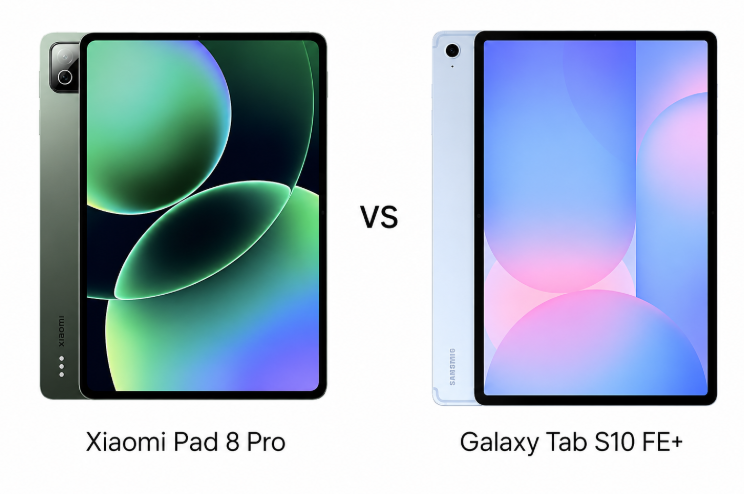
Choosing between the Xiaomi Pad 8 Pro and Samsung Galaxy Tab S10 FE+ comes down to priorities. Xiaomi focuses on flagship-level performance and high-refresh-rate entertainment, while Samsung targets productivity users with a larger display, IP68 durability, and stronger ecosystem support. Both tablets serve different audiences despite their relatively close pricing, making this comparison particularly interesting for students, professionals, and multimedia enthusiasts.
Major Features:
Feature
Xiaomi Pad 8 Pro
Samsung Galaxy Tab S10 FE+
Winner
Design
Aluminum body, 5.8mm, 485g
Aluminum body, 6mm, 664g
Xiaomi – Thinner and significantly lighter
Durability
Standard protection
IP68 water & dust resistance
Samsung – Better durability
Display Size
11.2-inch IPS LCD
13.1-inch IPS LCD
Samsung – Larger workspace
Refresh Rate
144Hz
90Hz
Xiaomi – Much smoother visuals
Resolution
2136 × 3200
1800 × 2880
Xiaomi – Higher sharpness
HDR Support
Dolby Vision, HDR10, HDR Vivid
No HDR certification
Xiaomi – Better multimedia experience
Processor
Snapdragon 8 Elite (3nm)
Exynos 1580 (4nm)
Xiaomi – Flagship-level performance
GPU
Adreno 830
Xclipse 540
Xiaomi – Stronger gaming performance
RAM Options
Up to 16GB
Up to 12GB
Xiaomi – Higher maximum RAM
Storage
Up to 512GB UFS 4.1
Up to 256GB
Xiaomi – Faster and larger storage
Expandable Storage
No
microSD card support
Samsung – Expandable storage
Software
Android 16, HyperOS 3
Android 15, One UI 8.5
Samsung – More refined tablet software
Rear Camera
50MP
13MP
Xiaomi – Higher resolution sensor
Front Camera
32MP Ultrawide
12MP Ultrawide
Xiaomi – Better detail for video calls
Rear Video
4K@60fps
4K@30fps
Xiaomi – Higher frame-rate recording
Selfie Video
1080p
4K
Samsung – Better front video recording
Speakers
Quad speakers, Dolby Atmos
Stereo speakers
Xiaomi – Richer audio setup
Wi-Fi
Wi-Fi 7
Wi-Fi 6E
Xiaomi – Newer connectivity standard
Battery
9200mAh
10090mAh
Samsung – Larger battery
Charging
67W wired
45W wired
Xiaomi – Faster charging
Reverse Charging
22.5W
No
Xiaomi – Extra convenience
Cellular Option
No
Yes (select models)
Samsung – Mobile connectivity
Stylus Support
Yes
Yes (S Pen ecosystem)
Samsung – Better stylus experience
Starting Price
~$500 / ₹47,000
~$700 / ₹48,500
Xiaomi – Better hardware value
Disclaimer: Specs are based on available data. Actual performance may vary. Verify details from official sources before buying.
The Xiaomi Pad 8 Pro adopts a premium aluminum unibody design with a slim 5.8mm profile and weighs under 500g, making it noticeably lighter and easier to carry. Its compact 11.2-inch form factor feels more comfortable for prolonged handheld use, especially for gaming and media consumption.
Samsung’s Galaxy Tab S10 FE+ is significantly larger with its 13.1-inch display and weighs over 660g. However, it compensates with IP68 water and dust resistance, a feature rarely found in tablets. The inclusion of optional cellular connectivity also adds flexibility for users who work on the move.
Display & Multimedia
Xiaomi clearly prioritizes multimedia. The 11.2-inch IPS panel offers a 144Hz refresh rate, Dolby Vision, HDR10 support, and up to 800 nits brightness. The higher pixel density also produces sharper visuals.
Samsung counters with a much larger 13.1-inch display that is better suited for multitasking and split-screen workflows. However, the 90Hz refresh rate and lower pixel density make it less impressive for gaming and premium content consumption.
Verdict
Users seeking portability and entertainment will likely favor the Xiaomi Pad 8 Pro. Samsung’s larger display remains excellent for productivity, but Xiaomi delivers the more advanced viewing experience overall.
2. Performance and Software
Processor & UI Smoothness
The Xiaomi Pad 8 Pro gains a substantial advantage with the Snapdragon 8 Elite chipset. Built on a cutting-edge 3nm process and paired with the Adreno 830 GPU, it delivers flagship smartphone-class performance. Demanding games, creative applications, and AI-driven tasks run effortlessly.
Samsung’s Exynos 1580 is a capable upper-midrange processor, but it cannot compete with the raw power offered by the Snapdragon 8 Elite. Everyday performance remains smooth, though heavy multitasking and gaming workloads favor Xiaomi.
Productivity & Multitasking
Samsung leverages its software ecosystem exceptionally well. One UI is mature, optimized for large-screen usage, and works seamlessly with Samsung’s productivity features. The microSD card slot is another practical advantage for students and professionals handling large files.
Xiaomi offers faster storage options, including UFS 4.1, and supports up to 16GB RAM. Multitasking performance is excellent, but Samsung’s software refinement and ecosystem integration create a more desktop-like experience.
Verdict
For pure performance, the Xiaomi Pad 8 Pro wins comfortably. For productivity-focused users invested in Samsung’s ecosystem, the Galaxy Tab S10 FE+ remains a compelling alternative despite its slower hardware.
3. Battery and Accessories
Battery Life
Samsung packs a larger 10,090mAh battery, while Xiaomi includes a slightly smaller 9,200mAh cell. Real-world endurance is expected to be competitive between the two, although Samsung’s less demanding 90Hz panel could help offset its larger display size.
Charging speed is where Xiaomi pulls far ahead. Its 67W wired charging can dramatically reduce downtime, while Samsung remains limited to 45W charging. Xiaomi also supports reverse wired charging, adding extra versatility.
Stylus, Keyboard & Ecosystem
Both tablets support stylus input, making them suitable for note-taking and creative work. Samsung’s S Pen experience is highly regarded thanks to years of software refinement and seamless integration across Galaxy devices.
Xiaomi continues to improve its accessory ecosystem and productivity features under HyperOS, but Samsung maintains the advantage in accessory support, ecosystem connectivity, and long-term workflow integration.
Verdict
Battery life is likely close, but Xiaomi wins on charging technology. Samsung takes the lead for stylus functionality, accessories, and ecosystem maturity, making this category surprisingly balanced.
4. Camera & Media
Rear and Front Camera
Tablet cameras are rarely a purchasing priority, yet Xiaomi still offers stronger hardware. Its 50MP rear camera captures more detail than Samsung’s 13MP sensor and provides greater flexibility for document scanning and casual photography.
On the front, Xiaomi includes a 32MP ultrawide camera that is particularly useful for video conferencing and group calls. Samsung’s 12MP ultrawide camera remains capable but lacks the same level of detail.
Video & Audio Quality
Both tablets support 4K video recording from the rear camera, while Samsung also enables 4K recording through the selfie camera. For content creators and remote professionals, this may prove beneficial.
Audio performance slightly favors Xiaomi thanks to Dolby Atmos-tuned quad speakers, Dolby Vision support, and Hi-Res audio certification. The multimedia package feels more premium and immersive during movie watching and gaming sessions.
Verdict
Samsung offers useful front-camera video capabilities, but Xiaomi delivers stronger camera hardware and a richer multimedia experience. Entertainment-focused users will likely appreciate Xiaomi’s advantages more.
5. Pricing
Xiaomi positions the Pad 8 Pro at approximately $500 (₹47,000), while Samsung prices the Galaxy Tab S10 FE+ around $700 (₹48,500).
Verdict
The pricing difference is surprisingly small in Indian pricing estimates, yet Xiaomi delivers a flagship Snapdragon 8 Elite processor, 144Hz display, faster charging, and stronger multimedia capabilities. Samsung justifies its premium with IP68 protection, microSD expansion, a larger display, cellular options, and a refined ecosystem.
For buyers focused on hardware value, Xiaomi offers significantly more performance per rupee.
Disclaimer: Prices are approximate and may vary based on country, region, launch timing, and applicable taxes. Always check whether the listed price is for a China unit or a global/international variant when purchasing.
6. Conclusion
Xiaomi Pad 8 Pro
Snapdragon 8 Elite flagship chipset
144Hz Dolby Vision display
67W fast charging
Quad Dolby Atmos speakers
Lighter and more portable design
Samsung Galaxy Tab S10 FE+
Large 13.1-inch display
IP68 water and dust resistance
microSD expansion
Optional cellular connectivity
Strong Samsung ecosystem and S Pen experience
Verdict
Xiaomi Pad 8 Pro emerges as the better overall tablet for most users. Its flagship processor, superior display technology, faster charging, stronger multimedia package, and lower price create an exceptional value proposition.
Galaxy Tab S10 FE+ remains the better choice for users who prioritize productivity, Samsung ecosystem integration, expandable storage, and durability. However, when considering performance, entertainment, and overall value, the Xiaomi Pad 8 Pro delivers the more compelling package.
Disclaimer: This comparison is based on the specifications provided and is intended for general informational purposes. Actual performance, camera results, battery life, and overall experience may vary depending on real-world usage, software updates, and individual preferences.
We use cookies on our website to give you the most relevant experience by remembering your preferences and repeat visits. By clicking “Accept”, you consent to the use of ALL the cookies.
This website uses cookies to improve your experience while you navigate through the website. Out of these, the cookies that are categorized as necessary are stored on your browser as they are essential for the working of basic functionalities of the website. We also use third-party cookies that help us analyze and understand how you use this website. These cookies will be stored in your browser only with your consent. You also have the option to opt-out of these cookies. But opting out of some of these cookies may affect your browsing experience.
Necessary cookies are absolutely essential for the website to function properly. This category only includes cookies that ensures basic functionalities and security features of the website. These cookies do not store any personal information.
Any cookies that may not be particularly necessary for the website to function and is used specifically to collect user personal data via analytics, ads, other embedded contents are termed as non-necessary cookies. It is mandatory to procure user consent prior to running these cookies on your website.


Comments