Advertisement

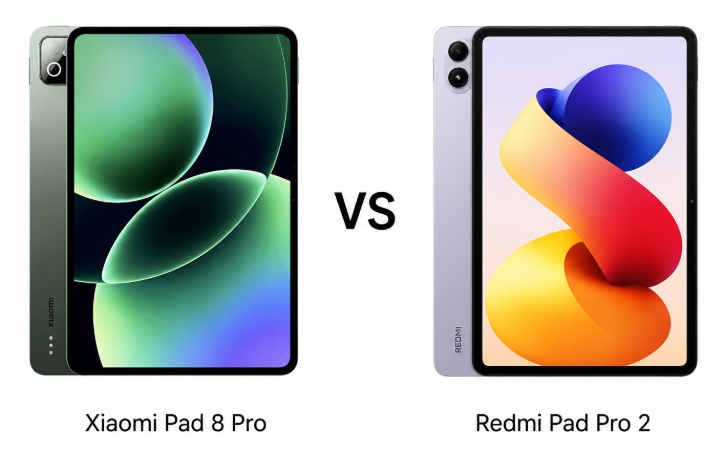
Choosing between the Xiaomi Pad 8 Pro and Redmi Pad Pro 2 comes down to one simple question: do you want flagship-level performance or the best value for money? While both tablets target productivity, entertainment, and stylus users, they sit in completely different price segments. The Xiaomi Pad 8 Pro focuses on premium performance and cutting-edge hardware, while the Redmi Pad Pro 2 aims to deliver a large-screen experience at a much lower price.
Major Features:

FeatureXiaomi Pad 8 ProRedmi Pad Pro 2Winner
Build QualityAluminum frame & back, 5.8mmAluminum frame & back, 7.5mmXiaomi – Slimmer and more premium feel
Weight485g / 494g600g / 610g / 620gXiaomi – Much lighter
Display Size11.2-inch12.1-inchRedmi – Larger workspace
Display Quality3.2K, 144Hz, HDR10, Dolby Vision, 800 nits2.5K, 120Hz, Dolby Vision, 600 nitsXiaomi – Sharper and smoother
Pixel Density345 ppi249 ppiXiaomi – Crisper visuals
ProtectionStandard glassGorilla Glass 3Redmi – Better durability
ProcessorSnapdragon 8 EliteSnapdragon 7s Gen 4Xiaomi – Flagship-level power
GPUAdreno 830Adreno 810Xiaomi – Stronger graphics
SoftwareAndroid 16, HyperOS 3Android 15, HyperOS 2Xiaomi – Newer software
RAM OptionsUp to 16GBUp to 8GBXiaomi – Better multitasking
Storage TypeUFS 4.1UFS 2.2Xiaomi – Faster storage
Expandable StorageNomicroSD supportRedmi – More flexibility
Rear Camera50MP8MP / 13MPXiaomi – Significantly better camera
Front Camera32MP Ultrawide8MPXiaomi – Better video calls
Video Recording4K 60fps1080p 30fpsXiaomi – Higher-quality recording
SpeakersQuad speakers, Dolby AtmosQuad speakers, Dolby AtmosTie – Excellent on both
Headphone JackNoYesRedmi – Wired audio support
Wi-FiWi-Fi 7Wi-Fi 6Xiaomi – Faster connectivity
USB PortUSB-C 3.2USB-C 2.0Xiaomi – Faster data transfer
Fingerprint ScannerSide-mountedNoXiaomi – Better security
Battery9,200mAh12,000mAhRedmi – Larger battery
Charging67W33WXiaomi – Much faster charging
Reverse Charging22.5W27WRedmi – Faster reverse charging
Cellular OptionNoYes (selected models)Redmi – Mobile connectivity
Water ResistanceNoIP53Redmi – Added protection
Price₹47,000 / $500₹20,000 / $240Redmi – Outstanding value
Disclaimer: Specs are based on available data. Actual performance may vary. Verify details from official sources before buying.

1. Design and Display

Build Quality

The Xiaomi Pad 8 Pro adopts a premium design with a slim 5.8mm aluminum body weighing just 485g. Despite packing powerful hardware, it remains portable and comfortable for long reading or gaming sessions. The Redmi Pad Pro 2 is considerably larger and heavier at around 600g+, making it feel more like a laptop replacement than a portable tablet. However, it adds Gorilla Glass 3 protection, optional matte glass, IP53 protection, and cellular connectivity options that the Pad 8 Pro lacks.

Display & Multimedia

The Xiaomi Pad 8 Pro features an 11.2-inch 3.2K IPS display with a 144Hz refresh rate, HDR10, Dolby Vision, and up to 800 nits brightness. Its sharper 345ppi density makes text and media look noticeably crisper.

The Redmi Pad Pro 2 counters with a larger 12.1-inch display, making it better for split-screen work and document viewing. However, its 120Hz panel, lower resolution, and 249ppi density cannot match the sharpness of the Pad 8 Pro.

Verdict

For overall display quality, portability, and premium construction, the Xiaomi Pad 8 Pro clearly leads. The Redmi Pad Pro 2’s larger screen remains attractive for productivity-focused users, but the flagship panel on the Pad 8 Pro is simply in another league.

2. Performance and Software

Processor & UI Smoothness

This is where the gap becomes enormous. The Xiaomi Pad 8 Pro runs the Snapdragon 8 Elite chipset paired with up to 16GB RAM and UFS 4.1 storage. It is designed for high-end gaming, advanced multitasking, video editing, and AI-powered workloads.

The Redmi Pad Pro 2 uses the Snapdragon 7s Gen 4, which is a capable mid-range chip for streaming, browsing, note-taking, and casual gaming. However, demanding games and heavy multitasking workloads reveal a significant performance difference.

Both tablets use HyperOS, but the Pad 8 Pro ships with newer Android 16-based HyperOS 3, providing a longer software runway.

Productivity & Multitasking

The Pad 8 Pro benefits from faster storage, more RAM options, superior processing power, and USB 3.2 connectivity. Large files transfer faster, apps open quicker, and multitasking feels smoother.

The Redmi Pad Pro 2 remains excellent for students and office users, but power users will quickly appreciate the extra headroom offered by Xiaomi’s flagship tablet.

Verdict

Performance is not a close contest. The Xiaomi Pad 8 Pro dominates in gaming, productivity, multitasking, and future-proofing. The Redmi Pad Pro 2 is sufficient for everyday use, but it cannot compete with flagship-class hardware.

3. Battery and Accessories

Battery Life

Battery capacity favors the Redmi Pad Pro 2 with its massive 12,000mAh cell. Combined with a mid-range processor, it can comfortably deliver extended media consumption and work sessions.

The Xiaomi Pad 8 Pro houses a smaller 9,200mAh battery, but the more efficient Snapdragon 8 Elite helps maintain strong endurance. More importantly, charging is much faster at 67W versus 33W on the Redmi.

A quick top-up on the Pad 8 Pro can save significant time during busy workdays.

Stylus, Keyboard & Ecosystem

Both tablets support magnetic stylus accessories and productivity-focused setups. The Xiaomi Pad 8 Pro benefits from Xiaomi’s premium ecosystem integration and higher-end hardware, making digital note-taking and creative work feel more responsive.

The Redmi Pad Pro 2 still supports accessory-based workflows effectively and offers expandable storage via microSD, something missing from the Pad 8 Pro.

Verdict

The Redmi Pad Pro 2 wins battery capacity and expandability, while the Xiaomi Pad 8 Pro wins charging speed and premium ecosystem performance. Overall, the Pad 8 Pro delivers a more polished accessory experience.

4. Camera & Media

Rear and Front Camera

The Xiaomi Pad 8 Pro includes a 50MP rear camera and a 32MP ultrawide front camera. Video calls look sharper, and document scanning benefits from the higher-resolution sensor.

The Redmi Pad Pro 2 features an 8MP front camera and either an 8MP or 13MP rear camera, depending on the model. These cameras are adequate for occasional calls and scanning but offer less detail overall.

Video & Audio Quality

The Pad 8 Pro supports 4K recording at up to 60fps, making it surprisingly capable for content creation and classroom recordings. The Redmi Pad Pro 2 is limited to 1080p recording.

Both tablets feature quad-speaker Dolby Atmos systems that deliver immersive audio. However, the Redmi includes a 3.5mm headphone jack, which remains useful for wired audio enthusiasts.

Verdict

Camera quality strongly favors the Xiaomi Pad 8 Pro thanks to its superior sensors and 4K video capabilities. Audio is excellent on both devices, though the Redmi gains a small advantage with its headphone jack.

5. Pricing

The Xiaomi Pad 8 Pro starts around $500 (₹47,000), placing it firmly in the premium tablet segment.

The Redmi Pad Pro 2 starts around $240 (₹20,000), costing less than half the price of Xiaomi’s flagship tablet.

Verdict 

The Redmi Pad Pro 2 delivers outstanding value for students, casual users, and media consumers. However, the Xiaomi Pad 8 Pro justifies its premium price through dramatically better performance, cameras, charging, display quality, and software experience.

Disclaimer:
Prices are approximate and may vary based on country, region, launch timing, and applicable taxes. Always check whether the listed price is for a China unit or a global/international variant when purchasing.

6. Conclusion

Xiaomi Pad 8 Pro

  • Snapdragon 8 Elite flagship processor
  • 144Hz 3.2K display
  • 67W fast charging
  • 50MP rear camera
  • 32MP ultrawide selfie camera
  • Android 16 with HyperOS 3
  • USB 3.2 connectivity

Redmi Pad Pro 2

  • Large 12.1-inch display
  • 12,000mAh battery
  • microSD card support
  • 3.5mm headphone jack
  • Optional cellular connectivity
  • IP53 protection
  • Exceptional value pricing

Verdict

The Xiaomi Pad 8 Pro is the better tablet overall. Its display, performance, cameras, charging speed, and software experience place it among the strongest Android tablets available in its class.

The Redmi Pad Pro 2, however, remains one of the most compelling value-focused tablets on the market. For users focused on streaming, studying, reading, and light productivity, it delivers far more than its price suggests.

If budget is the priority, choose the Redmi Pad Pro 2. If the goal is getting the best Android tablet experience Xiaomi currently offers, the Xiaomi Pad 8 Pro is the clear winner.

Disclaimer: This comparison is based on the specifications provided and is intended for general informational purposes. Actual performance, camera results, battery life, and overall experience may vary depending on real-world usage, software updates, and individual preferences.

Read More:

Comments