
Add GIZMOCHINA as Preferred Source on Google
Choosing between the Xiaomi Pad 8 Pro and the Lenovo Xiaoxin Pad Pro 2025 is not as straightforward as comparing specifications. One tablet focuses on flagship-level performance and premium hardware, while the other prioritizes a larger display, productivity features, and aggressive pricing. Both target users who want a capable Android tablet for entertainment, work, and gaming, but they take different approaches to get there.
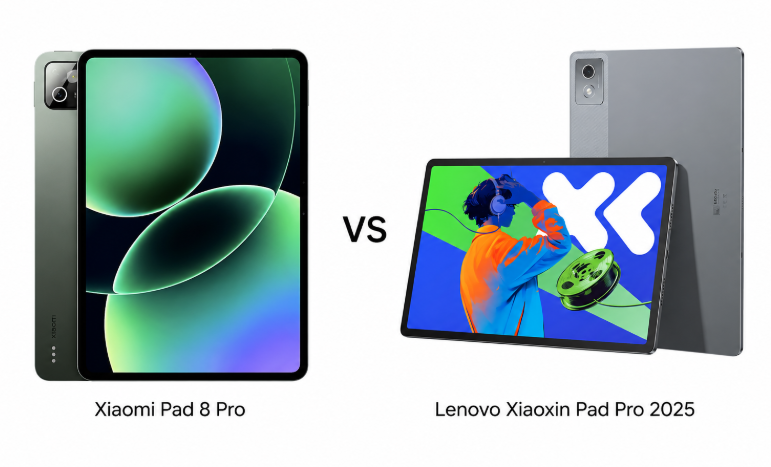
1. Design and Display
Build Quality
The Xiaomi Pad 8 Pro immediately feels more premium thanks to its slim 5.8mm aluminum unibody construction and lighter weight of around 485g. The refined design makes it easier to carry around and more comfortable during long usage sessions. It also supports a magnetic stylus and features a cleaner flagship-style aesthetic.
The Lenovo Xiaoxin Pad Pro 12.7 2025 is larger and built around productivity. While it is not as compact as Xiaomi’s offering, the bigger chassis allows room for a larger battery and a more expansive display. The side-mounted fingerprint scanner and POGO pin support further strengthen its productivity-focused appeal.
Display & Multimedia
Display quality is excellent on both tablets. Xiaomi offers an 11.2-inch 3.2K IPS panel with Dolby Vision, HDR Vivid, and 800 nits peak brightness. The 144Hz refresh rate makes navigation and gaming exceptionally smooth.
Lenovo counters with a much larger 12.7-inch 2.9K LCD, also running at 144Hz while supporting HDR10+ and Dolby Vision. The extra screen space benefits multitasking, reading, and media consumption.
Verdict
Users prioritizing portability and premium construction may prefer the Xiaomi Pad 8 Pro. However, the Lenovo Xiaoxin Pad Pro’s larger display creates a more immersive experience for productivity and entertainment. The advantage is slightly in Lenovo’s favor for overall display versatility.
2. Performance and Software
Processor & UI Smoothness
This is where Xiaomi creates a significant gap. The Snapdragon 8 Elite is currently one of the most powerful mobile chipsets available, delivering flagship-level CPU and GPU performance. Combined with up to 16GB RAM and UFS 4.1 storage, the tablet is built for demanding gaming, video editing, and heavy multitasking.
The Lenovo Xiaoxin Pad Pro 12.7 2025 uses the MediaTek Dimensity 8300, which remains a strong upper-midrange processor. Daily tasks, content consumption, office work, and casual gaming run smoothly, but it cannot match the raw power available on Xiaomi’s tablet.
Productivity & Multitasking
Lenovo’s larger display naturally benefits split-screen work, document editing, and multitasking. Expandable storage through a microSD card also adds flexibility for users managing large files.
Xiaomi compensates with newer software, Android 16-based HyperOS 3, faster storage standards, and significantly stronger performance reserves that should age better over time.
Verdict
The Xiaomi Pad 8 Pro is clearly the stronger performer. While Lenovo remains highly capable for productivity and everyday use, Xiaomi’s Snapdragon 8 Elite platform places it in a different performance class altogether.
3. Battery and Accessories
Battery Life
Battery endurance should be excellent on both tablets. Xiaomi includes a 9200mAh battery paired with 67W fast charging, allowing users to quickly top up the device when needed. The addition of reverse wired charging is a useful bonus for accessories and small gadgets.
Lenovo offers a larger 10200mAh battery that should deliver longer screen-on times, particularly for video streaming and productivity workloads. While charging speeds are not as aggressive, the larger battery capacity provides an advantage for users who prioritize endurance.
Stylus, Keyboard & Ecosystem
Both tablets support accessories designed for productivity. Xiaomi benefits from the company’s growing HyperOS ecosystem, enabling better integration with smartphones and other connected devices. The magnetic stylus support also feels polished and well integrated.
Lenovo’s POGO pin connector, larger display, and productivity-oriented design make it well-suited for keyboard accessories and workstation-style setups. Expandable storage further enhances its usefulness for students and professionals.
Verdict
Xiaomi wins for charging speed and ecosystem integration, while Lenovo offers stronger endurance and a more productivity-focused approach. For battery life alone, Lenovo holds a slight edge.
4. Camera & Media
Rear and Front Camera
Tablet cameras are rarely a primary buying factor, but Xiaomi provides noticeably stronger hardware. The 50MP rear camera captures more detailed photos and documents, while the 32MP ultrawide front camera is particularly useful for video calls and online meetings.
Lenovo’s 13MP rear camera and 8MP front camera are adequate for scanning documents, video conferencing, and occasional photography. They perform the essentials well without aiming for flagship-quality imaging.
Video & Audio Quality
Xiaomi supports 4K recording at up to 60fps, making it more versatile for content creation and video capture. The tablet also includes Dolby Atmos tuning and high-resolution audio support.
Lenovo answers with a four-speaker JBL setup enhanced by Dolby Atmos. Audio performance is expected to be excellent, especially for movies and music. The larger display further improves the media experience.
Verdict
Xiaomi delivers better camera hardware and video recording capabilities, while Lenovo focuses on audio quality and entertainment. Overall, Xiaomi takes the lead thanks to its stronger imaging package.
5. Pricing
The Xiaomi Pad 8 Pro is expected to cost around $500 (approximately ₹47,000), placing it firmly in the premium Android tablet segment.
The Lenovo Xiaoxin Pad Pro 12.7 2025 generally targets a lower price bracket while still offering a large 144Hz display, solid performance, expandable storage, JBL speakers, and a larger battery.
Verdict
For users seeking maximum value per rupee, Lenovo presents the more attractive package. Xiaomi justifies its higher price through flagship-level performance, superior cameras, faster charging, and newer software.
Disclaimer:
Prices are approximate and may vary based on country, region, launch timing, and applicable taxes. Always check whether the listed price is for a China unit or a global/international variant when purchasing.
6. Conclusion
Xiaomi Pad 8 Pro
- Snapdragon 8 Elite processor
- Android 16 with HyperOS 3
- 50MP rear and 32MP front cameras
- 67W fast charging
- Premium lightweight metal design
- UFS 4.1 storage
Lenovo Xiaoxin Pad Pro 12.7 2025
- Large 12.7-inch 144Hz display
- 10200mAh battery
- JBL quad-speaker system
- MicroSD expansion
- Productivity-focused design
- Strong value proposition
Verdict
The Xiaomi Pad 8 Pro is the better tablet overall. Its flagship chipset, faster storage, superior cameras, newer software, and premium design make it a stronger long-term investment for power users and gamers.
The Lenovo Xiaoxin Pad Pro 12.7 2025 remains the smarter choice for buyers who prioritize screen size, battery life, productivity, and value. For entertainment and everyday work, it delivers an impressive experience at a more accessible price point.
However, when pure performance and premium features are considered, the Xiaomi Pad 8 Pro takes the win.
Disclaimer: This comparison is based on the specifications provided and is intended for general informational purposes. Actual performance, camera results, battery life, and overall experience may vary depending on real-world usage, software updates, and individual preferences.
Read More:

Comments