Advertisement

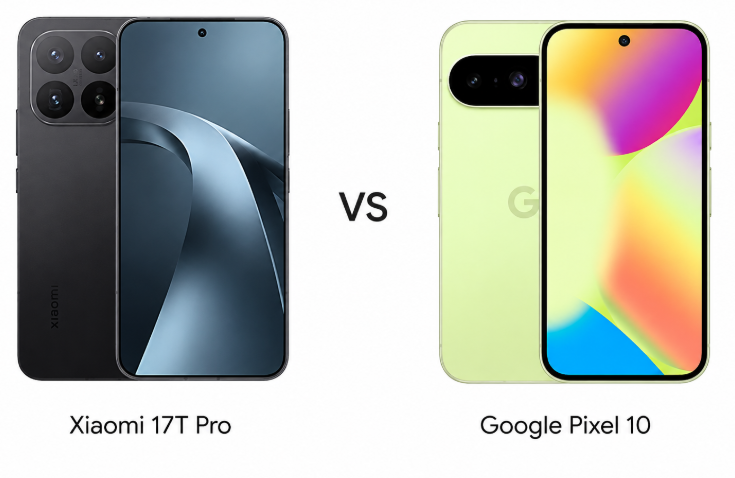
Choosing between the Xiaomi 17T Pro and Google Pixel 10 comes down to priorities. One focuses on flagship-grade hardware, ultra-fast charging, and a large battery, while the other emphasizes software longevity, AI features, and Google’s renowned camera processing. Both target premium smartphone buyers, but they deliver very different experiences despite being priced relatively close to each other.
Major Features:

FeatureXiaomi 17T ProGoogle Pixel 10Winner
Build QualityGorilla Glass 7i front/back, aluminum frame, IP68Gorilla Glass Victus 2 front/back, aluminum frame, IP68Google – Better glass protection.
Display6.83-inch AMOLED, 144Hz, Dolby Vision, 3500 nits peak6.3-inch OLED, 120Hz, HDR10+, 3000 nits peakXiaomi – Larger, smoother, and brighter display.
Resolution1280 × 2772 pixels1080 × 2424 pixelsXiaomi – Sharper panel.
ProcessorMediaTek Dimensity 9500 (3nm)Google Tensor G5 (3nm)Xiaomi – Higher raw performance potential.
RAM & StorageUp to 16GB RAM, 1TB UFS 4.112GB RAM, up to 256GB UFS 4.0Xiaomi – More RAM and storage options.
Main Camera50MP (1/1.31″) OIS48MP OISXiaomi – Larger sensor and stronger hardware.
Telephoto Camera50MP periscope, 5x optical zoom10.8MP telephoto, 5x optical zoomXiaomi – Much stronger zoom hardware.
Ultrawide Camera12MP13MPGoogle – Slight edge on paper.
Camera SoftwareLeica tuning, Ultra HDRBest Take, Pixel AI processingGoogle – Superior computational photography.
Video RecordingUp to 8K 30fps, 4K 120fpsUp to 4K 60fpsXiaomi – More advanced video capabilities.
Selfie Camera32MP, 4K video10.5MP with PDAF, 4K videoXiaomi – Higher-resolution sensor.
Battery7000mAh4970mAhXiaomi – Much larger battery.
Wired Charging100W30WXiaomi – Significantly faster charging.
Wireless Charging50W15W Qi2 magneticXiaomi – Faster wireless charging.
Software SupportAndroid 16, HyperOS 3Android 16, 7 major Android upgradesGoogle – Longer update commitment.
AI FeaturesStandard AI toolsCircle to Search, Pixel AI suite, Satellite SOSGoogle – More advanced AI ecosystem.
ConnectivityWi-Fi 7, Bluetooth 6.0, IR BlasterWi-Fi 6E, Bluetooth 6.0Xiaomi – Better connectivity features.
USB PortUSB-C 2.0USB-C 3.2Google – Faster data transfer speeds.
PricePriced around ₹75,000 ($900)Priced around ₹70,000 ($800)Google – Lower purchase price.
Disclaimer: Specs are based on available data. Actual performance may vary. Verify details from official sources before buying.

1. Design and Display

Build and Feel

The Xiaomi 17T Pro adopts a premium glass-and-aluminum construction with Gorilla Glass 7i protection and an IP68 rating. It feels like a true performance flagship, with features such as an infrared blaster and support for multiple SIM and eSIM configurations adding practicality. The overall design leans toward users who enjoy powerful hardware and feature-rich devices.

The Google Pixel 10 also features a glass-and-aluminum build with Gorilla Glass Victus 2 protection and IP68 certification. Google’s design language remains clean and minimalist, giving the phone a refined appearance that feels modern without being flashy. The software-first approach is reflected in the overall user experience.

Display Quality

Xiaomi takes a clear lead on paper with its 6.83-inch AMOLED panel featuring a 144Hz refresh rate, Dolby Vision support, 3840Hz PWM dimming, and a peak brightness of 3500 nits. The display feels more immersive for gaming, streaming, and multitasking.

The Pixel 10 offers a smaller OLED display with a 120Hz refresh rate and up to 3000 nits peak brightness. While less ambitious in specifications, Google’s display tuning remains excellent for everyday use and color accuracy.

Verdict

The Xiaomi 17T Pro delivers a more impressive display package and feels like a true multimedia powerhouse. The Pixel 10 counters with a cleaner, more compact experience, but Xiaomi wins this section thanks to its superior screen technology and feature set.

2. Specifications Including Battery

Performance

The Xiaomi 17T Pro is powered by the MediaTek Dimensity 9500 chipset paired with UFS 4.1 storage and up to 16GB RAM. It is designed to handle demanding gaming, multitasking, and intensive workloads with ease. The hardware specifications suggest flagship-level performance with significant headroom for future software updates.

The Pixel 10 uses Google’s Tensor G5 processor with up to 12GB RAM. While Tensor chips continue to improve, their focus remains on AI-driven tasks and software intelligence rather than outright benchmark dominance. Daily performance is expected to be smooth, but power users may notice Xiaomi’s hardware advantage.

Battery and Charging

Battery life is one of Xiaomi’s biggest strengths. The massive 7000mAh battery, combined with 100W wired and 50W wireless charging, creates a package that is difficult to match in the premium segment. Fast top-ups and extended endurance make the device particularly attractive for heavy users.

The Pixel 10 includes a 4970mAh battery with 30W wired and 15W wireless charging. The battery should comfortably last a day, but charging speeds feel conservative compared to Xiaomi’s offering.

Verdict

For raw performance and battery technology, the Xiaomi 17T Pro is clearly ahead. The Pixel 10 remains efficient and intelligent, but Xiaomi offers substantially more hardware value for demanding users.

3. Camera

Main and Secondary Lenses

The Xiaomi 17T Pro features a 50MP primary camera, a 50MP periscope telephoto camera with 5x optical zoom, and a 12MP ultrawide lens. Leica tuning, Ultra HDR support, and advanced video capabilities, including 8K recording, give it a versatile camera system. The larger primary sensor should also help in challenging lighting conditions.

The Pixel 10 combines a 48MP main camera, a 10.8MP 5x telephoto lens, and a 13MP ultrawide camera. While the hardware appears less impressive, Google’s image processing remains one of the strongest advantages of the Pixel lineup. Features like Best Take, Pixel Shift, and computational photography often produce consistently excellent results.

Selfie Camera

Xiaomi equips the device with a 32MP front camera capable of 4K recording and HDR10+ support. The higher resolution offers greater flexibility for detailed selfies and content creation.

Google’s 10.5MP ultrawide selfie camera benefits from autofocus and Google’s image processing, delivering reliable and natural-looking results.

Verdict

The Xiaomi 17T Pro offers stronger camera hardware and broader video capabilities. However, the Pixel 10 remains highly competitive thanks to Google’s software expertise. Hardware enthusiasts may prefer Xiaomi, while photography purists may still appreciate Pixel’s image processing.

4. Pricing

The Xiaomi 17T Pro is priced around ₹75,000 ($900), while the Google Pixel 10 is priced around ₹70,000 ($800). The difference is relatively small considering the substantial hardware upgrades Xiaomi provides.

At its asking price, the Xiaomi 17T Pro delivers a flagship processor, significantly larger battery, faster charging, a higher-refresh-rate display, more storage options, and stronger camera hardware. The overall package feels aggressively positioned for buyers seeking maximum specifications.

The Pixel 10, despite being priced around ₹70,000, justifies its cost through seven years of Android upgrades, Google’s AI ecosystem, camera software, and the clean Pixel experience. Long-term software support remains a major advantage that many buyers value more than raw specifications.

Verdict

The Pixel 10 offers excellent long-term value through software support, but the Xiaomi 17T Pro delivers more hardware for the money. Buyers focused on specifications and features are likely to see Xiaomi as the stronger value proposition.

Disclaimer:
Prices are approximate and may vary based on country, region, launch timing, and applicable taxes. Always check whether the listed price is for a China unit or a global/international variant when purchasing.

5. Conclusion

The Xiaomi 17T Pro stands out with its 144Hz AMOLED display, massive 7000mAh battery, 100W charging, Leica-tuned camera system, 50W wireless charging, and flagship-grade Dimensity 9500 processor. It is clearly designed for users who want cutting-edge hardware and minimal compromises.

The Google Pixel 10 differentiates itself with seven years of Android updates, advanced AI capabilities, Circle to Search, Satellite SOS, excellent computational photography, and a clean Android experience. These advantages make it appealing to users who prioritize software quality and long-term reliability.

Verdict

Xiaomi 17T Pro is the better choice for most buyers seeking maximum value in the premium segment. Its display, battery, charging speeds, performance, and camera hardware provide a more complete flagship package. The Google Pixel 10 remains an excellent option for users who prioritize software support, AI features, and Google’s photography experience, but Xiaomi offers a more compelling overall smartphone at this price point.

Disclaimer: This comparison is based on the specifications provided and is intended for general informational purposes. Actual performance, camera results, battery life, and overall experience may vary depending on real-world usage, software updates, and individual preferences.

Read More:

Comments