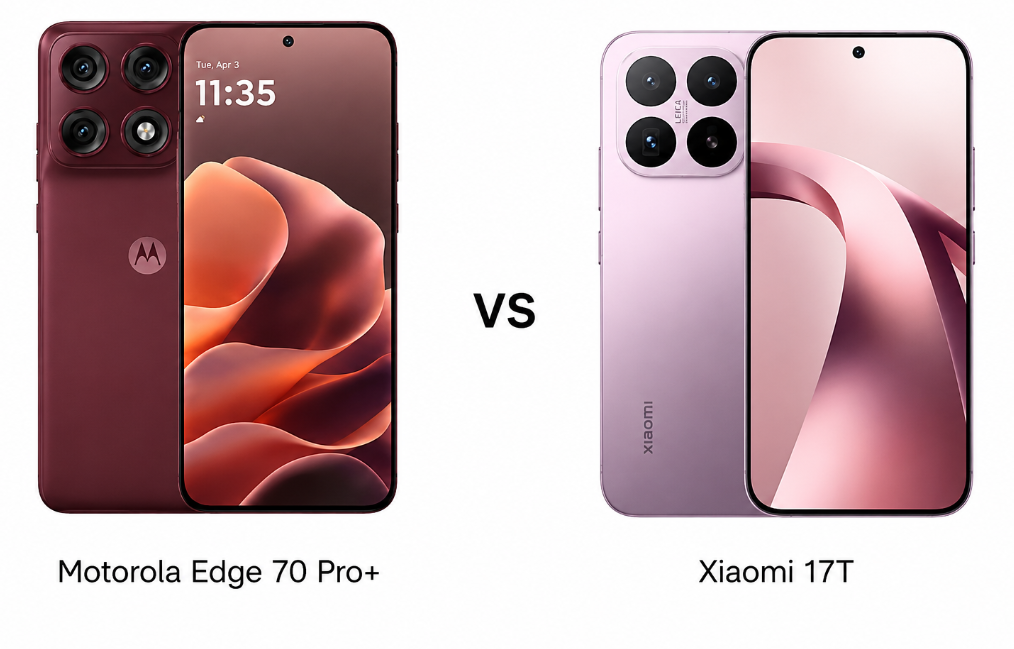
Motorola Edge 70 Pro+ and Xiaomi 17T target premium smartphone buyers with powerful hardware, large batteries, and capable camera systems. While Motorola focuses on delivering exceptional value, Xiaomi aims to impress with premium features and Leica-enhanced photography. Here’s how they compare across design, performance, cameras, battery life, and overall value.
Major Features:
Category
Motorola Edge 70 Pro+
Xiaomi 17T
Winner
Design & Build
Eco-leather back, IP68/IP69, MIL-STD-810H
Glass-fiber reinforced back, IP68
Motorola – Better durability and more practical finish.
Display
144Hz AMOLED, HDR10+, 5200 nits
120Hz AMOLED, Dolby Vision, 68B colors
Xiaomi – Richer colors and better multimedia experience.
Performance
Dimensity 8500 Extreme
Dimensity 8500 Ultra
Tie – Nearly identical real-world performance.
Software
Near-stock Android 16
HyperOS 3
Motorola – Cleaner and more streamlined UI.
Main Camera
50MP OIS
50MP Leica-tuned OIS
Xiaomi – Better image processing and color science.
Telephoto Camera
50MP, 3.5x zoom
50MP, 5x zoom
Xiaomi – Longer optical zoom reach.
Ultrawide Camera
50MP
12MP
Motorola – Higher-resolution ultrawide sensor.
Selfie Camera
50MP with AF
32MP
Motorola – Sharper selfies with autofocus.
Video Recording
4K 120fps
Log recording, Leica tuning
Xiaomi – More advanced video tools.
Battery Life
6500mAh
6500mAh
Tie – Similar endurance potential.
Charging
90W wired, wireless charging
67W wired
Motorola – Faster and more versatile charging.
Connectivity
Wi-Fi 7
eSIM, IR Blaster, Bluetooth 6.0
Xiaomi – More connectivity features.
Audio
Stereo speakers, Dolby Atmos
Stereo speakers, Dolby Atmos
Tie – Comparable audio experience.
Storage Options
256GB
256GB / 512GB
Xiaomi – More storage flexibility.
Value for Money
Priced around ₹48,000
Priced around ₹60,000
Motorola – Similar experience for less money.
Disclaimer: Specs are based on available data. Actual performance may vary. Verify details from official sources before buying.
The Motorola Edge 70 Pro+ and Xiaomi 17T take slightly different approaches to design. Motorola opts for an eco-leather rear panel that offers a softer grip and resists fingerprints better during everyday use. It also carries IP68/IP69 protection and MIL-STD-810H certification, giving it a more rugged and confidence-inspiring feel. Xiaomi uses a glass-fiber reinforced rear panel with Gorilla Glass protection on both sides, creating a more premium and polished appearance. It also supports dual eSIM functionality in selected markets, adding flexibility for frequent travelers. Motorola feels more practical and comfortable for extended use, while Xiaomi focuses on delivering a flagship-style finish.
Display Quality
Motorola features a 144Hz AMOLED panel with HDR10+ support and an impressive peak brightness rating, making animations exceptionally smooth. Xiaomi counters with a 120Hz AMOLED display supporting Dolby Vision, HDR10+, 68 billion colors, and ultra-high-frequency PWM dimming for better viewing comfort. The Xiaomi screen appears richer and more cinematic, while Motorola delivers a slightly more fluid experience during gaming and scrolling.
Verdict
Motorola wins for durability and smoothness, while Xiaomi offers a more premium multimedia experience. Users focused on entertainment may prefer Xiaomi, whereas Motorola feels better suited for those wanting a tougher everyday companion.
2. Specifications Including Battery
Performance
Both smartphones are powered by MediaTek’s Dimensity 8500 series chipset paired with UFS 4.1 storage and 12GB RAM, resulting in flagship-level responsiveness. Daily tasks, multitasking, gaming, and demanding applications run effortlessly on either device. The real-world performance difference between the Dimensity 8500 Extreme and Dimensity 8500 Ultra is likely to be minimal. Motorola’s clean software experience may feel faster and more streamlined, while Xiaomi’s HyperOS 3 offers a wider range of customization features. Those who enjoy a clutter-free interface may naturally lean toward Motorola.
Battery and Charging
Each phone packs a large 6500mAh battery globally, ensuring excellent endurance. Motorola takes a clear lead in charging with 90W wired charging alongside 15W wireless and reverse wireless charging support. Xiaomi offers 67W wired charging and reverse wired charging but lacks wireless charging. Motorola’s charging package feels more complete and convenient for premium buyers.
Verdict
Performance is effectively tied, but Motorola gains an advantage through faster charging and wireless charging capabilities. For users seeking maximum convenience, the Edge 70 Pro+ delivers a more well-rounded hardware package.
3. Camera
Main and Secondary Lenses
The Motorola Edge 70 Pro+ features an unusually balanced triple 50MP camera system consisting of wide, periscope telephoto, and ultrawide lenses. This creates consistency across different focal lengths and shooting situations. Xiaomi’s setup includes a strong 50MP primary sensor, a 50MP periscope telephoto lens with 5x optical zoom, and a 12MP ultrawide camera. The Leica tuning, Ultra HDR support, and professional video features, such as Log recording, give Xiaomi an edge for enthusiasts. Xiaomi’s longer optical zoom is especially useful for distant subjects, while Motorola provides more uniform image quality across all cameras.
Selfie Camera
Motorola includes a 50MP autofocus selfie camera capable of producing sharper and more versatile self-portraits. Xiaomi uses a 32MP front camera that performs well but lacks autofocus flexibility.
Verdict
Xiaomi is the stronger choice for photography enthusiasts thanks to Leica processing and superior zoom capabilities. Motorola counters with a more balanced camera array and a noticeably stronger selfie experience.
4. Pricing
The Motorola Edge 70 Pro+ is priced around ₹48,000, while the Xiaomi 17T is priced around ₹60,000. This creates a significant price gap despite both devices sharing a similar performance foundation and battery capacity. Motorola manages to include features such as wireless charging, faster wired charging, a high-refresh-rate display, and a versatile triple 50MP camera setup at a noticeably lower cost. Xiaomi justifies part of its premium through Leica imaging, Dolby Vision support, improved zoom capabilities, and additional software features. However, the difference in everyday performance is unlikely to match the difference in pricing.
When considering overall value, Motorola feels aggressively positioned and delivers more features per rupee spent. Xiaomi targets buyers who specifically value camera tuning, multimedia enhancements, and flagship-style refinement.
Verdict
Motorola offers stronger value for money and covers the needs of most users at a lower price. Xiaomi is better suited for buyers willing to pay extra for its camera-focused and premium-oriented experience.
Disclaimer: Prices are approximate and may vary based on country, region, launch timing, and applicable taxes. Always check whether the listed price is for a China unit or a global/international variant when purchasing.
5. Conclusion
Motorola stands out with its eco-leather finish, IP69 protection, 144Hz display, 90W charging, wireless charging support, and a unique triple 50MP camera system. Xiaomi differentiates itself through Leica imaging, Dolby Vision support, advanced video recording options, stronger 5x optical zoom, dual eSIM capability, and HyperOS customization features. Both devices provide flagship-grade performance and excellent battery life, making them highly competitive in the upper-premium segment. Motorola emphasizes practicality and value, while Xiaomi focuses more on refinement and imaging sophistication.
Verdict
For most buyers, the Motorola Edge 70 Pro+ emerges as the smarter purchase. It delivers flagship-level performance, premium features, superior charging options, and a versatile camera system at a significantly lower price.
Xiaomi 17T remains an excellent option for users who prioritize Leica photography, advanced video tools, and enhanced multimedia capabilities.
Unless those specific strengths are a priority, Motorola provides the more compelling overall package and the stronger value proposition.
Disclaimer: This comparison is based on the specifications provided and is intended for general informational purposes. Actual performance, camera results, battery life, and overall experience may vary depending on real-world usage, software updates, and individual preferences.
We use cookies on our website to give you the most relevant experience by remembering your preferences and repeat visits. By clicking “Accept”, you consent to the use of ALL the cookies.
This website uses cookies to improve your experience while you navigate through the website. Out of these, the cookies that are categorized as necessary are stored on your browser as they are essential for the working of basic functionalities of the website. We also use third-party cookies that help us analyze and understand how you use this website. These cookies will be stored in your browser only with your consent. You also have the option to opt-out of these cookies. But opting out of some of these cookies may affect your browsing experience.
Necessary cookies are absolutely essential for the website to function properly. This category only includes cookies that ensures basic functionalities and security features of the website. These cookies do not store any personal information.
Any cookies that may not be particularly necessary for the website to function and is used specifically to collect user personal data via analytics, ads, other embedded contents are termed as non-necessary cookies. It is mandatory to procure user consent prior to running these cookies on your website.




Comments