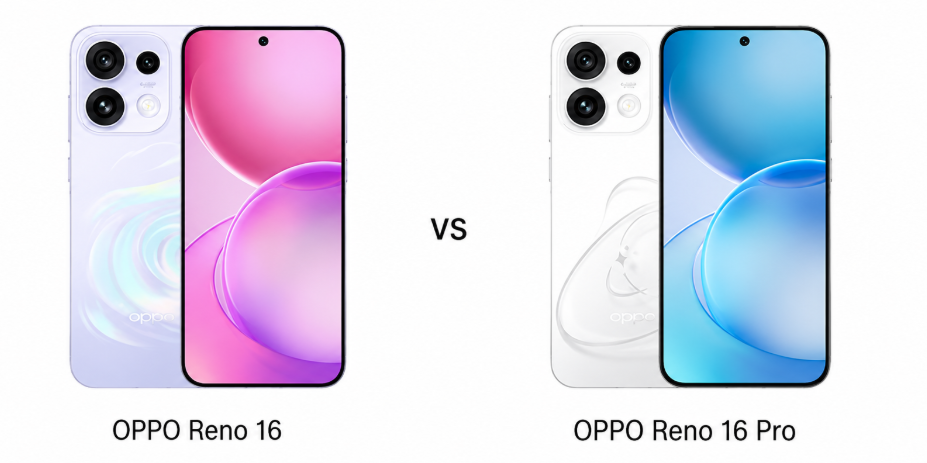
OPPO Reno 16 and OPPO Reno 16 Pro share the same premium design language and many flagship-level features, but the Pro model introduces meaningful upgrades in performance, display smoothness, imaging, and video recording. Instead of redesigning the phone, OPPO has focused on improving the core hardware where it matters most. Here’s a closer look at the biggest differences between the two models.
Major Features:
Category
OPPO Reno 16
OPPO Reno 16 Pro
Pro Upgrade
Display
6.32-inch AMOLED, 120Hz
6.32-inch AMOLED, 144Hz
Smoother scrolling and gaming with a 144Hz refresh rate.
Processor
Snapdragon 7 Gen 4
MediaTek Dimensity 8550 Super
Faster CPU and GPU performance for gaming, multitasking, and demanding apps.
RAM Options
8GB / 12GB
12GB only
Higher base memory for improved multitasking.
Main Camera
50MP with OIS
200MP with OIS
Significantly higher-resolution primary camera for more detailed photos.
Telephoto Camera
50MP, 3.5x optical zoom
50MP, 3.5x optical zoom
No upgrade.
Ultra-wide Camera
50MP
50MP
No upgrade.
Rear Video Recording
4K up to 60fps, 1080p up to 120fps
4K up to 60fps, 1080p up to 480fps, 720p up to 960fps
Much more advanced slow-motion video capabilities.
Selfie Camera
50MP AF, 4K 60fps
50MP AF, 4K 60fps
No upgrade.
Battery
6700mAh (Intl.) / 6000mAh (EU)
6700mAh (Intl.) / 6000mAh (EU)
No upgrade.
Charging
80W wired, 55W PPS
80W wired, UFCS support, 55W PPS
Adds UFCS compatibility and slightly faster full charge.
Connectivity
Bluetooth 5.4 with aptX HD, aptX Adaptive, LHDC 5
Bluetooth 5.4 with aptX HD, LHDC 5
Similar overall connectivity with minor codec differences.
Storage Options
256GB/512GB with 8GB or 12GB RAM
256GB/512GB with 12GB RAM
Higher-end memory configuration by default.
Price
Priced around $600 / ₹62,000
Priced around $830 / ₹71,000
Around $230 / ₹9,000 premium for the hardware upgrades.
Disclaimer: Specs are based on available data. Actual performance may vary. Verify details from official sources before buying.
At first glance, both smartphones look nearly identical. They feature the same premium construction with a glass front, aluminum frame, and either a glass or composite plastic back, depending on the variant. Both also carry IP68 and IP69 ratings for excellent resistance against dust and water, making them equally durable for everyday use. The in-display fingerprint scanner, stereo speakers, and modern ColorOS 16 interface create a familiar flagship experience on both devices. Since the overall build quality is unchanged, choosing between them does not come down to materials but rather to what is inside.
Display Quality
Both phones use a 6.32-inch AMOLED display with a sharp 1216 × 2640 resolution, HDR10+ support, up to 3,600 nits peak brightness, and Crystal Guard protection. The biggest difference is the refresh rate. The Reno 16 offers a smooth 120Hz panel, while the Reno 16 Pro increases it to 144Hz for even smoother animations and gaming. The improvement is subtle during everyday use but becomes more noticeable while scrolling quickly or playing high-frame-rate games.
Verdict
The design experience remains virtually identical across both models. The primary display upgrade is the 144Hz refresh rate on the Reno 16 Pro, making it feel slightly more responsive without changing the overall viewing quality.
2. Specifications Including Battery
Performance
The largest hardware upgrade comes from the processor. The OPPO Reno 16 runs on the Snapdragon 7 Gen 4, which is well-suited for daily tasks, multitasking, and moderate gaming. The Reno 16 Pro steps up with the MediaTek Dimensity 8550 Super, featuring higher CPU frequencies and a more powerful Mali-G720 MC8 GPU. This allows the Pro model to handle demanding games, intensive multitasking, and future software updates more comfortably. The Reno 16 also offers 8GB and 12GB RAM options, while the Pro starts with 12GB RAM, giving it a stronger baseline for power users.
Battery and Charging
Both smartphones include a large 6,700mAh silicon-carbon battery internationally, with a 6,000mAh version available in Europe. Charging speeds are almost identical, with both supporting 80W wired charging and 55W PPS. The Reno 16 Pro adds UFCS support and completes charging a couple of minutes faster, but the real-world difference is fairly small. Battery endurance should remain very similar because both use the same battery capacity.
Verdict
The Reno 16 Pro delivers its biggest upgrade through processing power and memory configuration rather than battery improvements. Users focused on gaming, long-term performance, and demanding workloads will notice the difference most.
3. Camera
Main and Secondary Lenses
Camera hardware is where the Reno 16 Pro makes its strongest statement. The Reno 16 features a capable triple-camera setup with a 50MP main camera, a 50MP telephoto lens offering 3.5x optical zoom, and a 50MP ultrawide camera. The Reno 16 Pro upgrades the primary sensor dramatically to 200MP while retaining the same 50MP telephoto and 50MP ultrawide cameras. Beyond higher resolution, the Pro also expands video recording with support for 1080p recording up to 480fps and slow-motion recording at 720p 960fps, making it considerably more versatile for creative users.
Selfie Camera
Both devices feature the same 50MP autofocus ultrawide selfie camera capable of recording 4K video at up to 60fps. Selfie quality, autofocus performance, and video capabilities remain identical, meaning front-camera users receive the same experience regardless of model.
Verdict
The biggest photography upgrade is clearly the 200MP main camera and significantly expanded slow-motion recording on the Reno 16 Pro. Meanwhile, the Reno 16 maintains the same telephoto, ultrawide, and selfie hardware, keeping much of the overall camera experience consistent.
4. Pricing
The OPPO Reno 16 is priced around $600 (₹62,000), making it the more accessible option in the lineup. The OPPO Reno 16 Pro is priced around $830 (₹71,000), representing roughly a $230 premium. That additional cost is mainly directed toward the faster Dimensity 8550 Super chipset, the upgraded 200MP primary camera, the smoother 144Hz display, higher standard RAM, and expanded video recording features. Since many core features remain identical, buyers are primarily paying for internal hardware improvements rather than an entirely different smartphone experience.
Is the Price Justified?
The pricing reflects the hardware upgrades rather than cosmetic changes. Those who value higher performance, advanced photography, and stronger gaming capabilities are more likely to appreciate the additional investment. Buyers who mainly use their phone for everyday tasks may find that the standard Reno 16 already delivers a premium experience.
Verdict
The price difference aligns closely with the performance and camera upgrades. The Reno 16 focuses on offering flagship-like essentials, while the Reno 16 Pro adds premium hardware for users seeking extra power and creative flexibility.
Disclaimer: Prices are approximate and may vary based on country, region, launch timing, and applicable taxes. Always check whether the listed price is for a China unit or a global/international variant when purchasing.
5. Conclusion
OPPO Reno 16 and Reno 16 Pro share an impressive foundation, including premium construction, IP68/IP69 protection, stereo speakers, Android 16 with ColorOS 16, a large silicon-carbon battery, and a versatile triple-camera system. The differences are concentrated in four major areas: the Reno 16 Pro upgrades to a 144Hz display, introduces the faster MediaTek Dimensity 8550 Super processor, replaces the 50MP main camera with a 200MP sensor, and adds far more advanced slow-motion video recording. These enhancements make the Pro model feel like an evolution focused on enthusiasts rather than a complete redesign.
Verdict
This comparison is less about one phone replacing the other and more about understanding the hardware improvements. The Reno 16 Pro builds on the Reno 16 with meaningful upgrades in performance, imaging, and display smoothness, while preserving the same premium design, battery capacity, and overall user experience.
Choose OPPO Reno 16 if premium design, long battery life, and reliable everyday performance are the priority, while the OPPO Reno 16 Pro is better suited for users who want faster performance, a higher-resolution main camera, and more advanced video recording capabilities.
Disclaimer: This comparison is based on the specifications provided and is intended for general informational purposes. Actual performance, camera results, battery life, and overall experience may vary depending on real-world usage, software updates, and individual preferences.
We use cookies on our website to give you the most relevant experience by remembering your preferences and repeat visits. By clicking “Accept”, you consent to the use of ALL the cookies.
This website uses cookies to improve your experience while you navigate through the website. Out of these, the cookies that are categorized as necessary are stored on your browser as they are essential for the working of basic functionalities of the website. We also use third-party cookies that help us analyze and understand how you use this website. These cookies will be stored in your browser only with your consent. You also have the option to opt-out of these cookies. But opting out of some of these cookies may affect your browsing experience.
Necessary cookies are absolutely essential for the website to function properly. This category only includes cookies that ensures basic functionalities and security features of the website. These cookies do not store any personal information.
Any cookies that may not be particularly necessary for the website to function and is used specifically to collect user personal data via analytics, ads, other embedded contents are termed as non-necessary cookies. It is mandatory to procure user consent prior to running these cookies on your website.





Comments