As an Amazon Associate, Gizmochina earns from qualifying purchases. Links on this page may earn us a commission at no extra cost to you.
The JBL Pulse lineup has always occupied a very specific niche in the Bluetooth speaker market. It’s essentially a portable lava lamp that plays your music. For a few years, the JBL Pulse 5 has been a reliable recommendation for anyone who wants a speaker that doubles as a visual centerpiece. Now, JBL has released the Pulse 6.
At first glance, the two speakers look quite similar, and you might assume JBL just tweaked the LEDs. However, looking at the spec sheet shows that the Pulse 6 brings a few practical updates to both sound and connectivity. If you’re trying to decide between the two, here is how they actually compare in everyday use.
The Pulse 5 has a transparent outer shell that displays a 360-degree light show, and it uses a basic, rugged fabric strap for carrying. The Pulse 6 changes this approach.
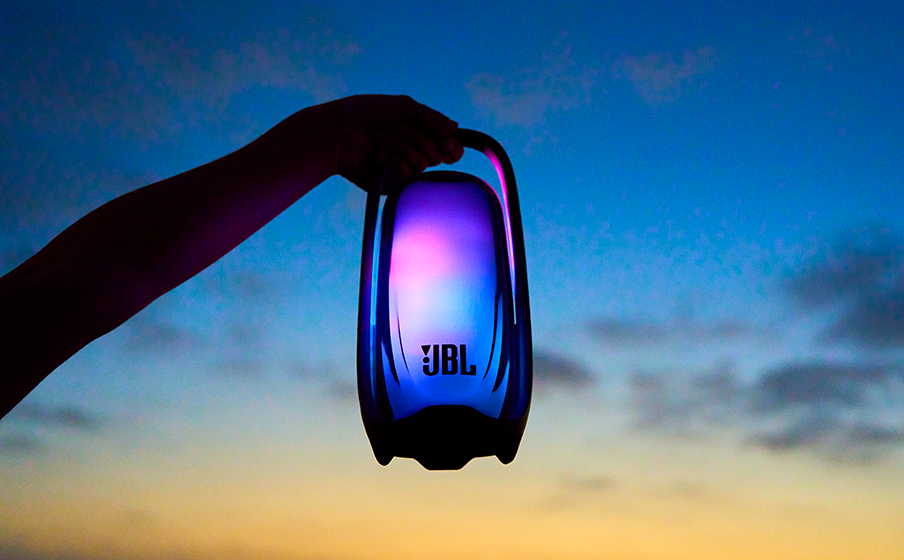
Instead of a fabric strap, the Pulse 6 has an integrated handle. What’s interesting is that the handle itself is illuminated, allowing the light show to extend across the entire top of the device. It makes the speaker look a bit more like a modern lantern.
JBL also added some features for when you aren’t actively listening to music. The Pulse 6 includes a Sunset Mode in the JBL One app, which slowly dims the lights into a warm orange fade to help you wind down.
There is also a built-in sensor that lets you double-tap the speaker to turn on a soft nightlight. It’s a small addition, but it makes the speaker useful even when the music is off.
2. Sound Quality
On paper, both speakers have the same power output: a 30W RMS woofer and a 10W RMS tweeter. However, the acoustic design has been updated.
The Pulse 5 has a frequency response of 58 Hz to 20 kHz. The Pulse 6 lowers that bass floor to 42 Hz. In a portable speaker, that 16 Hz difference is noticeable. It means the Pulse 6 can produce deeper low-end frequencies, making bass-heavy tracks sound a bit fuller.
To manage that extra bass, the Pulse 6 uses a feature JBL calls AI Sound Boost. While the name sounds like marketing jargon, it essentially functions as a dynamic equalizer. It analyzes the audio in real-time to adjust the output, which helps prevent the bass from distorting when you turn the volume up to higher levels.
3. Connectivity
The connectivity update is probably the most practical difference between the two models. The Pulse 5 uses Bluetooth 5.3 and relies on JBL’s PartyBoost feature to link with other speakers. It works well, but it only connects with other PartyBoost-compatible JBL devices.
The Pulse 6 moves to Bluetooth 6.0 and adopts Auracast. Auracast is becoming the new industry standard for broadcasting audio to multiple devices. Instead of being locked into PartyBoost, the Pulse 6 can sync with any Auracast-enabled speaker, including newer JBL models like the PartyBox line. It’s a more flexible system that will likely age better as you buy new audio gear.
4. Final Thoughts
Both speakers offer the same 12 hours of battery life, and both are highly durable. The Pulse 6 gets a minor bump to an IP68 rating (dust and waterproof) compared to the Pulse 5’s IP67 rating, though both will easily survive a trip to the beach or pool.
If you already own a Pulse 5, it’s still a very capable speaker, and there isn’t a pressing need to upgrade. However, if you are buying one today, the Pulse 6 is the more logical choice.
The improved bass response, the shift to the more universal Auracast standard, and the subtle quality-of-life additions like the nightlight feature make it a more well-rounded device for daily use.
Although it isn’t widely available yet, the JBL Pulse 6 is expected to launch in more global markets soon, following its debut in China and its listing on the JBL Cambodia website.
For more daily updates, please visit our News Section.
We use cookies on our website to give you the most relevant experience by remembering your preferences and repeat visits. By clicking “Accept”, you consent to the use of ALL the cookies.
This website uses cookies to improve your experience while you navigate through the website. Out of these, the cookies that are categorized as necessary are stored on your browser as they are essential for the working of basic functionalities of the website. We also use third-party cookies that help us analyze and understand how you use this website. These cookies will be stored in your browser only with your consent. You also have the option to opt-out of these cookies. But opting out of some of these cookies may affect your browsing experience.
Necessary cookies are absolutely essential for the website to function properly. This category only includes cookies that ensures basic functionalities and security features of the website. These cookies do not store any personal information.
Any cookies that may not be particularly necessary for the website to function and is used specifically to collect user personal data via analytics, ads, other embedded contents are termed as non-necessary cookies. It is mandatory to procure user consent prior to running these cookies on your website.