Advertisement

Add GIZMOCHINA as Preferred Source on Google

iPhone 18 Pro Max and Galaxy S26 Ultra represent two very different approaches to the premium smartphone. Apple leans into the A20 Pro, advanced video features, and a polished iOS experience, while Samsung pushes display technology, camera versatility, S Pen functionality, and Android flexibility. At around the same US price, the real question is which flagship delivers the more complete package.
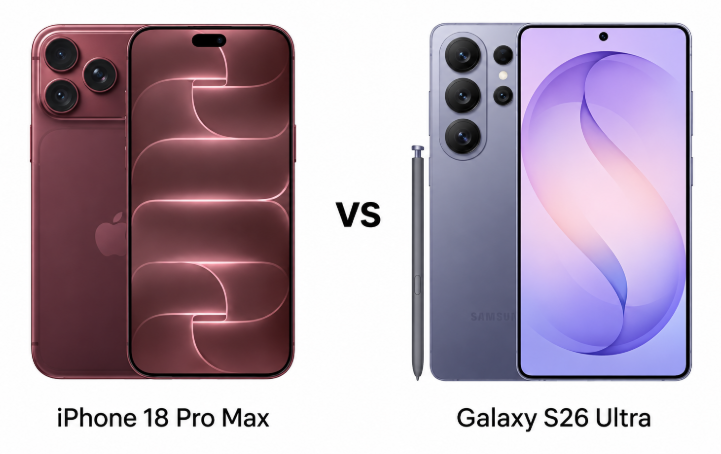
Major Features:

CategoryiPhone 18 Pro MaxGalaxy S26 UltraWinner
Display6.9-inch LTPO OLED, 120Hz, 3000 nits peak6.9-inch LTPO AMOLED 2X, 120Hz, 2600 nits peakSamsung — Higher resolution and sharper 500ppi panel
Resolution1320 × 2868 pixels1440 × 3120 pixelsSamsung — Higher resolution
Display ProtectionCeramic Shield 2, Mohs 5Gorilla Armor 2, Mohs 6Samsung — Stronger rated protection
ProcessorApple A20 Pro, 2nmSnapdragon 8 Elite Gen 5, 3nmApple — More advanced process and strong performance
RAM12GBUp to 16GBSamsung — More RAM available
Storage256GB–2TB256GB–1TBApple — Offers up to 2TB
Main Camera48MP, f/1.5–4.0, OIS200MP, f/1.4, OISSamsung — Higher-resolution main sensor
Telephoto48MP periscope, 4x optical zoom10MP 3x + 50MP 5x telephotoSamsung — More versatile zoom system
Ultrawide48MP, 120°50MP, 120°Samsung — Higher-resolution ultrawide
VideoUp to 4K 120fps, Dolby Vision, ProRes RAWUp to 8K 30fps, 4K 120fps, HDR10+Apple — More advanced professional video tools
Selfie Camera18MP with PDAF12MP with PDAFApple — Higher resolution and stronger video features
Battery5391mAh–5567mAh5000mAhApple — Larger reported battery capacity
Wired Charging50% in 15 minutes60W, 75% in 30 minutesSamsung — Faster charging
Wireless Charging25W MagSafe/Qi225W Qi2.2Tie — Similar maximum wireless charging
Reverse Charging4.5W wired4.5W wirelessSamsung — More convenient reverse charging
SoftwareiOS 27Android 16, One UI 8.5Tie — Different strengths and ecosystems
StylusNoS PenSamsung — Built-in stylus support
Desktop ModeNoSamsung DeX and Wireless DeXSamsung — Full desktop experience
PricePriced around $1,300 / ₹180,000Priced around $1,300 / ₹140,000Samsung — Lower Indian price
Overall ValuePremium ecosystem and creator featuresMore hardware versatility and productivity featuresSamsung — More features for the money
Disclaimer: Specs are based on available data. Actual performance may vary. Verify details from official sources before buying.

1. Design and Display

Build and Feel

The iPhone 18 Pro Max combines Ceramic Shield 2 protection with an aluminum frame and IP68 water resistance, while the Galaxy S26 Ultra uses Gorilla Armor 2, Gorilla Glass Victus 2, Armor Aluminum 2, and IP68 protection. Samsung also includes an S Pen, giving it a useful productivity advantage that the iPhone cannot match. For a large flagship, the Galaxy feels more function-focused.

Display Quality

Both phones feature 6.9-inch 120Hz LTPO OLED-class displays, but Samsung offers the sharper 1440 x 3120 resolution and up to 2600 nits peak brightness. The iPhone counters with HDR10, Dolby Vision, up to 3000 nits peak brightness, and an anti-reflective coating. Its display should be particularly impressive for HDR video, while Samsung is the better choice for detail and productivity.

Verdict

Samsung Galaxy S26 Ultra wins the design and display section for its sharper panel, anti-reflective technology, S Pen, and productivity-focused hardware, although the iPhone offers exceptional brightness and Dolby Vision support.

2. Specifications Including Battery

Performance

The iPhone 18 Pro Max uses Apple’s A20 Pro built on a 2nm process, paired with 12GB RAM, while the Galaxy S26 Ultra runs the Snapdragon 8 Elite Gen 5 with up to 16GB RAM. Both should deliver flagship-class performance, but Apple’s silicon remains particularly compelling for demanding apps, gaming, and video workloads. The iPhone feels like the stronger performance-first choice.

Battery and Charging

Apple offers a 5391mAh battery in its Nano-SIM model and up to 5567mAh in the eSIM-only version, with 50% charging in 15 minutes. Samsung uses a 5000mAh battery with 60W wired charging, reaching 75% in 30 minutes, plus 25W wireless charging. Samsung is more convenient for faster top-ups, while Apple offers greater reported battery capacity.

Verdict

iPhone 18 Pro Max takes the performance edge with its 2nm A20 Pro, while Galaxy S26 Ultra wins charging convenience. Overall, Apple has the stronger performance package, but Samsung is more flexible for power users.

3. Camera

Main and Secondary Lenses

The iPhone 18 Pro Max features three 48MP cameras, including a 4x periscope telephoto and 120-degree ultrawide, plus LiDAR. Samsung counters with a 200MP main camera, 3x telephoto, 5x periscope, and 50MP ultrawide. The Galaxy clearly offers greater focal-length flexibility, while the iPhone focuses heavily on computational consistency and professional video capabilities.

Selfie Camera

Apple uses an 18MP multi-aspect selfie camera with PDAF and supports 4K video, Dolby Vision, spatial audio, ProRes RAW, and Apple Log 2. Samsung has a 12MP autofocus selfie camera with 4K video recording. For creators and frequent video callers, Apple’s front camera system is substantially more advanced. Samsung remains perfectly capable, but the iPhone feels considerably more video-focused.

Verdict

Samsung Galaxy S26 Ultra wins for overall camera versatility with its 200MP main sensor and dual telephoto setup. The iPhone 18 Pro Max is the better pick for professional video and creator-focused shooting.

4. Pricing

The iPhone 18 Pro Max is priced around $1300 or ₹180,000, while the Galaxy S26 Ultra is priced around $1300 or ₹140,000. That creates a substantial difference in the Indian market despite similar US pricing. Samsung therefore starts with a significant value advantage, especially for buyers who want flagship hardware without paying Apple’s higher local price.

Is the price justified? 

The iPhone’s premium can be justified by the A20 Pro, advanced video recording, LiDAR, long-term ecosystem integration, and storage options reaching 2TB. However, Samsung delivers a sharper display, S Pen, more versatile cameras, faster wired charging, and up to 16GB RAM for considerably less in India. The Galaxy offers stronger overall value.

Verdict

Galaxy S26 Ultra is the better value-for-money flagship. The iPhone 18 Pro Max justifies its premium for Apple ecosystem users and serious video creators, but Samsung gives buyers more hardware flexibility for the money.

Disclaimer:
Prices are approximate and may vary based on country, region, launch timing, and applicable taxes. Always check whether the listed price is for a China unit or a global/international variant when purchasing.

5. Conclusion

The iPhone 18 Pro Max stands out with the A20 Pro, LiDAR, Apple Log 2, ProRes RAW, Dolby Vision video, spatial video, and up to 2TB storage. Galaxy S26 Ultra counters with an S Pen, Privacy Display, Samsung DeX, a 200MP camera, dual telephoto lenses, and 8K recording. Each flagship has a distinct identity rather than simply copying the other.

Verdict

Samsung Galaxy S26 Ultra is the overall winner for its stronger value, more versatile camera hardware, sharper display, S Pen, faster charging, and broader power-user features. The iPhone 18 Pro Max remains the better choice for Apple users and professional video creators.


FAQs

1. Which phone has the better camera for everyday photography?
The Galaxy S26 Ultra offers greater versatility, while the iPhone 18 Pro Max delivers consistent results across photos and video.

2. Which phone is faster for gaming and demanding apps?
The iPhone 18 Pro Max has the stronger performance-focused chip, while Samsung offers more RAM for heavy multitasking.

3. Which phone has better battery life?
Both should provide strong all-day endurance, but real-world battery life depends heavily on usage, connectivity, and software optimization.

4. Which phone offers better value for money?
The Galaxy S26 Ultra offers better value, particularly in India, with extensive flagship features at a lower starting price.

5. Should you buy the iPhone 18 Pro Max or Galaxy S26 Ultra?
Choose the iPhone for iOS and video creation; choose Samsung for camera flexibility, productivity, customization, and value.

Disclaimer: Prices, specifications, and availability may vary by region and retailer. Recommendations in this article are based on editorial opinion, feature-based value, and market positioning at the time of writing. Readers are advised to do their own research before making a purchase.

Read More:

Comments