Advertisement

Add GIZMOCHINA as Preferred Source on Google

As an Amazon Associate, Gizmochina earns from qualifying purchases. Links on this page may earn us a commission at no extra cost to you.

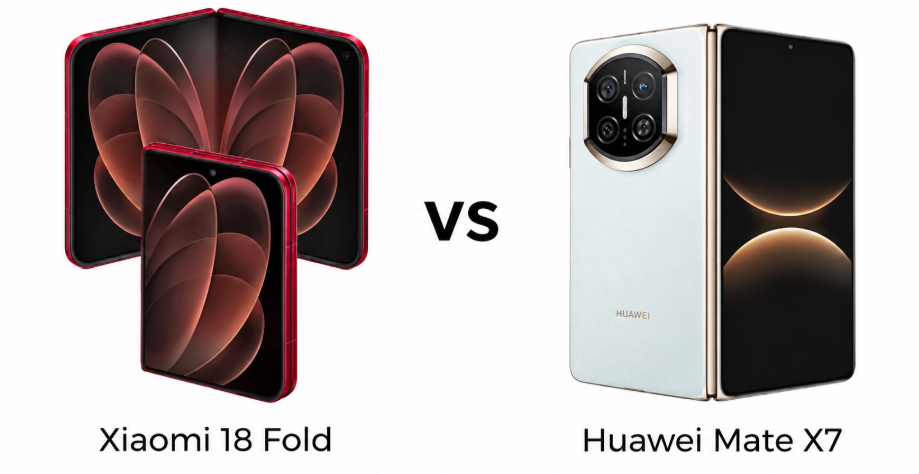
Foldables are moving beyond novelty, with flagship models now competing on camera hardware, display quality, battery capacity, and everyday usability. The Xiaomi 18 Fold and Huawei Mate X7 take different approaches: Xiaomi focuses on a powerful 200MP Leica camera, a large battery and high-brightness displays, while Huawei counters with a larger inner screen, variable-aperture camera and premium foldable design. Here is how they compare.
Major Features:

CategoryXiaomi 18 FoldHuawei Mate X7Winner
BuildGlass, aluminum frame, IP58/IP59Glass, aluminum frame, IP58/IP59Xiaomi — Dragon Crystal Glass 3 and strong protection
Inner Display7.58-inch LTPO AMOLED, 120Hz, 4000 nits8-inch LTPO OLED, 120Hz, 2500 nitsHuawei — Larger foldable display
Cover Display5.38-inch, 120Hz, 4000 nits6.49-inch, 120Hz, 3000 nitsHuawei — Larger cover screen
ProcessorXRing O3, 3nmKirin 9030 Pro, 6nmXiaomi — Newer 3nm chipset
RAMUp to 16GBUp to 20GBHuawei — Higher maximum RAM
StorageUp to 1TB, UFS 4.1Up to 1TB, UFS 4.xXiaomi — Faster UFS 4.1 storage
Main Camera200MP Leica, OIS50MP variable-aperture, OISXiaomi — Higher-resolution Leica main camera
Telephoto50MP, 3.2x-class optical zoom50MP periscope, 3.5x optical zoomHuawei — Longer optical zoom
Ultrawide50MP40MP, 120°Xiaomi — Higher-resolution ultrawide
Selfie Cameras16MP + 16MP8MP + 8MPXiaomi — Higher-resolution selfie cameras
VideoUp to 8K, Dolby Vision 4KUp to 4K, HDR VividXiaomi — Higher-resolution video recording
Battery6000mAh5600mAh/5525mAhXiaomi — Larger battery
Wired Charging67W66WXiaomi — Slightly faster charging
Wireless Charging50W50WXiaomi — Equal charging speed with larger battery
ConnectivityWi-Fi 7, Bluetooth 6.0, UWBWi-Fi 7, Bluetooth 6.0Xiaomi — Adds UWB support
PriceAround $1,600 / ₹1,55,000Around $2,000 / ₹2,20,000Xiaomi — More hardware for less money
OverallPowerful, camera-focused foldableLarger-screen premium foldableXiaomi — Stronger overall value

1. Design and Display

Build and Feel

Xiaomi 18 Fold combines an aluminum frame, glass back and Dragon Crystal Glass 3 on the cover, with IP58/IP59 protection. Its dual-SIM setup and UWB support add practical touches. Huawei Mate X7 uses aerospace-grade aluminum with a glass front and either nylon fiber or silicone polymer back, plus the same IP58/IP59 rating and optional eSIM support internationally. Huawei also offers protection against immersion up to 2m.

Display Quality

The Xiaomi 18 Fold has a 7.58-inch LTPO AMOLED inner display with 120Hz refresh rate, Dolby Vision, HDR10+ and an impressive 4000-nit peak brightness. Its 5.38-inch cover screen also reaches 4000 nits. Huawei counters with a larger 8-inch 120Hz LTPO OLED panel, 2500 nits brightness and 1440Hz PWM, alongside a 6.49-inch 3000-nit cover display. Huawei suits large-screen use better, while Xiaomi delivers stronger brightness.

Verdict

Xiaomi feels more practical for durability and bright outdoor viewing, while Huawei offers the larger inner canvas. For display versatility and brightness, Xiaomi has the more compelling package.

2. Specifications Including Battery

Performance

Xiaomi 18 Fold is powered by the 3nm XRing O3 with a 10-core CPU clocked up to 4.35GHz and Arm G2-Ultra NX MC16 graphics. Storage reaches 1TB with up to 16GB RAM and UFS 4.1. Huawei uses the 6nm Kirin 9030 Pro, with up to 20GB RAM and 1TB storage. Xiaomi’s newer 3nm platform is the more performance-focused configuration on paper.

Battery and Charging

Xiaomi packs a substantial 6000mAh silicon-carbon battery with 67W wired charging, 50W wireless charging and reverse wired charging. Huawei offers a 5600mAh or 5525mAh battery, depending on configuration, with 66W wired and 50W wireless charging. Xiaomi therefore combines greater capacity with almost identical charging speeds, making it better suited to demanding foldable use throughout a busy day.

Verdict

Xiaomi wins the hardware battle with a newer 3nm chip, UFS 4.1 storage and a larger battery. Huawei’s higher RAM ceiling is notable, but Xiaomi offers the stronger overall specification package.

3. Camera

Main and Secondary Lenses

Xiaomi 18 Fold features a Leica-backed triple camera system led by a 200MP main sensor with OIS, alongside a 50MP 3.2x-class telephoto and 50MP ultrawide. It supports 8K recording and Dolby Vision 4K video. Huawei uses a 50MP variable-aperture main camera, 50MP 3.5x periscope telephoto and 40MP ultrawide with a 120-degree field of view. Huawei’s variable aperture adds useful versatility, while Xiaomi brings higher-resolution capture.

Selfie Camera

Xiaomi equips both displays with 16MP selfie cameras, giving the cover and inner screens matching hardware. Huawei uses 8MP cameras on both displays, with 4K video supported. For users who frequently rely on the internal camera during video calls or selfies, Xiaomi’s higher-resolution sensors provide more flexibility. Huawei’s 4K selfie recording is useful, but the lower resolution remains a clear hardware compromise.

Verdict

Xiaomi offers the more ambitious camera hardware, particularly with its 200MP Leica main sensor and 16MP selfie cameras. Huawei remains competitive with its variable aperture and periscope zoom.

4. Pricing

The Xiaomi 18 Fold is priced around $1,600 or ₹1,55,000, positioning it below Huawei’s flagship foldable. The Huawei Mate X7 is priced around $2,000 or ₹2,20,000, creating a significant premium. Xiaomi also offers configurations from 256GB to 1TB, while Huawei reaches 1TB and adds a 20GB RAM option at the top end. The pricing gap is substantial for buyers comparing flagship foldables.

Is the price justified? 

Huawei’s premium is partly reflected in its larger inner display, sophisticated variable-aperture camera, periscope telephoto and premium foldable construction. However, Xiaomi delivers a 3nm processor, 6000mAh battery, 200MP Leica camera, 4000-nit displays and 50W wireless charging for considerably less. For consumers focused on specifications and everyday functionality, Xiaomi’s package appears more cost-effective.

Verdict

Xiaomi offers stronger value for money, delivering newer silicon, a larger battery and high-end camera hardware at a considerably lower price. Huawei’s premium is easier to justify for buyers prioritising its larger display and camera versatility.

5. Conclusion

Xiaomi 18 Fold stands out with its 200MP Leica camera, 3nm XRing O3 chipset, 6000mAh silicon-carbon battery, 4000-nit displays, UWB and IP58/IP59 protection. Huawei Mate X7 counters with an 8-inch inner screen, variable-aperture main camera, 3.5x periscope telephoto, up to 20GB RAM, 1440Hz PWM and international eSIM support. Each model has a distinct approach to flagship foldable hardware.

Verdict

Xiaomi 18 Fold is the overall winner because it combines stronger core hardware, a larger battery, brighter displays and more ambitious cameras with a substantially lower price, making its package more complete.


FAQs

1. Which phone has better camera zoom, Xiaomi 18 Fold or Huawei Mate X7?
Huawei Mate X7 offers a 3.5x periscope telephoto, while Xiaomi provides 3.2x-class optical zoom.

2. Which phone is better for gaming?
Xiaomi 18 Fold is better suited to demanding gaming thanks to its newer 3nm chipset and high-performance GPU.

3. Which foldable has better battery life?
Xiaomi 18 Fold has the larger 6000mAh battery, giving it more capacity for intensive daily use.

4. Is Huawei Mate X7 worth the higher price?
It can be worthwhile for buyers prioritizing the larger inner display, variable-aperture camera and premium foldable experience.

5. Which phone should you buy overall?
Xiaomi 18 Fold is the more compelling choice for buyers seeking flagship hardware at a lower price.

Disclaimer: Prices, specifications, and availability may vary by region and retailer. Recommendations in this article are based on editorial opinion, feature-based value, and market positioning at the time of writing. Readers are advised to do their own research before making a purchase.

Read More:

Comments