Advertisement

Add GIZMOCHINA as Preferred Source on Google

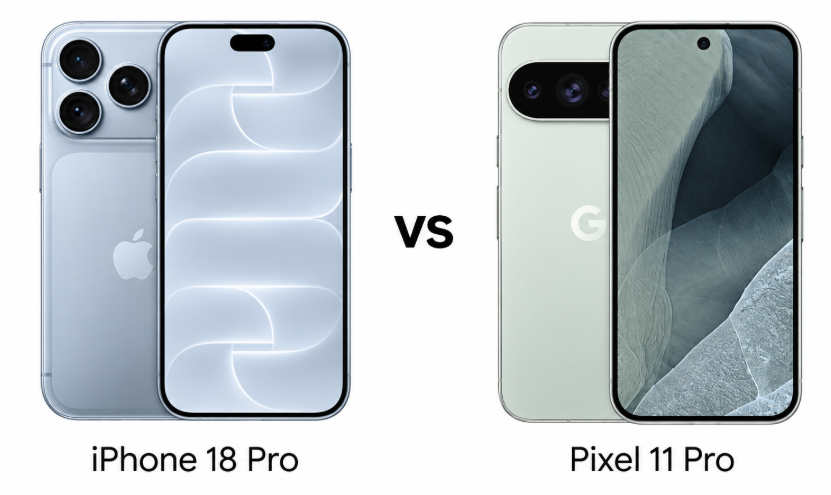
iPhone 18 Pro and Google Pixel 11 Pro take very different approaches to the premium smartphone experience. Apple focuses on its A20 Pro chip, advanced video tools and a refined display, while Google pushes computational photography, a high-resolution selfie camera and long-term Android support. With both phones targeting the same flagship audience, the choice comes down to performance, cameras, battery, and overall value.
Major Features:

CategoryiPhone 18 ProGoogle Pixel 11 ProWinner
Display6.3-inch LTPO Super Retina XDR OLED, 120Hz, Dolby Vision, 3000 nits peak6.3-inch LTPO OLED, 120Hz, HDR10+, 3600 nits peakApple — Better overall display package
BuildCeramic Shield 2, aluminum frame, IP68Gorilla Glass Victus 2, aluminum frame, IP68Apple — Stronger front protection
ProcessorApple A20 Pro, 2nmGoogle Tensor G6, 3nmApple — More performance-focused chipset
RAM12GB12GB/16GBGoogle — Up to 16GB RAM
Storage256GB/512GB/1TB/2TB256GB/512GB/1TBApple — Up to 2TB storage
Main Camera48MP wide50MP wideGoogle — Higher-resolution primary sensor
Telephoto48MP periscope, 4x optical zoom48MP periscope, 5x optical zoomGoogle — Longer optical reach
Ultrawide48MP, 120°48MP, 123°Google — Slightly wider field of view
VideoUp to 4K 120fps, Dolby Vision, ProRes RAW, Apple Log 2Up to 8K 30fps, 4K 60fps, 10-bit HDRApple — More advanced professional video tools
Selfie Camera18MP ultrawide, PDAF42MP ultrawide, PDAFGoogle — Higher resolution
Operating SystemiOS 27Android 17, 7 major OS updatesGoogle — Longer stated update support
Battery4056mAh/4288mAh, 50% in 15 minutes4850mAh, 55% in 30 minutesGoogle — Larger battery capacity
Wireless Charging25W MagSafe/Qi225W magnetic, Qi2.2Google — Qi2.2 support
BiometricsFace IDUltrasonic fingerprint sensorApple — Advanced facial authentication
ConnectivityWi-Fi 7, Bluetooth 6.0, USB 3.2 Gen 2Wi-Fi 7, Bluetooth 6.0, USB 3.2Apple — Faster USB implementation
PriceAround $1,200 / ₹164,900Around $1,100 / ₹120,000Google — Lower starting price
OverallPremium performance, video and ecosystemPhotography, battery and valueApple — Stronger overall performance and video package
Disclaimer: Specs are based on available data. Actual performance may vary. Verify details from official sources before buying.

1. Design and Display

Build and Feel

The iPhone 18 Pro combines a Ceramic Shield 2 front with an aluminum frame and Ceramic Shield rear construction, plus IP68 protection rated for immersion up to 6 meters. Its design feels particularly focused on durability and premium materials, while Face ID provides secure biometric authentication. The overall hardware package remains distinctly Apple.

The Pixel 11 Pro uses Gorilla Glass Victus 2 on both sides with an aluminum frame and IP68 protection rated for immersion up to 1.5 meters. Its under-display ultrasonic fingerprint scanner adds flexibility that the iPhone lacks. The Pixel’s biometric approach is arguably more convenient for users who prefer fingerprint unlocking alongside face recognition.

Display Quality

Both phones use 6.3-inch LTPO OLED panels with 120Hz refresh rates, HDR support and adaptive refresh technology. The iPhone reaches 3,000 nits peak brightness and adds Dolby Vision, while Ceramic Shield 2 and an anti-reflective coating strengthen its outdoor usability and protection.

The Pixel 11 Pro counters with a sharper 1280 x 2856 resolution, 497ppi density and up to 3,600 nits peak brightness. Its 2,400-nit HBM rating is also higher than the iPhone’s 1,600 nits. For pure specifications, Google’s panel has the edge, although Apple’s display remains exceptionally polished.

Verdict

Apple feels better for premium build refinement and display protection, while Google offers higher brightness and sharper resolution. The Pixel wins on display specifications; the iPhone delivers the more balanced overall package.

2. Specifications Including Battery

Performance

The iPhone 18 Pro is powered by Apple’s A20 Pro, built on a 2nm process, paired with 12GB RAM and NVMe storage. Its six-core CPU and seven-core GPU are designed for demanding apps, gaming and Apple’s increasingly sophisticated on-device workloads. The combination should appeal strongly to performance-focused users seeking sustained flagship-class capability.

The Pixel 11 Pro runs Google’s Tensor G6 on a 3nm process, with 12GB RAM on the 256GB model and 16GB on higher storage configurations. Android 17 and Google’s promise of seven major OS updates add substantial long-term appeal. Tensor emphasizes Google’s AI ecosystem, making the Pixel particularly interesting for software-driven features.

Battery and Charging

The Pixel 11 Pro packs a larger 4,850mAh battery and supports 30W wired charging, reaching 55% in 30 minutes. It also offers 25W magnetic wireless charging, Qi2.2, reverse wired charging and bypass charging. That combination makes the Pixel more flexible for heavy users and gamers who value charging control.

The iPhone 18 Pro uses a market-dependent 4,056mAh or 4,288mAh battery and supports wired charging to 50% in 15 minutes. Its 25W MagSafe/Qi2 wireless charging is similarly competitive, while reverse wired charging adds another practical feature. Apple’s smaller battery capacity does not necessarily indicate weaker real-world endurance.

Verdict

Apple takes the performance-focused approach with the A20 Pro, while Google offers the larger battery and more flexible charging tools. For raw performance, Apple is the stronger choice; for battery capacity and charging versatility, Google stands out.

3. Camera

Main and Secondary Lenses

The iPhone 18 Pro features a 48MP main camera, 48MP 4x periscope telephoto and 48MP ultrawide, backed by sensor-shift stabilization and LiDAR. Its video capabilities are especially extensive, including 4K recording at up to 120fps, Dolby Vision, ProRes RAW and Apple Log 2. It remains exceptionally well-equipped for serious mobile video.

The Pixel 11 Pro combines a 50MP main sensor with a 48MP 5x periscope telephoto and 48MP ultrawide. Google adds Pixel Shift, Ultra HDR, Best Take and Zoom Enhance, while 8K video recording gives it a notable headline feature. Its computational photography approach makes the camera system particularly versatile for still photography.

Selfie Camera

Apple’s 18MP ultrawide selfie camera includes PDAF, Face ID’s SL 3D sensor and advanced video features such as Dolby Vision, ProRes RAW and Apple Log 2. The multi-aspect design also adds flexibility for framing selfies and video. For creators, Apple’s front-camera toolkit is unusually comprehensive.

The Pixel 11 Pro uses a substantially higher-resolution 42MP ultrawide selfie camera with PDAF and a 103-degree field of view. It supports 4K video at 60fps, giving Google a strong advantage for high-resolution front-facing video and group selfies. The Pixel is more specification-heavy, while Apple’s implementation is more creator-oriented.

Verdict

Apple is the stronger choice for professional-grade video and recording tools, while Google offers powerful computational photography and a higher-resolution selfie camera. For overall camera versatility, the iPhone’s video ecosystem gives it the advantage.

4. Pricing

The iPhone 18 Pro is priced around $1,200 / ₹164,900, placing it firmly in the ultra-premium segment. Its starting configuration includes 256GB storage and 12GB RAM, with options extending to 2TB. Apple’s higher Indian pricing reflects its premium positioning and substantial storage ceiling.

The Pixel 11 Pro is priced around $1,100 / ₹120,000, making it noticeably less expensive in both markets. Google also offers 12GB RAM with 256GB storage, while 16GB RAM becomes available with higher-capacity versions. That makes the Pixel particularly interesting for buyers comparing flagship specifications against upfront cost.

Is the price justified?

The iPhone’s premium can be justified by its A20 Pro platform, extensive professional video capabilities, Ceramic Shield 2, Face ID and mature ecosystem. However, buyers paying the premium are primarily choosing Apple’s platform and specialized features rather than simply getting more hardware for every dollar.

The Pixel 11 Pro delivers a larger battery, brighter display, higher-resolution cameras and seven major Android updates while costing substantially less. On specification-led value, Google’s approach is difficult to overlook. The Pixel therefore makes a more practical proposition for buyers who want flagship hardware without stretching toward Apple’s pricing.

Verdict

Google offers stronger value for money thanks to its lower pricing and competitive flagship specifications. Apple justifies its premium through performance, ecosystem integration and advanced video capabilities.

Disclaimer:
Prices are approximate and may vary based on country, region, launch timing, and applicable taxes. Always check whether the listed price is for a China unit or a global/international variant when purchasing.

5. Conclusion

iPhone 18 Pro distinguishes itself with the A20 Pro 2nm chipset, Face ID, LiDAR, Ceramic Shield 2, MagSafe/Qi2 charging and an unusually advanced video recording suite. ProRes RAW, Apple Log 2, Dolby Vision and 4K 120fps recording make it especially compelling for creators. Its 2TB storage option also suits demanding professional workflows.

Pixel 11 Pro counters with Tensor G6, seven major Android updates, a 5x periscope camera, 8K video, a 42MP ultrawide selfie camera and Google’s computational photography features. Its 4,850mAh battery, 3,600-nit display and bypass charging add further practical advantages. The lower price also significantly changes the value equation between these flagships.

Verdict

iPhone 18 Pro is the overall winner for its superior performance, professional video capabilities and polished ecosystem. Google Pixel 11 Pro remains the better value choice, especially for photography, battery capacity and long-term Android support.


FAQs

1. Which phone has better gaming performance?
The iPhone 18 Pro should deliver stronger gaming performance thanks to the A20 Pro chipset and Apple’s optimized gaming ecosystem.

2. Which phone takes better zoom photos?
The Pixel 11 Pro offers a 5x optical telephoto lens, while the iPhone 18 Pro provides 4x optical zoom.

3. Which phone charges faster?
The iPhone 18 Pro reaches 50% wired charge in 15 minutes, compared with 55% in 30 minutes for the Pixel 11 Pro.

4. Which phone is cheaper to buy?
The Pixel 11 Pro is significantly cheaper, making it the more affordable entry into this flagship class.

5. Which phone should you buy overall?
The iPhone 18 Pro suits performance and video-focused buyers, while the Pixel 11 Pro makes more sense for value-focused users.

Disclaimer: Prices, specifications, and availability may vary by region and retailer. Recommendations in this article are based on editorial opinion, feature-based value, and market positioning at the time of writing. Readers are advised to do their own research before making a purchase.

Read More:

Comments