Advertisement

Add GIZMOCHINA as Preferred Source on Google

As an Amazon Associate, Gizmochina earns from qualifying purchases. Links on this page may earn us a commission at no extra cost to you.

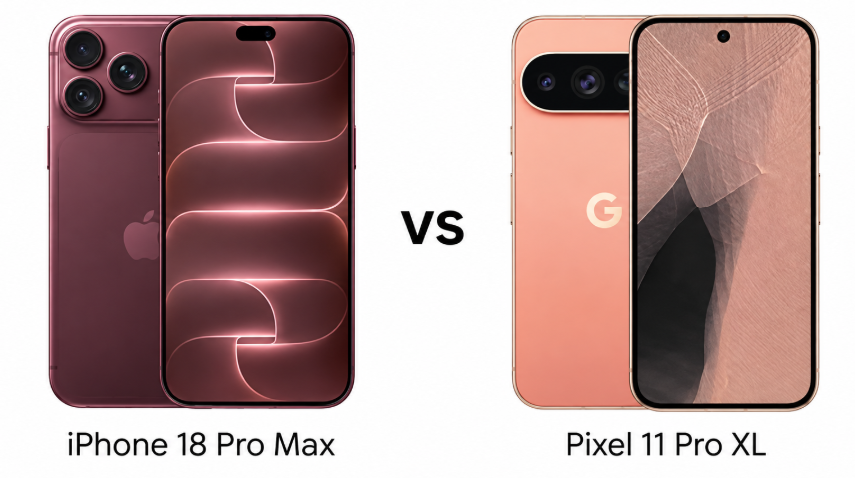
iPhone 18 Pro Max and Google Pixel 11 Pro XL represent two very different approaches to premium smartphones. Apple focuses on performance, video, ecosystem integration and pro-grade hardware, while Google pushes computational photography, AI features and a more flexible Android experience. With both priced around the $1,300 mark, the differences matter when choosing a long-term flagship.
Major Features:

CategoryiPhone 18 Pro MaxPixel 11 Pro XLWinner
BuildCeramic Shield 2, aluminum frame, IP68Gorilla Glass Victus 2, aluminum frame, IP68Apple – Stronger protection
Display6.9-inch LTPO OLED, 120Hz, Dolby Vision6.8-inch LTPO OLED, 120Hz, HDR10+Apple – Dolby Vision support
Peak BrightnessUp to 3000 nitsUp to 3600 nitsGoogle – Higher peak brightness
ProcessorA20 Pro, 2nmTensor G6, 3nmApple – Performance-focused chip
RAM12GBUp to 16GBGoogle – More RAM available
StorageUp to 2TBUp to 1TBApple – Higher maximum capacity
Main Camera48MP triple camera50MP triple cameraGoogle – Larger main sensor
Telephoto48MP, 4x optical zoom48MP, 5x optical zoomGoogle – Longer optical reach
Ultrawide48MP, 120°48MP, 123°Google – Slightly wider field
VideoUp to 4K 120fps, ProRes RAW, Dolby VisionUp to 8K 30fpsApple – More professional video tools
Selfie Camera18MP ultrawide, PDAF42MP ultrawide, PDAFGoogle – Higher resolution
BatteryUp to 5567mAh, market dependent5115mAhApple – Larger stated capacity
Wired Charging50% in 15 minutes75% in 30 minutesApple – Faster initial charging
Wireless Charging25W MagSafe/Qi225W magnetic Qi2.2Tie – Similar rated speeds
SoftwareiOS 27Android 17, 7 major OS updatesGoogle – Longer stated update commitment
PriceApprox. $1,300 / ₹180,000Approx. $1,300 / ₹135,000Google – Lower Indian price
ValuePremium performance and videoStrong cameras, AI and lower priceGoogle – More affordable package
OverallPerformance and creator-focused flagshipAI and photography-focused flagshipApple – Stronger overall package
Disclaimer: Specs are based on available data. Actual performance may vary. Verify details from official sources before buying.

1. Design and Display

Build and Feel

The iPhone 18 Pro Max combines a Ceramic Shield 2 front with an aluminum frame and Ceramic Shield rear construction, plus IP68 protection rated for deeper water immersion. Pixel 11 Pro XL uses Gorilla Glass Victus 2 on both sides with an aluminum frame and also carries IP68 protection. Apple’s construction feels more purpose-built for demanding everyday use, particularly with its upgraded front protection.

Both phones deliver a premium flagship feel, but their design philosophies differ. The iPhone emphasizes durability and a refined hardware ecosystem, while Pixel retains Google’s distinctive styling and familiar Android flagship identity. Ceramic Shield 2 and the stronger water-resistance specification give the iPhone a practical edge for users who prioritize physical protection and longevity.

Display Quality

The iPhone features a 6.9-inch LTPO Super Retina XDR OLED with 120Hz refresh rate, HDR10 and Dolby Vision. Pixel counters with a 6.8-inch LTPO OLED, 120Hz refresh rate and HDR10+, while reaching higher claimed peak brightness. Google’s panel therefore looks particularly compelling for outdoor visibility and HDR content.

Verdict

Apple delivers stronger protection and Dolby Vision support, while Google offers higher claimed peak brightness. The iPhone feels more refined overall, but Pixel remains highly competitive for users prioritizing display brightness.

2. Specifications Including Battery

Performance

The iPhone 18 Pro Max runs Apple’s A20 Pro built on a 2nm process, paired with 12GB RAM and NVMe storage. Pixel 11 Pro XL uses Google’s Tensor G6 on 3nm, with up to 16GB RAM and UFS 4.x storage. Apple’s silicon remains the more performance-focused approach, while Google emphasizes AI-driven workloads and software integration.

For demanding gaming, sustained performance and professional workloads, the A20 Pro specification suggests a stronger performance-oriented package. Pixel’s Tensor G6 instead makes more sense for users who value Google’s computational photography, AI processing and deeply integrated Android features. The higher RAM options are attractive, but RAM capacity alone does not determine real-world speed.

Battery and Charging

The iPhone offers market-dependent battery capacities, with wired charging reaching 50% in 15 minutes and 25W MagSafe/Qi2 wireless charging. Pixel packs a 5115mAh battery with 45W wired charging, reaching 75% in 30 minutes, alongside 25W magnetic wireless charging, reverse charging and bypass charging.

Verdict

The iPhone targets peak performance and fast charging, while Pixel provides more flexible charging features. For performance-heavy users, Apple has the stronger package; Pixel is more versatile for charging-focused use.

3. Camera

Main and Secondary Lenses

The iPhone uses a triple 48MP setup comprising wide, 4x periscope telephoto and ultrawide cameras. Pixel combines a 50MP main camera with 48MP 5x periscope and 48MP ultrawide lenses. Pixel offers longer native optical reach and a wider ultrawide field, while the iPhone adds LiDAR for depth sensing and advanced imaging workflows.

Video is a major iPhone strength, supporting 4K recording up to 120fps, Dolby Vision, ProRes, ProRes RAW and Apple Log 2. Pixel counters with 8K recording, Ultra-HDR, Pixel Shift, Best Take and Zoom Enhance. For creators prioritizing professional video controls, the iPhone’s toolset is notably more comprehensive and mature.

Selfie Camera

The iPhone uses an 18MP ultrawide selfie camera with PDAF and SL 3D depth sensing, while Pixel offers a 42MP ultrawide camera with PDAF. Both support 4K video, but Apple adds Dolby Vision, ProRes RAW and Apple Log 2 capabilities to its front-camera workflow.

Verdict

Pixel offers stronger native zoom and a higher-resolution selfie camera, but Apple’s video capabilities are significantly broader. The iPhone is the more creator-focused camera package, especially for professional video.

4. Pricing

The iPhone 18 Pro Max is priced around $1,300 or ₹180,000, while the Pixel 11 Pro XL is priced around $1,300 or ₹135,000. The similar US pricing creates a different value equation in India, where Google’s flagship carries a substantially lower listed price in the supplied figures.

The iPhone’s higher Indian pricing reflects the premium associated with Apple’s flagship positioning, ecosystem and professional-grade capabilities. Pixel’s lower Indian pricing makes its combination of 16GB RAM options, 5x optical zoom, bright display and charging flexibility considerably more accessible. For buyers comparing specifications against upfront cost, Google presents the less expensive proposition.

Is the price justified? 

At roughly the same US price, both phones justify their positioning through different strengths. The iPhone targets users who value performance, video production and Apple’s ecosystem, while Pixel prioritizes AI, photography and Android flexibility.

Verdict

Pixel offers stronger value at the supplied Indian pricing, while iPhone justifies its premium through performance and professional video capabilities. The better value depends heavily on ecosystem and usage priorities.

Disclaimer:
Prices are approximate and may vary based on country, region, launch timing, and applicable taxes. Always check whether the listed price is for a China unit or a global/international variant when purchasing.

5. Conclusion

The iPhone 18 Pro Max stands out with the A20 Pro chip, LiDAR, ProRes RAW, Apple Log 2, Dolby Vision video and extensive professional recording options. Pixel 11 Pro XL counters with Tensor G6, up to 16GB RAM, 5x optical zoom, 8K video, Zoom Enhance, Best Take, bypass charging and a 42MP ultrawide selfie camera.

Apple therefore targets users who want maximum performance and a highly capable video-production tool, while Google offers a broader computational photography and AI-focused experience. Pixel also has an important pricing advantage in the supplied Indian figures, making the decision less straightforward than the specifications alone suggest.

Verdict

Overall winner: iPhone 18 Pro Max. Its A20 Pro performance, professional video capabilities, LiDAR and polished flagship ecosystem give it the more complete premium package, despite Pixel’s stronger value proposition.


FAQs

1. Which phone has the better camera zoom?
The Pixel 11 Pro XL offers 5x optical zoom, compared with 4x on the iPhone 18 Pro Max.

2. Which phone is better for gaming?
The iPhone 18 Pro Max is better suited to demanding gaming thanks to its A20 Pro chipset.

3. Which phone charges faster?
The Pixel 11 Pro XL reaches 75% in 30 minutes, while the iPhone reaches 50% in 15 minutes.

4. Which phone offers more RAM?
The Pixel 11 Pro XL offers up to 16GB RAM, while the iPhone 18 Pro Max comes with 12GB.

5. Which phone is cheaper in India?
The Pixel 11 Pro XL is priced around ₹135,000, making it considerably cheaper than the iPhone 18 Pro Max.

Disclaimer: Prices, specifications, and availability may vary by region and retailer. Recommendations in this article are based on editorial opinion, feature-based value, and market positioning at the time of writing. Readers are advised to do their own research before making a purchase.

Read More:

Comments