Advertisement

Add GIZMOCHINA as Preferred Source on Google

As an Amazon Associate, Gizmochina earns from qualifying purchases. Links on this page may earn us a commission at no extra cost to you.

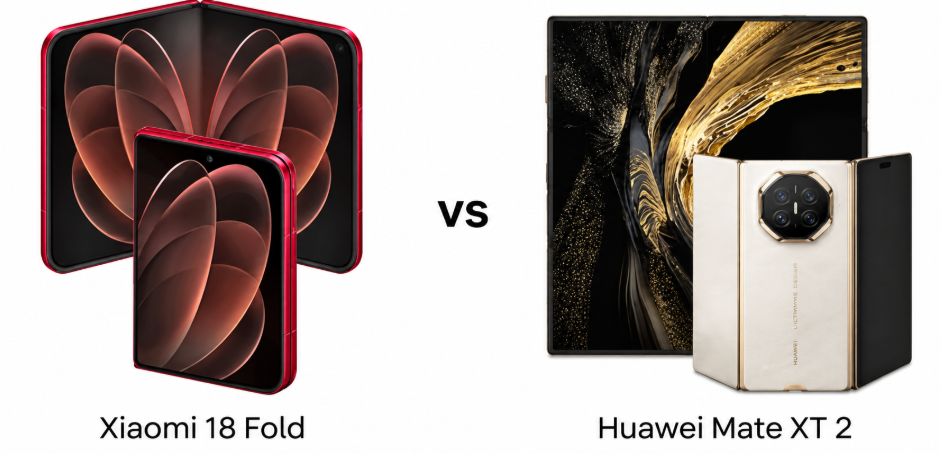
Xiaomi 18 Fold vs Huawei Mate XT 2 Ultimate is a fascinating foldable comparison because both push the category in different directions. Xiaomi focuses on a more conventional book-style foldable experience with flagship cameras and a high-refresh-rate display, while Huawei takes the concept further with a massive tri-fold screen. The choice ultimately comes down to whether practicality or maximum screen versatility matters more.
Major Features:

CategoryXiaomi 18 FoldHuawei Mate XT 2 UltimateWinner
Display7.58-inch LTPO AMOLED, 120Hz, 4000 nits10.2-inch tri-fold LTPO OLED, 90HzHuawei — Larger tri-fold display
Cover Display5.38-inch LTPO AMOLED, 120Hz6.5-inch LTPO OLED, 120HzHuawei — Larger external screen
BuildDragon Crystal Glass 3, glass back, aluminum frame, IP58/IP59Kunlun glass, IP58/IP59, stylus supportHuawei — Stylus support and tri-fold design
ChipsetXRing O3, 3nmKirin 9050 ProXiaomi — Newer 3nm platform
RAMUp to 16GB16GBXiaomi — UFS 4.1 storage
StorageUp to 1TB, UFS 4.1Up to 1TBXiaomi — Faster storage standard
Main Camera200MP, OIS, Leica lenses50MP variable aperture, OISXiaomi — Higher-resolution main camera
Telephoto50MP, 3.x optical zoom50MP periscope, 3.5x optical zoomHuawei — Longer optical reach
Ultrawide50MP40MPXiaomi — Higher resolution
Selfie Camera16MP front and cover cameras8MP front and external camerasXiaomi — Higher-resolution selfies
VideoUp to 8K, Dolby Vision 4KUp to 4K, HDR VividXiaomi — 8K recording
Battery6000mAh5600mAhXiaomi — Larger battery
Wired Charging67W66WXiaomi — Slightly faster charging
Wireless Charging50W50WXiaomi — Equal charging speed
SoftwareAndroid 17, HyperOS 4HarmonyOS 7.0Xiaomi — Android-based ecosystem
AudioStereo speakers, Dolby AtmosStereo speakersXiaomi — Dolby Atmos support
ConnectivityWi-Fi 7, Bluetooth 6.0, UWBWi-Fi 7, Bluetooth 6.0Xiaomi — Adds UWB
PriceAround $1,600 / ₹155,000Around $2,800 / ₹280,000Xiaomi — Much lower price
OverallFlagship book-style foldablePremium tri-fold flagshipXiaomi — Stronger overall value
Disclaimer: Specs are based on available data. Actual performance may vary. Verify details from official sources before buying.

1. Design and Display

Build and Feel

The Xiaomi 18 Fold uses a premium combination of Dragon Crystal Glass 3, glass, and an aluminum frame, while maintaining IP58/IP59 protection. Its dual-SIM setup also makes it straightforward for conventional smartphone use. Huawei Mate XT 2 Ultimate uses a similarly durable construction with IP58/IP59 protection and adds stylus support. Its tri-fold mechanism makes the Huawei far more ambitious, but the Xiaomi feels like the more practical everyday foldable.

Display Quality

Xiaomi offers a 7.58-inch LTPO AMOLED panel with 120Hz refresh rate, HDR10+, Dolby Vision, HDR Vivid, and up to 4000 nits peak brightness. Huawei counters with a much larger 10.2-inch tri-fold LTPO OLED panel, but its 90Hz refresh rate is lower. The Huawei is better suited to tablet-style productivity, while Xiaomi delivers a smoother, more familiar flagship viewing experience.

Verdict

Xiaomi offers the more practical design and smoother display experience, while Huawei wins for sheer screen versatility. For everyday foldable use, Xiaomi feels easier to live with.

2. Specifications Including Battery

Performance

Xiaomi 18 Fold is powered by the 3nm XRing O3 chipset with a 10-core CPU and Arm G2-Ultra NX MC16 GPU. Storage reaches 1TB with up to 16GB RAM and UFS 4.1. Huawei uses the Kirin 9050 Pro with 16GB RAM and up to 1TB storage. Xiaomi’s newer platform and faster UFS 4.1 specification give it a stronger flagship-oriented hardware package.

Battery and Charging

The Xiaomi packs a 6000mAh silicon-carbon battery with 67W wired charging, 50W wireless charging, and reverse wired charging. Huawei uses a 5600mAh battery with 66W wired, 50W wireless, 7.5W reverse wireless, and 5W reverse wired charging. Xiaomi’s larger battery gives it an advantage for sustained everyday use, while both provide fast and flexible charging options.

Verdict

Xiaomi takes this section with its larger battery, newer-looking performance platform, and UFS 4.1 storage. Huawei remains competitive, but Xiaomi offers the stronger all-round hardware package.

3. Camera

Main and Secondary Lenses

Xiaomi 18 Fold features a 200MP main camera with OIS, alongside a 50MP telephoto offering 3.x optical zoom and a 50MP ultrawide. Leica lens branding, laser autofocus, 8K recording, and Dolby Vision 4K video strengthen its camera credentials. Huawei uses a 50MP variable-aperture main sensor, 50MP 3.5x periscope telephoto, and 40MP ultrawide. Xiaomi offers the more feature-rich camera system.

Selfie Camera

Xiaomi equips both the main and cover displays with 16MP selfie cameras capable of 1080p recording. Huawei uses 8MP selfie cameras on both configurations, although external-display video recording can reach 4K with HDR Vivid. For selfies, video calls, and front-facing detail, Xiaomi’s higher-resolution cameras are the more compelling choice. Huawei’s 4K external-camera recording is useful, but it does not offset the resolution gap.

Verdict

Xiaomi wins the camera comparison with higher-resolution selfie cameras, a 200MP main sensor, Leica tuning, and 8K video. Huawei remains versatile, particularly with its periscope camera.

4. Pricing

The Xiaomi 18 Fold is priced around $1,600, or approximately ₹155,000, while the Huawei Mate XT 2 Ultimate is priced around $2,800, or approximately ₹280,000. That makes Huawei substantially more expensive, reflecting its tri-fold construction and larger display. Xiaomi therefore enters a much more accessible premium-foldable price bracket while still offering flagship-level specifications.

Is the price justified? 

Huawei’s premium is easier to understand if the massive tri-fold screen, stylus support, and tablet-style experience are essential. For most buyers, however, Xiaomi’s combination of flagship cameras, 120Hz displays, large battery, powerful hardware, and wireless charging creates a more balanced package. The Xiaomi 18 Fold delivers considerably more conventional flagship value without sacrificing the core foldable experience.

Verdict

Xiaomi offers significantly stronger value for money. Huawei’s premium pays for its unique tri-fold concept, while Xiaomi provides a broader flagship feature set at a substantially lower price.

Disclaimer:
Prices are approximate and may vary based on country, region, launch timing, and applicable taxes. Always check whether the listed price is for a China unit or a global/international variant when purchasing.

5. Conclusion

Xiaomi 18 Fold stands out with its 200MP Leica camera system, 120Hz 4000-nit displays, 6000mAh battery, UFS 4.1 storage, and 50W wireless charging. Huawei Mate XT 2 Ultimate’s defining advantage is its tri-fold 10.2-inch display, stylus support, optional privacy display, and tablet-like productivity potential. Huawei is the more experimental device, while Xiaomi feels closer to a polished flagship smartphone that happens to fold.

Verdict

Xiaomi 18 Fold is the overall winner, offering the stronger combination of performance, cameras, battery, display smoothness, and value. Huawei Mate XT 2 Ultimate makes more sense for buyers specifically seeking its unique tri-fold tablet experience.


FAQs

1. Which phone has the better camera system?
The Xiaomi 18 Fold has the more versatile camera setup, led by a 200MP main sensor and Leica optics.

2. Which phone is better for gaming?
The Xiaomi 18 Fold offers stronger gaming hardware with its XRing O3 chipset, 16GB RAM option, and UFS 4.1 storage.

3. Which phone has better battery life?
The Xiaomi 18 Fold has a larger 6000mAh battery, giving it an advantage for longer everyday usage.

4. Is Huawei Mate XT 2 worth its premium price?
It can be worthwhile for buyers who specifically want a tri-fold design, huge tablet-style display, and stylus support.

5. Which foldable should most buyers choose?
The Xiaomi 18 Fold is the more balanced option for buyers prioritizing flagship features, practicality, and lower cost.

Disclaimer: Prices, specifications, and availability may vary by region and retailer. Recommendations in this article are based on editorial opinion, feature-based value, and market positioning at the time of writing. Readers are advised to do their own research before making a purchase.

Read More:

Comments