Advertisement

Add GIZMOCHINA as Preferred Source on Google

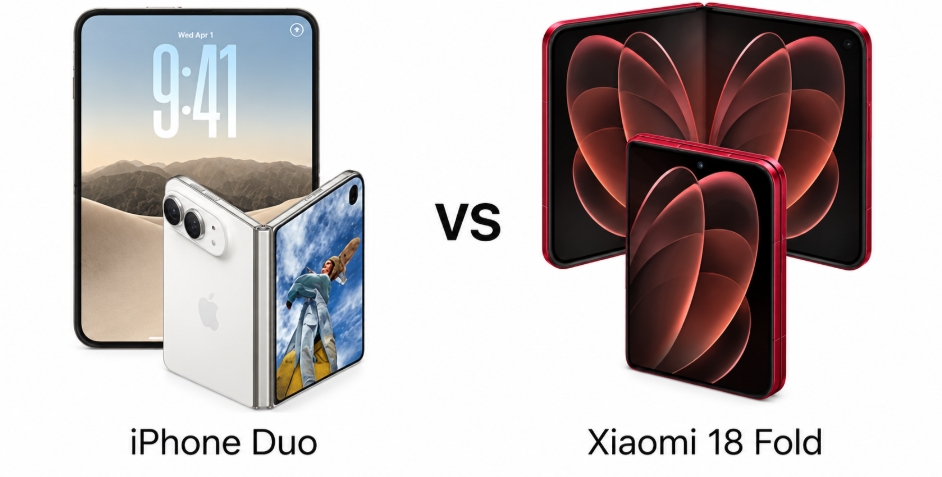
iPhone Duo and Xiaomi 18 Fold represent two very different approaches to premium foldables. Apple focuses on premium materials, software integration and advanced video features, while Xiaomi pushes hardware specifications with a larger battery, faster charging and a versatile Leica camera system. The price gap also makes this an especially interesting flagship foldable comparison.
Major Features:

CategoryiPhone DuoXiaomi 18 FoldWinner
BuildTitanium frame, Ceramic Shield glass, IP68, stylus supportDragon Crystal Glass 3, aluminium frame, IP58/IP59Apple – More premium materials and stronger water resistance
Display7.6-inch LTPO OLED, 120Hz, nano-texture, anti-reflective coating7.58-inch LTPO AMOLED, 120Hz, 4000-nit peak brightnessXiaomi – Higher peak brightness and sharper resolution
Cover Display5.4-inch LTPO OLED, 120Hz, Dolby Vision5.38-inch LTPO AMOLED, 120Hz, Dolby VisionApple – Higher pixel density and anti-reflective treatment
ProcessorA20 Pro, 2nmXRing O3, 3nmApple – More advanced chip fabrication and tight software integration
RAM/Storage12GB RAM, up to 2TBUp to 16GB RAM, 1TB, UFS 4.1Xiaomi – More RAM and faster storage standard
Main Camera48MP wide + 48MP ultrawide200MP wide + 50MP telephoto + 50MP ultrawideXiaomi – More versatile triple-camera system
ZoomNo dedicated telephoto3x optical telephotoXiaomi – Dedicated optical zoom camera
VideoUp to 4K 120fps, Dolby Vision, ProRes, spatial videoUp to 8K 24fps, 4K 60fps Dolby VisionApple – More advanced professional video features
Selfie CameraUnder-display inner camera + 12MP cover camera16MP inner + 16MP cover camerasApple – Cleaner inner-screen design and 4K cover-camera video
BatteryLi-Ion, 25W wireless6000mAh, 67W wired, 50W wirelessXiaomi – Larger battery and significantly faster charging
AudioStereo speakersStereo speakers, Dolby Atmos, Hi-Res audioXiaomi – Broader high-resolution audio support
ConnectivityWi-Fi 7, Bluetooth 6.0, satellite SOS, UWBWi-Fi 7, Bluetooth 6.0, IR, UWBApple – Adds satellite connectivity alongside UWB
PricePriced around $2,000 / ₹3,00,000Priced around $1,600 / ₹1,55,000Xiaomi – Much lower price with extensive flagship hardware
OverallPremium ecosystem-focused foldableHardware-focused flagship foldableXiaomi – Stronger combination of cameras, battery and value
Disclaimer: Specs are based on available data. Actual performance may vary. Verify details from official sources before buying.

1. Design and Display

Build and Feel

The iPhone Duo takes a premium-first approach with a titanium frame, Ceramic Shield glass and IP68 protection. Its folding panel adds a matte, anti-reflective finish, while stylus support broadens productivity. Xiaomi counters with Dragon Crystal Glass 3, an aluminium frame and IP58/IP59 protection, making the Xiaomi 18 Fold a lighter-feeling flagship while still offering solid durability.

Display Quality

Both phones use 120Hz LTPO panels with HDR support and Dolby Vision. The iPhone Duo’s 7.6-inch inner OLED emphasizes readability with a nano-texture surface and anti-reflective coating, while Xiaomi offers higher peak brightness and sharper resolution. Xiaomi uses a conventional glossy inner display, whereas Apple’s matte treatment should appeal more to users who read or work in varied lighting.

Verdict

Xiaomi wins on display resolution and peak brightness, but Apple offers the more refined foldable display treatment. For premium build quality, water resistance and reduced reflections, the iPhone Duo feels more polished.

2. Specifications Including Battery

Performance

The iPhone Duo is powered by Apple’s 2nm A20 Pro, paired with up to 2TB storage and 12GB RAM. Xiaomi uses the 3nm XRing O3 with up to 1TB storage and 16GB RAM, plus UFS 4.1. Raw specifications favor Xiaomi in memory capacity, but Apple’s chip and tightly integrated iOS 27 platform should deliver strong sustained performance and efficiency.

Battery and Charging

Battery hardware is more clearly differentiated. Xiaomi packs a 6000mAh silicon-carbon lithium-ion battery with 67W wired charging, 50W PPS and 50W wireless charging. The iPhone Duo supports wired PD3.2 charging, reaching 50% in 20 minutes, alongside 25W MagSafe or Qi2 wireless charging. Xiaomi’s larger battery and faster wireless charging make it the more practical endurance-focused choice.

Verdict

Xiaomi wins for battery capacity, charging flexibility and memory options. Apple remains compelling for chip efficiency and software integration, but Xiaomi delivers the broader hardware package for power users.

3. Camera

Main and Secondary Lenses

Apple uses a dual-camera system with 48MP wide and 48MP ultrawide sensors, plus sensor-shift OIS and advanced video features including 4K Dolby Vision up to 120fps, ProRes and spatial video. Xiaomi goes further with a 200MP main camera, 50MP 3x telephoto and 50MP ultrawide, backed by Leica lenses, laser autofocus and 8K recording.

Selfie Camera

The iPhone Duo’s under-display selfie camera keeps the inner screen clean, while its 12MP cover camera adds autofocus and 4K video. Xiaomi uses 16MP selfie cameras on both displays, but limits them to 1080p video. For photography flexibility, Xiaomi’s dedicated telephoto is a major advantage; for video capture and the overall recording toolkit, Apple’s system looks more mature.

Verdict

Xiaomi wins for camera versatility, thanks to its telephoto, Leica optics and 200MP main sensor. Apple takes the edge for advanced video features and the cleaner under-display inner camera.

4. Pricing

The iPhone Duo is priced around $2,000 or ₹3,00,000, placing it firmly in ultra-premium territory. The Xiaomi 18 Fold is priced around $1,600 or ₹1,55,000, creating a substantial gap. Both target buyers seeking flagship foldable hardware, but Xiaomi asks significantly less while offering more RAM, a larger battery and a three-camera setup.

Is the price justified?

Apple’s premium can be easier to justify for buyers invested in iOS, MagSafe, satellite features and Apple’s broader ecosystem. Xiaomi offers stronger hardware value, with faster charging, more flexible cameras and up to 16GB RAM. Unless Apple’s ecosystem or software experience is the priority, the Xiaomi 18 Fold makes the pricing equation considerably easier to accept.

Verdict

Xiaomi wins on value for money. Its lower price combines with stronger hardware specifications, making the 18 Fold the more compelling purchase for buyers focused on features per rupee.

5. Conclusion

The iPhone Duo stands out with titanium construction, IP68 protection, a nano-textured anti-reflective inner display, stylus support, MagSafe, satellite connectivity and Apple’s video capabilities. Xiaomi answers with Leica cameras, a 3x telephoto, 8K video, infrared control, 50W wireless charging and a 6000mAh battery, giving it an unusually broad feature set.

These differences make the two foldables unusually distinct. The iPhone Duo is built around Apple’s ecosystem, premium materials and software-led polish, while Xiaomi emphasizes hardware breadth and charging speed. For most feature-focused foldable buyers, Xiaomi’s combination of camera flexibility, battery capacity and lower pricing creates a stronger practical package overall.

Verdict

Xiaomi 18 Fold is the overall winner for hardware value and versatility. The iPhone Duo remains the stronger fit for buyers prioritizing Apple’s ecosystem, premium materials and advanced video features.

Disclaimer: Prices, specifications, and availability may vary by region and retailer. Recommendations in this article are based on editorial opinion, feature-based value, and market positioning at the time of writing. Readers are advised to do their own research before making a purchase.

Read More:

Comments