Add GIZMOCHINA as Preferred Source on Google
As an Amazon Associate, Gizmochina earns from qualifying purchases. Links on this page may earn us a commission at no extra cost to you.
We’ve spent the past couple of days comparing some of 2026’s biggest new flagships, from Honor’s latest phone against the iPhone to other camera-heavy models from the Chinese market. One thing that keeps coming up with these newer phones is the same combination of bigger camera sensors, larger batteries, and AI features that can do more than answer questions.
Samsung is the odd one out here. The Galaxy S26 Ultra is still the company’s current flagship, while the next major Galaxy S-series refresh isn’t expected until 2027.
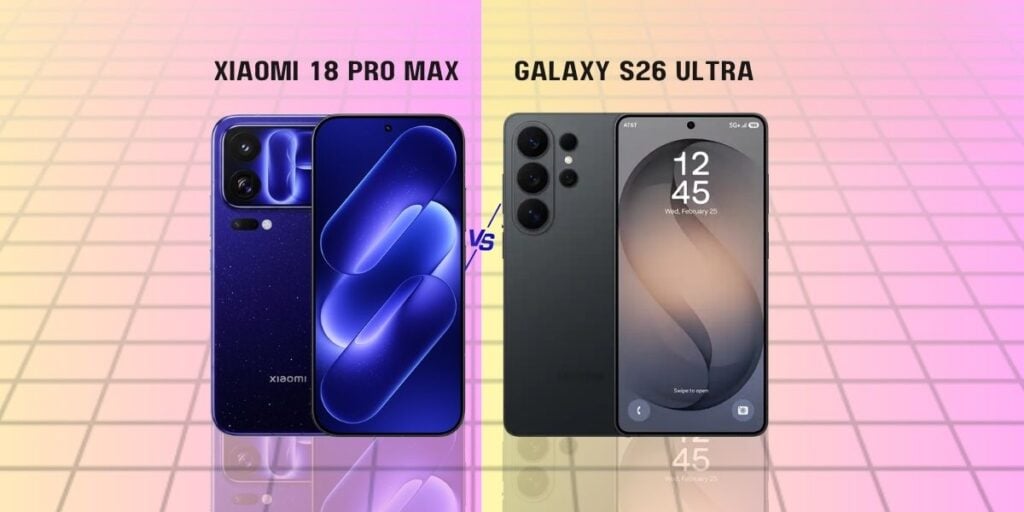
The timeline makes the Galaxy S26 Ultra an interesting phone to compare with newer Chinese flagships like the Xiaomi 18 Pro Max. Both phones have high-end cameras, big batteries, and plenty of AI, but they have a very different philosophy of what a flagship should feel like.
For instance, Xiaomi is still experimenting with a second display on the back of the 18 Pro Max, while Samsung is keen to keep the familiar Galaxy experience while adding minor features such as Privacy Display.
The different launch markets make the comparison even more interesting, too. If you’re considering Samsung’s current flagship while newer hardware from Xiaomi is already arriving, here’s how the two phones compare.
1. Xiaomi puts another screen on the back
As you might have known by now, the Xiaomi 18 Pro Max is the more unusual phone of the two. Its rear panel has a 2.9-inch AMOLED display with a 120Hz refresh rate and up to 4,000 nits of brightness. It can show custom AI avatars, run more than 100 app cards, and work with NFC-enabled plush toys that change what appears on the screen.
There’s also a voice assistant built around the rear display that can hold conversations and control compatible smart-home devices. On the front, Xiaomi has reduced the bezels to 0.99mm. Dragon Crystal Glass 3.0 protects the phone, while an IP68 rating provides water and dust resistance.
The 18 Pro Max comes in Black, White, Iced Peach Pink, and Galaxy Blue. Xiaomi also sells a transparent Special Edition, but that version is limited to the 16GB/1TB configuration.
Samsung takes a much more familiar route with the Galaxy S26 Ultra. It looks like a refined version of the Galaxy S25 Ultra, with a flat display, an S Pen built into the frame, and a slightly more rounded pill-shaped camera housing. The titanium frame is gone this time, replaced by Armor Aluminum, which Samsung says handles heat better.
The S26 Ultra is also IP68-rated and comes in Black, White, Sky Blue, Cobalt Violet, Silver Shadow, and Pink Gold. At 214 grams and 7.9mm thick, it is lighter and thinner than Xiaomi’s phone, even though it carries a much smaller battery.
2. Xiaomi brings the brightness, Samsung adds Privacy Display
Both phones have 6.9-inch displays, but Xiaomi’s panel has the bigger numbers. The Xiaomi 18 Pro Max uses a 2624 x 1208 LTPO AMOLED SuperPixel 2.0 display with a real RGB sub-pixel array, a 1-120Hz adaptive refresh rate, and up to 4,000 nits of peak brightness.
The RGB setup plays a role in the phone’s privacy feature. Xiaomi can control the direction of light from individual pixels, narrowing the viewing angle with a single tap at the hardware level. You can also set certain apps to trigger the privacy mode automatically, which is useful for things like banking and messaging apps.
Samsung’s 6.9-inch Dynamic AMOLED 2X display reaches 2,600 nits, so it falls short of Xiaomi’s peak brightness figure. It uses Corning’s third-generation Gorilla Armor with an anti-reflective coating, which helps with outdoor visibility.
Where to buyXiaomi 18 Pro MaxBrowse the range on AmazonShop now →
The Galaxy S26 Ultra also has a Privacy Display mode that narrows the viewing angle. Samsung lets you use it for specific apps or situations, such as entering a PIN. Both phones can keep people nearby from easily seeing what’s on the screen, but they handle the feature differently.
3. Dual 200MP sensors vs. Samsung’s four-camera setup
Xiaomi has two 200MP sensors at the center of its rear camera system. The main camera uses a 1/1.28-inch Light Hunter 960L sensor with an f/1.67 aperture and a 23mm equivalent focal length. It uses 16-in-1 pixel binning to produce 2.44µm pixels and comes with a Leica Summilux lens designed to reduce internal reflections.
The 200MP periscope telephoto uses a 1/1.56-inch sensor with an f/2.4 aperture. It offers 3.2x optical zoom and up to 12.8x lossless zoom, along with a 75mm portrait mode. Rounding out the setup is a 50MP ultrawide camera with autofocus as close as 5cm.
Where to buySamsung Galaxy S26 UltraLatest price on AmazonCheck price →
Samsung has a more conventional route with four rear cameras. The main camera is 200MP with an f/1.4 aperture and OIS, joined by a 50MP ultrawide with an f/1.9 aperture and a 120-degree field of view. There’s also a new 50MP periscope telephoto with 5x optical zoom and a 10MP telephoto with an f/2.4 aperture for shorter-range zoom.
Samsung has also opened up the main and telephoto lenses compared with the S25 Ultra. The wider apertures allow more light to reach the sensors, which should help with low-light photos and HDR scenes.
4. Two different Snapdragon chips
Both phones use Qualcomm silicon, but the Xiaomi 18 Pro Max gets the newer chip. It runs the Snapdragon 8 Elite Extreme Gen 6, built on a 2nm process with a 2+6 all-big-core design and clock speeds of up to 5GHz. Xiaomi pairs it with a ring-shaped vapor-cooling system covering 5,513 mm² on the Pro Max.
The Galaxy S26 Ultra uses the Snapdragon 8 Elite Gen 5 for Galaxy. Samsung’s version is built on 3nm and uses two cores reaching 4.74GHz and six cores reaching 3.62GHz. Samsung also redesigned the phone’s vapor chamber for better cooling.
According to Samsung, the S26 Ultra delivers 19% faster CPU performance, 24% faster GPU performance, and 39% better NPU performance than the S25 Ultra.
Xiaomi’s chip has the newer architecture and smaller manufacturing process, while Samsung has its own chip tuning and cooling system. How that translates into sustained performance and battery life will depend on real-world testing.
5. Xiaomi has a huge capacity advantage
The Xiaomi 18 Pro Max comes with an 8,500mAh silicon-carbon battery, along with 100W wired and 50W wireless charging. The Galaxy S26 Ultra has a 5,000mAh battery, the same capacity it has used on several recent Ultra models. The charging has improved to 60W wired and 25W wireless, but Xiaomi still has the clear lead in both battery size and charging speed.
6. Price and availability
The Galaxy S26 Ultra starts at $1,299 for 256GB in the US. The 512GB model costs $1,499, while the 1TB version reaches $1,799. It has been available worldwide since March.
The Xiaomi 18 Pro Max starts at 6,999 yuan (about $1,045) in China for the 12GB/256GB model. The 16GB/1TB version costs 9,999 yuan (about $1,492), while the transparent Special Edition adds another 1,000 yuan.
Xiaomi has confirmed that the 18 Pro series will launch globally later this year, which is different from the China-only Xiaomi 17 Pro Max. However, the 18 Pro Max is not yet available outside China, and there is still no indication of a US launch.
For daily updates, please visit our News Section.
Stay ahead in tech! Join our Telegram community and sign up for our daily newsletter of top stories!